Hindu youth converted to Islam and married to Muslim woman through forged documents by Maulana, several others targeted and lured
 Prayagraj (Allahabad), Uttar Pradesh, India
  11 October, 2022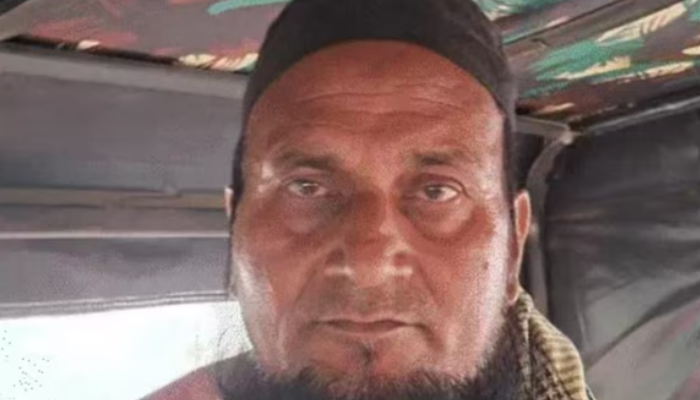
Case Summary
A Hindu youth named Ram Bihari was forcefully converted to Islam in 2022 in Prayagraj by a man identified as Maulana Hidayatullah, who later arranged his marriage to a Muslim woman named Salma from the Salon area of Rae Bareli. The incident took place in the Jhunsi police station area, where Hidayatullah, a former Hindu himself, has been residing for many years. Originally from the Basti district, he converted to Islam around 25 years ago and began working as a Maulana while also teaching Urdu to Muslim children. The matter came to light when a local advocate from Jhunsi filed a complaint alleging that Hidayatullah had been luring Hindu youths into religious conversion and organising their marriages. During the inquiry, Ram Bihari confirmed that Hidayatullah changed his name to Taj Mohammad and fabricated fake documents to carry out the marriage. The marriage certificate falsely listed his father’s name as Bashir, while official records and his Aadhaar card identified him by his Hindu name. Acting on the complaint, ACP Jhunsi Vimal Kishore Mishra formed a team and detained Hidayatullah for questioning. Initially, he attempted to mislead investigators, but under strict interrogation, he admitted to converting Ram Bihari and conducting the marriage. Maulana Hidayatullah lured poor Hindus into converting to Islam by promising them jobs and equal rights in society. Police investigations revealed that he arranged fake marriages between Hindu men and Muslim women using forged Nikahnamas. His racket was eventually exposed by the authorities. Police later recovered fake seals, marriage certificates, and a booklet containing several suspicious entries from his residence, suggesting multiple such conversions and marriages in the past. Authorities suspect that Hidayatullah may be linked to a broader religious conversion network. The police are investigating the purpose and possible organisational backing of these conversions. ACP Mishra stated that several crucial leads had emerged, and inquiries into the accused’s contacts and financial transactions were underway to determine whether he was part of a larger racket.
Why it is Hate Crime ?
The primary category in this case is: Predatory Proselytisation. The subcategory under this is: Proselytisation by grooming, brainwashing, manipulation or subtle indoctrination. The tertiary category under this is: Pattern of targeting Hindus. Religious brainwashing essentially means the often subtle and forcible indoctrination to induce someone to give up their religious beliefs to accept contrasting regimented ideas. Religious grooming or brainwashing also involves propaganda and manipulation. It involves the systematic effort, driven by religious malice and indoctrination, to persuade “non-believers’ to accept allegiance, command, or doctrine to and of a contrasting faith. Cases of such grooming or brainwashing are far more nuanced than direct threats, coercion, inducement and violence. In such cases, it is often seen that there is repeated, subtle and continual manipulation of the victim to induce disaffection towards their own faith and acceptance of the contrasting faith of the perpetrator. While subtle indoctrination is widely acknowledged as predatory, an element which is often understated in such conversions or the attempts of such conversion is the role of loyalty and trust which might develop between the perpetrator and the victim. Fiduciary relationships are often abused to affect such religious conversion. For example, an educator transmitting religious doctrine of a competing faith to a Hindu student. The Hindu student is likely to accept what the teacher is transmitting owing to existence of the fiduciary relationship. The exploitation of the fiduciary relationship to religiously indoctrinate victims would also be included in this category. Since the underlying animosity towards the victim’s faith forms the basis of predatory proselytization, such cases are considered religiously motivated hate crimes. Another subcategory in this case is: Conversion/ attempts to convert by inducement. Predatory Proselytisation is not just limited to threat, harassment, force and violence, but it also has contours of stealth. In several cases, the Hindu victim is exploited to convert, with non-Hindus taking advantage of their poverty. In such cases, the Hindu victim who is suffering financially is offered monetary benefits, including lucrative offers for jobs, health treatment, education, etc, to induce the victim into changing his/her religion. In such cases, the religious identity of the victim and the aim to disenfranchise him from his faith form the heart of the crime. Also, taking advantage of and exploiting an individual’s economic vulnerabilities is widely acknowledged as exploitation, forms of which are often penalised by law. Such cases, therefore, are considered religiously motivated hate crimes since the victim’s religious identity forms the very heart of the crime itself. The inclusion of this case in the Hinduphobia Tracker under the category Predatory Proselytisation is based on the systematic, deliberate and faith-targeted nature of the offence. The conversion of Hindu youth Ram Bihari by Maulana Hidayatullah was not an isolated incident of personal faith transition but part of a discernible pattern of religious manipulation aimed specifically at Hindus. Hidayatullah had embedded himself within a social and educational ecosystem where he could subtly influence others, particularly young and impressionable minds. By working as a Maulana and teaching Urdu to local children, he had access to both Hindu and Muslim families. He used his position to deliberately target Hindu families and build relationships of trust, which he later exploited for religious indoctrination. This case reveals a slow and calculated process of religious grooming, where the perpetrator leveraged emotional and social vulnerability to steer Hindu individuals towards conversion under the guise of monetary benefits or spiritual elevation. Such an approach reflects the broader mechanism of religious brainwashing, which does not always rely on open violence or coercion but rather on psychological and ideological conditioning. Through emotional manipulation, counterfeit documentation, and the orchestration of cross-religious marriages, Hidayatullah’s actions fit squarely within the spectrum of predatory proselytisation, an organised method of targeting and assimilating members of another faith group through deceitful or exploitative means. The recovered materials — fake seals, marriage certificates, and a booklet recording multiple suspicious marriages — reinforce the inference that this was a recurring and structured operation rather than a solitary act. The presence of such tools of fabrication implies an organised network functioning with the intent to erase religious identity and replace it through a systematised process of conversion. The abuse of trust, particularly in an educational or spiritual setting, is a defining feature of this type of religious exploitation. It mirrors patterns observed across several regions where Hindu youths have been selectively targeted for conversion by individuals presenting themselves as mentors, teachers, or guides. Also, the Maulana specifically targeted economically disadvantaged Hindu individuals, exploiting their vulnerability by promising them employment and equal rights in society. Under the guise of offering opportunity and dignity, he induced them to convert to Islam, concealing his true intent of eroding their cultural and religious identity. This organised pattern of deception and inducement constitutes a form of predatory proselytisation, driven by religious animosity and executed with the aim of systematically reducing Hindu presence through manipulation rather than voluntary faith. The ideological method and purpose behind Hidayatullah’s actions closely resemble the recruitment and indoctrination strategy employed by Hizb-ut-Tahrir (HuT), an extremist organisation whose operations have been documented in India, including by the Madhya Pradesh Anti-Terrorism Squad (ATS). HuT’s structure relies on layered deception and ideological grooming. Its cadres have been found to lure Hindu youths and non-Muslims under the pretext of friendship, guidance, or marriage, subsequently subjecting them to sustained religious conditioning aimed at eroding their Hindu identity. The Madhya Pradesh ATS uncovered that HuT operatives engaged in forced conversions through marital and social manipulation, followed by gradual ideological indoctrination, with the long-term objective of establishing a Sharia-based order. In this sense, Hidayatullah’s modus operandi mirrors both the intent and the method of HuT. Like HuT, he focused on the Hindu demographic — a community perceived as ideologically opposite and therefore essential to neutralise or absorb within a monolithic religious framework. His dual role as an educator and cleric positioned him ideally for the role of recruiter, enabling him to identify susceptible individuals and manipulate their beliefs under the veneer of guidance and learning. The repeated targeting of Hindu youths and the systematic pattern of conversions recorded through falsified documentation suggest that his actions were not mere personal choices but part of a larger ideological pursuit. At its core, this case exemplifies religiously motivated animosity disguised as religious outreach. It constitutes a hate crime because the act was predicated on hostility toward the Hindu faith and the intent to erase or supplant Hindu identity. Unlike interfaith exchanges grounded in consent and respect, predatory proselytisation operates through deceit, manipulation, and the exploitation of social trust, reflecting deep-seated religious contempt. Hidayatullah’s deliberate targeting of Hindus, his repeated conversion efforts, and his structural method of execution collectively mark this case as a textbook example of religiously motivated hate against Hindus, aligned both ideologically and operationally with extremist models such as that of Hizb-ut-Tahrir. Disclaimer: Media reports indicate that the victim’s ordeal began around three years before the incident was reported, but no specific date or month has been mentioned. For the purpose of documentation, we have used October 12, 2022, as a notional start date to represent the beginning of his suffering. Since the Hinduphobia Tracker records incidents based on when the victim’s ordeal began rather than when it was reported, and as the case was covered in the media on October 12, 2025, the indicative date has been set accordingly.
Victim Details
Total Victim
1
Deceased
0
Gender
- Male 1
- Female 0
- Third Gender 0
- Unknown 0
Caste
- SC/ST 0
- OBC 0
- General 0
- Unknown 1
Age Group
- Minor 0
- Adult 0
- Senior Citizen 0
- Unknown 1


Case Status
Arrested


Perpetrators Details
Perpetrators
Muslim Extremists
Perpetrators Range
One Person
Perpetrators Gender
male
 Sources




