Hindu faith insulted: American Christian woman makes abusive remark against revered Hindu deity on social media
 United States
  19 August, 2024
Case Summary
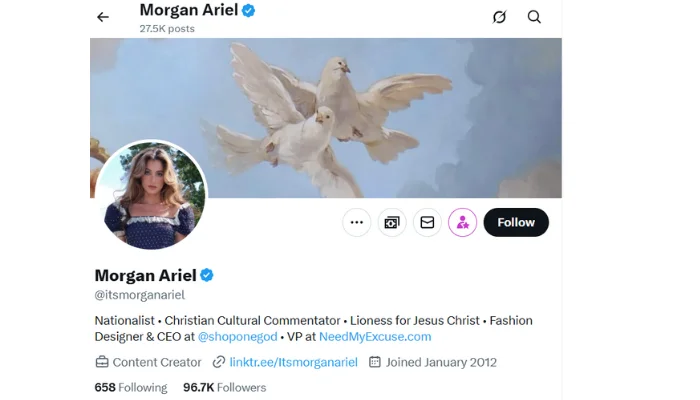
In the United States, a derogatory remark targeting Lord Hanuman, a revered Hindu deity, was made by a Christian conservative woman named Morgan Ariel. According to media sources, in August 2024, the Ashtalakshmi Temple in Sugar Land, Texas, installed a 90-foot bronze statue (murti) of Lord Hanuman, named the “Statue of Union.” This became the third-tallest statue in the United States, after the Statue of Liberty and the Pegasus and Dragon in Florida. The statue became a powerful symbol of Hindu pride and heritage, particularly for thousands of people of Indian origin living in Texas. However, the idol was mocked, and a derogatory remark was made against Lord Hanuman by the accused, Morgan Ariel. She referred to Lord Hanuman as “demonic filth.” On 20th August 2024, the accused, on her official X (formerly known as Twitter) account, wrote: “This is a Hindu statue they just built in Texas. I rebuke this demonic filth in the mighty name of Jesus Christ.”
Case Images
Why it is Hate Crime ?
This case has been added to the tracker under the primary category- Hate Speech against Hindus. The subcategory selected is- Anti-Hindu slurs, mocking faith. Anti-Hindu slurs and the deliberate mocking of the Hindu faith owing to religious animosity involve the usage of derogatory terms, stereotypes, or offensive references to religious practices, symbols, or figures. One of the common anti-Hindu slurs used against Hindus is “cow-worshipper” and “cow piss drinker”. The intention of using this term is to demean and mock Hindus as a group and their religious beliefs since Hindus consider the cow holy. Additionally, some symbols and the slurs attached to them have a historical context that exacerbates the insult, hate, stereotyping, dehumanisation and oppression against Hindus. Cow worship has been used for centuries to denigrate Hindus, insult their faith and oppress Hindus specifically as a religious group. There has been overwhelming documentation about how cow slaughter has been used to persecute Hindus with cow meat being thrown in temples and places of worship. There has also been overwhelming documentation where cow meat (beef) has been force-fed to Hindus to either forcefully convert them to Islam or denigrate their faith. Apart from cow worship, the Swastika – which holds deep religious significance for the Hindus – has also been misinterpreted and distorted to use as a slur against Hindus. Similarly, the worship of the Shivling has been used by supremacist ideologies and religions to denigrate Hindus owing to religious animosity. Such slurs and denigration stem out of inherent animosity and hate towards Hindus and their faith, therefore, it is categorised as hate speech targeted at Hindus specifically owing to their religious identity. This incident is a clear example of religiously motivated hate speech targeted at Hinduism and the Hindu community. Hindu deities are held in deep reverence by followers of the Hindu faith, forming an integral part of religious practice, identity, and heritage. They are worshipped with devotion and regarded as divine manifestations with profound spiritual significance. Among them, Lord Hanuman is one of the most highly revered deities. He is celebrated for his unwavering devotion to Lord Rama, his embodiment of courage, loyalty, and strength, and his role as a protector and helper of devotees. Millions across the world worship Lord Hanuman through prayers, chanting his name, and reading scriptures such as the Hanuman Chalisa. In this light, any derogatory remark against him not only insults a sacred deity but also reveals a deep-seated animosity towards the Hindu community and its faith. Furthermore, such offensive comments directed at Lord Hanuman or any Hindu deity cause deep emotional hurt and distress among Hindus, as they degrade and disrespect their deeply cherished beliefs. In this case, the accused used explicitly derogatory words to describe Lord Hanuman, calling him a "demonic filth". These are classic slurs often employed by Christian evangelists when referring to non-Christian faiths. Given that Christian religious doctrine has historically shown contempt towards polytheistic traditions, this prejudice extends to Hinduism, which they perceive as a polytheistic faith. Such language, therefore, is not an expression of casual hostility but is rooted in religious indoctrination that seeks to vilify and delegitimise Hindu belief systems, making this incident a direct and deliberate example of religiously motivated hate speech. Another point to highlight is that in her post, Morgan Ariel wrote that she “rebuked this demonic filth in the mighty name of Jesus Christ,” directly referring to Lord Hanuman. This statement illustrated an attempt to assert the superiority of one faith over another — by invoking Jesus Christ to condemn a sacred Hindu figure, she positioned Christianity as dominant and sought to depict Hinduism as impure or inferior. Using revered symbols of one religion to insult or denigrate those of another is a clear expression of religious animosity and bigotry. Such actions not only demean Hindu beliefs but also promote a narrative of Christian supremacy, attempting to undermine and belittle Hinduism as an inferior faith. Considering that this case meets the parameters of religiously motivated hate speech, it is being added to the hate crime database of the Hinduphobia Tracker.


Case Status
Unknown


Perpetrators Details
Perpetrators
Christian Extremists
Perpetrators Range
One Person
Perpetrators Gender
female
 Sources




