Hindus targeted for Christian conversion: Offered inducements, Hindu deities denigrated, and women threatened for opposing conversion
 Hanumangarh, Rajasthan, India
  25 February, 2024
Case Summary
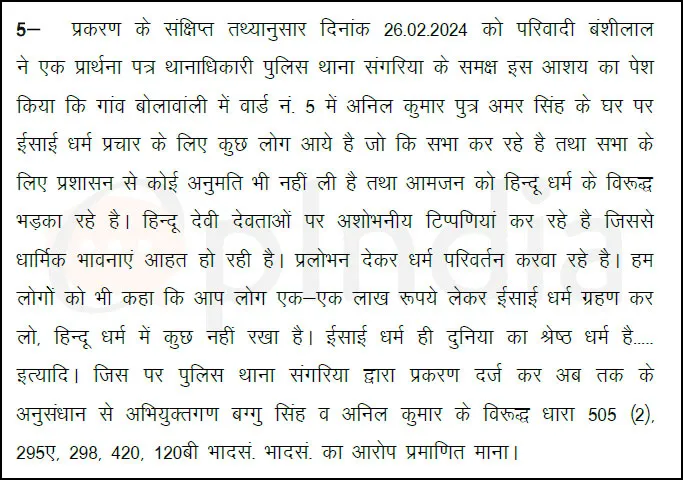
In Bolanwali village in Sangaria Tehsil, Hanumangarh district of Rajasthan, Hindus were targeted for Christian conversion by a Christian pastor named Baggu Singh and his accomplice Anil Kumar. The accused had lured Hindus with inducements and made offensive remarks against Hindu gods and goddesses. According to media reports, on 26th February 2024, Baggu Singh and Anil Kumar were booked by Sangaria Police under Sections 505(2), 295A, 298, 420, and 120B of the Indian Penal Code (IPC) on the complaint of Banshilal, a Hindu man. Court documents stated that a prayer gathering was held at Anil Kumar’s house in Bolanwali village. Some Christians, including Baggu Singh, had come to preach Christianity. The meeting was organised without permission from the administration, and during the event, inflammatory remarks were made against the Hindu religion. Indecent comments were also directed at Hindu deities, hurting religious sentiments. Following this, the accused also enticed people to convert to Christianity by offering inducements. Witnesses stated that they had told villagers, “Each of you can adopt Christianity for one lakh rupees. There is nothing left in Hinduism; Christianity is the greatest religion in the world.” In March 2024, Baggu Singh and Anil Kumar were granted bail by the Sangaria Court. The case remains pending before the court. Hindu villagers also stated that the conversion network had been operating in the border area for years under the pretext of “miracle healing.” Several locals indicated that over one hundred people were converted, with many too afraid to come forward. Hindu women opposing the activities had also been threatened. Sriganganagar Superintendent of Police Dr Amrit Duhan confirmed that a detailed investigation was underway to trace the pastor and uncover the larger network behind the forced conversions. At the time of writing this report, the police are verifying digital evidence and preparing to produce the accused before the court. This incident of targeting Hindus came to light due to a recent event involving a Sikh man named Satnam Singh, who had also been targeted for conversion by Baggu Singh. Satnam was told that his illnesses would be cured if he converted, and even Sikh gurus were abused by the accused. Satnam further stated that Baggu had built a church in his residence and was targeting large numbers of people to convert to Christianity under the pretext of “miraculous healing.” This revelation prompted the re-examination of the accused’s past activities, which showed a history of targeting Hindus for conversion.
Case Images
Why it is Hate Crime ?
This case has been added to the tracker under the primary category- Predatory Proselytisation. The subcategory selected is- Conversion/ attempts to convert by inducement. Predatory Proselytisation is not just limited to threat, harassment, force and violence, but it also has contours of stealth. In several cases, the Hindu victim is exploited to convert, with non-Hindus taking advantage of their poverty. In such cases, the Hindu victim who is suffering financially is offered monetary benefits, including lucrative offers for jobs, health treatment, education, etc, to induce the victim into changing his/her religion. In such cases, the religious identity of the victim and the aim to disenfranchise him from his faith form the heart of the crime. Also, taking advantage of and exploiting an individual’s economic vulnerabilities is widely acknowledged as exploitation, forms of which are often penalised by law. Such cases therefore are considered religiously motivated hate crimes since the victim’s religious identity forms the very heart of the crime itself. The other subcategory selected is- Attempting to convert/ converting by denigrating Hinduism. In several cases, Hindus are converted or an attempt is made to convert Hindus by denigrating their faith, Hinduism. In such cases, the Hindus associate with the non-Hindu perpetrators often by choice and then, the attempt to convert them by insulting their faith, showing the faith down etc begins. An example of this would be a non-Hindu gathering where the Hindus are attending the gathering of their own free will. However, once they attend the gathering, there is an explicit attempt to convert them by abusing their faith and hailing the faith of the perpetrator. The denigration of the Hindu faith is often based on misrepresentation of the Hindu faith, its doctrine and scriptures and insult to espoused traditions if not blatant lies about Hindu beliefs and ways. Such conversions or attempts at conversions are driven by animosity towards the Hindu faith and are therefore documented as religiously motivated hate crimes. The other subcategory selected is- Harassment, threats, coercion for conversion. Harassment covers a wide range of behaviours of an offensive nature. It is commonly understood as behaviour that demeans, humiliates, and intimidates a person, including threats and coercion. Harassment and threats, in this case, find their root on discriminatory grounds which has the effect of nullifying a person’s rights or infringing upon his freedom to exercise his right specifically owing to the victim’s religious identity. Verbal and physical threats and psychological or physical harassment are often used against Hindu victims because they choose to practice their professed religion. Religious harassment also includes forced and involuntary conversions by harassment, threats or coercion. Coercion includes intimidatory tactics like force-feeding a Hindu victim beef to convert to another religion, forceful circumcision etc. In several cases documented, non-Hindu perpetrators or those who harbour specific animosity towards Hinduism, harass victims simply based on their religious identity. Such cases often also include harassment to ensure the Hindu victim abandons his/her professed religion and adopts the religion of the perpetrator. Such cases where Hindu victims are harassed to convert to the perpetrator’s religion are rooted in animosity towards the victim’s religious identity and are therefore documented as religiously motivated hate crimes. The other subcategory selected is- Proselytisation by grooming, brainwashing, manipulation or subtle indoctrination. The tertiary category selected is- Pattern of targeting Hindus. Religious brainwashing essentially means the often subtle and forcible indoctrination to induce someone to give up their religious beliefs to accept contrasting regimented ideas. Religious grooming or brainwashing also involves propaganda and manipulation. It involves the systematic effort, driven by religious malice and indoctrination, to persuade “non-believers’ to accept allegiance, command, or doctrine to and of a contrasting faith. Cases of such grooming or brainwashing are far more nuanced than direct threats, coercion, inducement and violence. In such cases, it is often seen that there is repeated, subtle and continual manipulation of the victim to induce disaffection towards their own faith and acceptance of the contrasting faith of the perpetrator. While subtle indoctrination is widely acknowledged as predatory, an element which is often understated in such conversions or the attempts of such conversion is the role of loyalty and trust which might develop between the perpetrator and the victim. Fiduciary relationships are often abused to affect such religious conversion. For example, an educator transmitting religious doctrine of a competing faith to a Hindu student. The Hindu student is likely to accept what the teacher is transmitting owing to existence of the fiduciary relationship. The exploitation of the fiduciary relationship to religiously indoctrinate victims would also be included in this category. Since the underlying animosity towards the victim’s faith forms the basis of predatory proselytization, such cases are considered religiously motivated hate crimes. This case was an instance of an anti-Hindu hate crime as the accused deliberately targeted Hindus for conversion to Christianity. By singling out the Hindu community for conversion, the Christian perpetrators undermined and attacked the Hindu faith and its followers. This was an attempt to coerce members of the Hindu community into abandoning their religion, making the offence religiously motivated and rooted in hostility towards Hindus and Hinduism. Hindus in the village were targeted by the accused with monetary inducements of ₹1,00,000 to convert to Christianity. Such offers were intended to exploit the financial vulnerability of the victims rather than provide genuine charity or goodwill. Using money as bait for religious conversion was a calculated form of exploitation, turning economic hardship into a tool to forcibly alter the victims’ identity and faith. This approach reflects coercion and manipulation, making it a religiously motivated offence with the clear aim of diminishing the Hindu population through conversion. The accused insulted and denigrated Hindu gods and goddesses, who hold a place of high reverence and worship in Hinduism. By mocking these deities and portraying Hinduism as inferior, while simultaneously declaring Christianity as the greatest religion, the perpetrators demonstrated deep-seated religious hatred. Their deliberate attempt to diminish the dignity of the Hindu faith was aimed at instilling doubt and shame in the victims so that they might abandon their faith and convert, affirming that the crime was motivated by religious animosity towards Hindus. When Hindu women opposed the conversions, many of them were subjected to threats and harassment by the accused. The use of intimidation and abuse against women who resisted conversion is evidence of the perpetrators’ targeted hostility towards those defending their community’s religious identity. Threats in this context were not only acts of harassment but deliberate tactics to break the resistance of Hindus and destroy their autonomy, further proving that this was an act of religious hostility directed at the Hindu community. Hindu villagers stated that the accused Baggu Singh and his accomplice Anil Kumar were converting Hindus under the pretext of a ‘healing’ meeting. By falsely claiming to heal people’s diseases or solve their problems if they converted to Christianity, the perpetrators engaged in deliberate inducement and manipulation, exploiting vulnerability to achieve religious conversion. This tactic was a calculated form of subtle brainwashing, reinforced by statements like "Christianity was the most superior religion and that there was nothing left in Hinduism", thereby undermining the Hindu faith and coercively persuading its followers to abandon their religion. The perpetrators’ actions were not confined to one individual but targeted several Hindus, almost 100, as stated by the villagers, across the entire village. This wide-ranging nature of the offence amplified its harm and showcased sustained and deliberate targeting. It was not an isolated incident but a systematic effort to convert a specific religious group. This was a voluntary, motivated crime carried out with precision against the Hindu community with the intent to undermine their religious identity and cohesion. These instances of targeted proselytisation activities stem from inherent hostility towards the victims' professed faith since Abrahamic faiths believe that any non-adherent to their faith is subject to being dehumanised till they convert, making it a religiously motivated crime against Hindus. Since this case meets multiple parameters of a religiously motivated attack against Hindus and their faith, it is being added to the hate crime database of the Hinduphobia Tracker. Disclaimer: In this case, media reports stated that the incident came to light following the targeting of a Sikh man named Satnam Singh, who was approached for conversion. However, since Hinduphobia Tracker documents incidents involving Hindu victims specifically, this case has been recorded with a focus on Hindus being targeted for Christian conversion. In the case of Hindus, there were two named perpetrators: Pastor Baggu Singh and his accomplice Anil Kumar. Henceforth, for the purpose of documentation, the perpetrator count in this case has been recorded as '2'. Based on media reports, the exact number of Hindus converted under coercion is not specified, although it is mentioned that over 100 people were converted. Therefore, for the purpose of documentation, we are recording a conservative estimate of '100' victims. The reports also do not provide a precise gender breakdown of the victims. To estimate this, based on India's Census 2011 and National Family Health Survey 2019 rural population data, rural population gender ratios can be used as a proxy. The rural sex ratio in India is approximately 1,037 females per 1,000 males, which translates roughly to 51% women and 49% men in a typical rural family. Based on the reported figure of over 100 converted victims, applying the typical rural gender ratio of 51% women and 49% men gives an estimated count of approximately 51 women and 49 men among the victims. This indicative victim count is being recorded for this case.
Victim Details
Total Victim
100
Deceased
0
Gender
- Male 49
- Female 51
- Third Gender 0
- Unknown 0
Caste
- SC/ST 0
- OBC 0
- General 0
- Unknown 100
Age Group
- Minor 0
- Adult 0
- Senior Citizen 0
- Unknown 100


Case Status
Case sub-judice


Perpetrators Details
Perpetrators
Christian Extremists
Perpetrators Range
From 2 To 5
Perpetrators Gender
male
 Sources




