Dalit youths attacked by Muslims with sharp weapons in Dungarpur, Rajasthan; casteist slurs hurled
 Dungarpur, Rajasthan, India
  1 October, 2025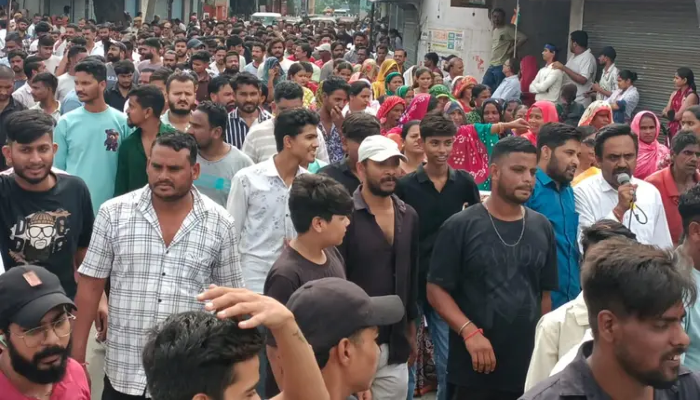
Case Summary
Two Dalit youths in Patela Valmiki Basti, Dungarpur city, were seriously injured after being attacked with sharp weapons by members of the Muslim community. The victims, Sumit, son of Ishwarlal Nalvaya, along with his friends Ankit and Piyush Dev, were sitting outside Sumit’s uncle Naresh’s house around 11 pm on the night of October 2, 2025, when several men on two motorcycles arrived and launched a sudden assault. The attackers reportedly used caste-based slurs and abusive language during the attack. Neighbours rushed to the scene as the assailants fled, and the injured were admitted to Dungarpur Hospital for treatment. In response, the Dungarpur Kotwali police registered a case against two named suspects and launched a special operation. A team led by ASI Dilip Singh conducted raids at possible hideouts. During these operations, Faizan, son of Rais Ahmed from Hajipura Mohalla and Mohammad Ali, son of Mohammad Firoz from Gareeb Nawaz Colony, were arrested. Police continued to search for the remaining suspects. The situation escalated late at night on October 3, 2025, when former BJP district president Prabhu Pandya and VHP district president Prakash Bhatt visited the victims’ families to offer support. Muslim community members surrounded the leaders, attempting to assault them, but police intervened to restore order. Subsequently, Prabhu Pandya filed a complaint at Kotwali Police Station against seven to eight named individuals. Protesting the attack, Hindu organisations, led by the Hindu Sangharsh Samiti, organised a large rally on October 6, 2025. The procession began from Gapsagar’s Pal, passed through the Tehsil chowk, and reached the Collectorate, where participants staged a sit-in and vocally demanded the immediate arrest of the attackers and their accomplices. Members of the Vishva Hindu Parishad, Bajrang Dal, and BJP workers participated in large numbers, with notable presence from former BJP district president Prabhu Pandya, VHP district president Prakash Bhatt, and Chamber of Commerce secretary Prabhu Patel. During the protest, demonstrators sat on the road, disrupting traffic and prompting police to divert vehicles. Leaders, including former BJP district president Velji Patidar and Chamber of Commerce president KK Gupta, condemned the assault and called for strict action. The rally and sit-in affected local businesses, with many shops along the route closing temporarily, though most reopened by the afternoon.
Why it is Hate Crime ?
The primary category in this case is: Hate speech against Hindus. The subcategory under this is: Anti-Hindu slurs, mocking faith. Anti-Hindu slurs and the deliberate mocking of the Hindu faith owing to religious animosity involve the usage of derogatory terms, stereotypes, or offensive references to religious practices, symbols, or figures. One of the common anti-Hindu slurs used against Hindus is “cow-worshipper” and “cow piss drinker”. The intention of using this term is to demean and mock Hindus as a group and their religious beliefs since Hindus consider the cow holy. Additionally, some symbols and the slurs attached to them have a historical context that exacerbates the insult, hate, stereotyping, dehumanisation and oppression against Hindus. Cow worship has been used for centuries to denigrate Hindus, insult their faith and oppress Hindus specifically as a religious group. There has been overwhelming documentation about how cow slaughter has been used to persecute Hindus with cow meat being thrown in temples and places of worship. There has also been overwhelming documentation where cow meat (beef) has been force-fed to Hindus to either forcefully convert them to Islam or denigrate their faith. Apart from cow worship, the Swastika – which holds deep religious significance for the Hindus – has also been misinterpreted and distorted to use as a slur against Hindus. Similarly, the worship of the Shivling has been used by supremacist ideologies and religions to denigrate Hindus owing to religious animosity. Such slurs and denigration stem out of inherent animosity and hate towards Hindus and their faith, therefore, it is categorised as hate speech targeted at Hindus specifically owing to their religious identity. The primary category in this case is: Attack not resulting in death. The subcategory under this is: Attacked for Hindu identity. In several cases, Hindus are attacked merely for their Hindu identity without any perceived provocation. A classic example of this category of religiously motivated hate crime is a murder in 2016. 7 ISIS terrorists were convicted for shooting a school principal in Kanpur because they got ‘triggered’ seeing the Kalava on his wrist and tilak that he had put. In this, the Hindu victim had offered no provocation except for his Hindu religious identity. The motivation for the murder was purely religious, driven by religious supremacy. Such cases where Hindus are targeted merely for their religious identity would be documented as a hate crime under this category. The second subcategory selected is- Attacked for opposing radicals or trying to save victim. In several cases, Hindus are attacked for opposing religiously motivated crimes being committed against a fellow Hindu or simply for voicing an opinion opposing radical elements, who either have in the past or continue to persecute Hindus. In such cases, the initial attack against the victim, against which the Hindu was trying to defend the victim, would also need to be classified as a religiously motivated hate crime. Since the initial crime itself was religiously motivated and the subsequent crime of attempting to save the victim or speaking against the radical elements ends up inviting a violent attack, it would also be classified as a religiously motivated hate crime under this category. This case has been added to the Hinduphobia Tracker because it exemplifies multiple forms of religiously motivated hate crimes against Hindus, rooted both in physical violence and verbal denigration. The attack on the two Dalit youths in Patela Valmiki Basti demonstrates the clear targeting of individuals solely for their Hindu identity. The assailants, belonging to the Muslim community, reportedly used caste-based slurs and abusive language while physically assaulting the victims. The victims, Sumit and Ankit, were not engaged in any act of provocation; they were simply sitting outside a family member’s home in their own locality when the attack occurred. While there is no definitive evidence yet to establish what triggered the assault, even if one were to assume that it stemmed from a personal disagreement or feud, the use of caste-specific insults and Hindu-identifying abuse makes the motive unmistakably communal. It reveals that the perpetrators’ hostility was not merely personal, but was directed at the victims because of who they were: Hindus. The invocation of caste-based slurs in this context demonstrates how anti-Hindu bias often intersects with caste identity to justify hatred and violence against members of the Hindu community. It can be argued that a caste-specific slur is aimed at her micro identity of belonging to the Dalit section of the Hindu community and not her Hindu identity itself. However, as far as Abrahamic religions are concerned, the micro identities of caste, region, and language are secondary. It is the religious identity that drives the animosity of the perpetrator against the Hindu victim. In this case, while the accused hurled caste abuses at the victims, the animosity was driven by his animosity towards Hinduism and Hindus. While the immediate trigger of the violence is not mentioned in reports, the fact that caste slurs were hurled at the victim by the perpetrator makes it a religiously motivated hate crime against the victim. Furthermore, the subsequent violence faced by former BJP district president Prabhu Pandya and VHP district president Prakash Bhatt while visiting the victims’ families underscores the secondary form of religiously motivated hate crime. These Hindu leaders, attempting to provide support and intervene in response to the initial attack, were themselves targeted for harassment and assault by members of the same community. This clearly falls under the subcategory “Attacked for opposing radicals or trying to save a victim,” highlighting that individuals defending or advocating for Hindus against extremist or radical elements are themselves at risk of violence. In this context, the physical assaults were not isolated incidents but part of a broader attempt to intimidate and suppress Hindus from asserting their rights or standing up against threats to their community. The case also incorporates elements of hate speech directed at Hindus, as the assailants employed caste and religion-based slurs during the attack. The use of such slurs—intended to demean, humiliate, and dehumanise the victims—demonstrates religious animosity. Anti-Hindu slurs and mocking of the Hindu faith, whether through derogatory references to Hindu practices, symbols, or beliefs, are categorically recognised as hate speech because they specifically target Hindus based on their religious identity. The deliberate invocation of historically charged symbols and terms, such as the denigration of cow worship or other religious practices, functions to stigmatise and intimidate Hindus, reinforcing patterns of communal marginalisation. The protest that followed, organised by Hindu Sangharsh Samiti and other Hindu organisations, further highlights the societal impact of the attack and the perception of targeted animosity. Taken together, the assault on the Dalit youths, the attempted attack on intervening Hindu leaders, and the use of caste and religion-based slurs constitute a multifaceted hate crime. This incident illustrates how Hindu individuals and communities are targeted because of their faith and caste, both directly and indirectly, making it a crucial addition to the Hinduphobia Tracker. The case highlights the interplay of physical violence, intimidation, and hate speech as instruments of religious persecution, exemplifying the need to document, monitor, and take action against such crimes targeting Hindus.
Victim Details
Total Victim
2
Deceased
0
Gender
- Male 2
- Female 0
- Third Gender 0
- Unknown 0
Caste
- SC/ST 2
- OBC 0
- General 0
- Unknown 0
Age Group
- Minor 0
- Adult 2
- Senior Citizen 0
- Unknown 0


Case Status
Case sub-judice


Perpetrators Details
Perpetrators
Muslim Extremists
Perpetrators Range
Unknown
Perpetrators Gender
male
 Sources




