Hindu siblings attacked by Muslim men during Durga Puja procession in Muslim-majority village in Uttar Pradesh, forced to chant Allah’s name
 Bahraich, Uttar Pradesh, India
  2 October, 2025
Case Summary
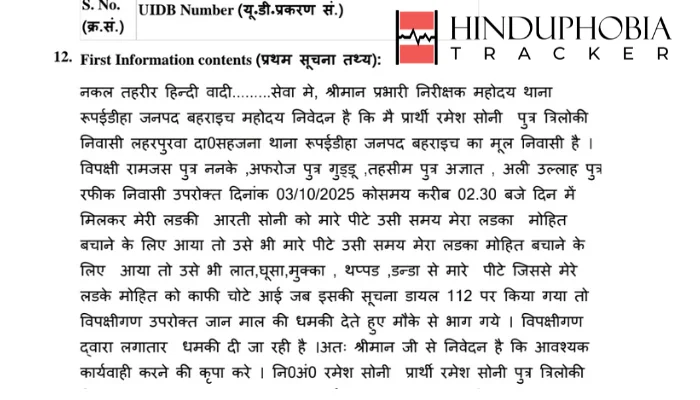
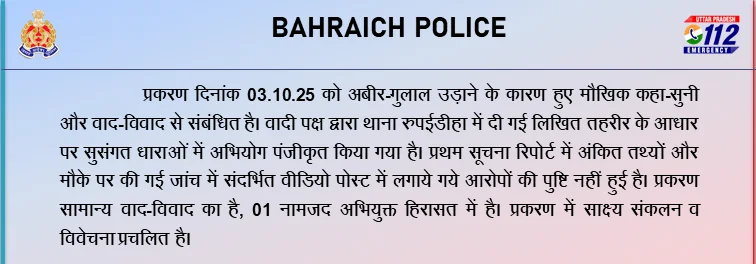
In Sumerpur, a Muslim-majority village in Bahraich, Uttar Pradesh, a Hindu girl named Aarti Soni and her brother Mohit Soni were brutally beaten by Muslim men while participating in a Durga Puja idol immersion procession. The attackers also forced the Hindu siblings to chant Allah’s name instead of Bhagwaan’s. Bhagwaan is a term used by Hindus to refer to God. A video of the victim’s testimony went viral on social media after being shared by an X (formerly Twitter) handle named Treeni. According to the victim, while they were participating in the Durga Puja procession, a small amount of vermilion and colour accidentally hit a Muslim man named Hakim Shafiq. Enraged by this, Hakim, along with his Muslim associates Afroz, Ramzan, Tehseen, Atiullah, and Shamim, launched a violent attack on Aarti. When her brother tried to rescue her, he too was mercilessly beaten. Following the assault, both siblings were forced to chant the name of Allah instead of Bhagwaan (a Hindu term for God). The victim and other local Hindus stated that such incidents were common in the village. They mentioned that Muslims in the area had repeatedly targeted Hindus and their religious processions in the past, including during past festivals such as Holi. The Hindu residents reiterated that, being a Muslim-majority village, Hindus were constantly subjected to such violence. Hinduphobia Tracker obtained the FIR in which the victim’s father, Ramesh Soni, clearly stated that the Muslim men brutally attacked both Hindu siblings, causing them injuries. Following the incident, locals staged a protest, prompting police and administrative officials to rush to the scene. The officials pacified the crowd and assured them of appropriate action. A case was registered against the accused under the relevant sections of the law. Afterwards, the immersion procession resumed. Police remained deployed in the area to maintain security.
Case Images
Why it is Hate Crime ?
This case has been added to the tracker under the primary category- Attack not resulting in death. Within this, the subcategory selected is- Attack on religious procession. The outward celebration and display of religious symbols in an intrinsic part of Hinduism. Religious processions on various festivals are age-old traditions and a way to manifest faith and form a part of the religious practices of Hindus. On several occasions, such religious processions come under attack by non-Hindu mobs, in a manifestation of their animosity towards Hinduism and their practices. The reasons cited for such violent attacks are many and range from crossing a non-Hindu resident-dominated area to playing loud music, crossing from an area where there is a religious structure of another faith etc. The violent attacks are triggered by the outward display of religiosity by Hindus. The attacks are mainly a manifestation of religious supremacist doctrine which believes that idolatry, essentially the Hindu faith, is one that deserves to be annihilated since the very tenets of Hinduism, its practices and traditions are considered a sin in those doctrines. Since these attacks emanate from intrinsic and doctrinal animosity towards Hindus and Hinduism, it is considered a religiously motivated hate crime under this category. The other subcategory selected is- Attack against Hindu devotees. Hindu devotees are a few of the easiest targets of religiously motivated hate crimes because during the festival/procession/puja etc, for non-Hindus it is easy to profile their victims on the basis of religion. Hindu devotees come under attack on several occasions by individual non-Hindus or mobs of non-Hindus owing to their animosity against Hinduism, its symbols and tradition/practices. There are several instances of Hindu devotees being attacked while they worship in temples or temporary religious structures, during religious processions, doing bhajan/kirtan/puja in their own homes, in the residential society etc. These attacks are perpetrated by non-Hindus primarily because of their animosity towards Hindus and their faith. In some cases, the trigger for the violence may be non-religious, however, there are two elements that make these hate crimes. First, the Hindus who come under attack are attacked violently while indulging in religious activity. Whether they are in a place of worship or not is immaterial to the crime. When individuals are attacked while indulging in religious practices, the attack in itself is a hindrance to their freedom to practice religion and therefore constitutes a hate crime. Secondly, religious supremacist doctrines and ideologies deem religious practices of Hindus to be offensive ab initio since they are considered “sinful” by these ideologies, worthy to be annihilated by force or coercion. Driven by these religious supremacist ideologies and doctrines, the attacks against Hindu devotees stem from intrinsic animosity towards Hinduism. In some cases, the trigger for the violence may be non-religious, however, it develops into a religiously motivated crime during the course of the violence. Since these attacks stem from animosity towards Hindus and Hinduism, they are considered religiously motivated hate crimes under this category. The other subcategory selected is- Attacked for opposing radicals or trying to save victim. In several cases, Hindus are attacked for opposing religiously motivated crimes being committed against a fellow Hindu or simply for voicing an opinion opposing radical elements, who either have in the past or continue to persecute Hindus. In such cases, the initial attack against the victim, against which the Hindu was trying to defend the victim, would also need to be classified as a religiously motivated hate crime. Since the initial crime itself was religiously motivated and the subsequent crime of attempting to save the victim or speaking against the radical elements ends up inviting a violent attack, it would also be classified as a religiously motivated hate crime under this category. The other subcategory selected is- Attacked for crossing 'Muslim area'. One of the reasons that Hindus get attacked unprovoked specifically by Islamists is for crossing ‘Muslim areas’. Essentially, Muslim mobs often attack Hindus crossing or present in certain areas which have a majority Muslim population. It has often been cited as one of the reasons to blame Hindus for attacks against themselves, signalling that Hindus displaying religious symbols, taking our religious processions or crossing any area which is dominated by Muslim residents is a provocation in and of itself. These areas are mostly ghettoized areas where mobs mobilize quickly to attack Hindus for a variety of reasons like playing music during a religious procession, crossing a mosque, wearing a tilak or any other religious symbol in a Muslim-dominated area, praying at a local temple in that area etc. There have been cases where the few local Hindus of that area have been attacked on their way to the Temple for prayers as well, simply because the area is considered a Muslim-dominated area. Several times, it is entirely possible that the immediate trigger for the violence against Hindus was non-religious in nature, however, the violence became religiously motivated in nature because the area was Muslim dominated and the residents on the whole harboured animosity towards Hindus, evidenced from the actions of the mob, the slogans, and the nature of the attack. Such crimes are motivated by the religious identity of the victims and are therefore classified as hate crimes under this category. The other subcategory selected is- Communal Clash/ Attack. Communal clash is a form of collective violence that involves clashes between groups belonging to different religious identities. For a communal clash between Hindus and non-Hindus to qualify as a religiously motivated hate crime, the trigger of the violence itself would have to be anti-Hindu in essence. For example, if there is a Hindu religious procession that comes under attack from a non-Hindu mob and after the initial attack, Hindus retaliate in self-defence, leading to a communal clash between the two religious communities. While at a later stage, both communities are involved in the clash/violence, the initial trigger of the violence was by the non-Hindu mob against the Hindus and therefore, it could safely be termed as an anti-Hindu violence. Further, the trigger would also have to be religiously motivated. In the cited example, the attack by the non-Hindu mob was against religious processions and therefore, can be concluded to be religiously motivated. In some cases, the trigger may be non-religious, however, it develops into religious violence against Hindus at a later stage. In such cases too, the foundational animosity towards Hindus becomes the motivating factor of the crime and therefore, it would be classified as a religiously motivated hate crime against Hindus under this category. Another primary category selected is- Hate Speech against Hindus. The subcategory selected is- Violent Threats. Violent threats, explicit, implicit or implied, is the most dangerous form of hate speech since it goes beyond discriminatory and prejudicial language to express the intent of causing harm to an individual or a group of people based on their religious identity and faith. There could be several different kinds of threats that are issued to Hindus based on religious animosity. An explicit threat would mean the direct threat of violence towards an individual Hindu, a group of Hindus or Hindus at large. Physical violence, death threats, threats of destruction of property belonging to Hindus and threats of genocide would mean explicit threats against Hindus for their religious identity. Implicit threats may not be a direct threat but implied through the use of symbols of actions – for example – in the Nupur Sharma case, other than explicit threats, there were also implicit threats when Islamists took to the streets to burn and beat her effigies. It implies that they want to do the same to Nupur Sharma – thereby is considered an implicit threat. Violent threats can be delivered in person, through letters, phone calls, graffiti, or increasingly through social media and other online platforms. It would be important to understand that a threat – explicit or implicit, online or offline – to an individual who happens to be a Hindu does not qualify as a religiously motivated threat. Such a threat, while vile and dangerous, could be owing to non-religious reasons and/or personal animosity. To qualify as a religiously motivated threat, it would need to exhibit an indication that the individual is being targeted for religious reasons and/or owing to his/her religious identity as a Hindu. In this case, the attack occurred during a Hindu religious procession held for the immersion of the Durga idol at the conclusion of Durga Puja. The Durga idol immersion is a deeply revered ritual marking the farewell of Goddess Durga after her annual visit to bless her devotees. It is not merely a celebration, but a symbol of devotion, cultural identity, and spiritual continuity in Hinduism. Launching an attack on Hindus during this sacred event demonstrates deep-seated religious hatred, as it directly targets a moment of collective Hindu worship and reverence. Such an extreme reaction to a harmless and purely accidental incident exposes something far more serious than mere intolerance. It reflects a mindset where even the slightest visible expression of Hindu faith, like vermilion, which holds deep spiritual significance, is viewed with hostility and contempt. Instead of perceiving the incident as an accident, the Muslim attackers interpreted it as an affront simply because it was linked to a Hindu ritual. This kind of hypersensitivity and aggression toward Hindu symbols points to a deeper resentment against the public assertion of Hindu identity. In essence, the violence was not about the vermilion itself, but about what it represented—a rejection of Hindu presence and religious expression in shared public spaces. Moreover, the aggression did not remain confined to the Hindu girl alone. When her brother, Mohit Soni, intervened to protect her and confront the Muslim assailants, the perpetrators collectively attacked him as well. This shows that Hindus who attempt to shield their fellow community members from Muslim attackers face violence as a repercussion. This pattern reveals an effort to punish Hindu defenders and intimidate the community through communal violence, further displaying entrenched religious animosity. Another point to highlight is that the attack took place in a Muslim-majority village, demonstrating a deliberate effort to dominate and suppress the Hindu minority residents. In many Muslim-dominated areas, such regions are regarded by Muslims as “Muslim areas”, revealing the disturbing sense of entitlement and religious supremacy harboured by such attackers. In this case, the perpetrators appeared to view the predominantly Muslim-occupied village as an exclusive zone where non-Muslims, particularly Hindus, were unwelcome. This mindset of superiority not only reveals deep-seated prejudice but also underscores a calculated drive to assert religious control over public spaces. The assault on the Hindu siblings was rooted in this supremacist ideology, where Muslims in the area looked down upon Hindus and believed they had the authority to decide who could move freely through their streets. This behaviour illustrates a dangerous attitude driven by exclusion, intolerance, and entrenched religious hostility, making this case a clear case of a religiously motivated offence. Adding to the gravity of the incident, the attackers went beyond physical assault to inflict psychological and spiritual violence on the Hindu victims. Forcing them to chant “Allah’s” name while forbidding the utterance of “Bhagwaan’s” name was a calculated act of intimidation meant to break their religious will. Bhagwaan, the sacred name by which Hindus refer to God, is central to their faith and identity. Compelling the victims to renounce it under duress was a form of coercive control, meant to instil fear and enforce submission. This was not a spontaneous act of rage but a deliberate exercise of dominance, using threats and violence to impose Islamic expressions upon unwilling Hindu devotees. The coercion to verbally reject one’s own deity, under the threat of harm, clearly qualifies as a violent threat targeting the victims’ religious identity. It reflects a deep-seated hate motive aimed at silencing and subjugating Hindus through fear, making the incident an unmistakable case of religiously motivated violent intimidation. Another important thing that needs to be highlighted is that the local Hindu residents and the victim, Aarti, stated that this was not an isolated case. They stated that similar attacks on Hindus and their religious processions had occurred before, including during Holi festivities. These repeated patterns of targeting Hindus in the Muslim-majority area demonstrate a continuing effort to suppress Hindu celebrations and instil fear among the minority Hindu population. The visible assertion of Hindu faith through their festivals was often met with hostility, signifying that the Muslim attackers aimed to punish Hindus for practising their religion publicly. This consistent pattern of attacks underscores systemic religious animosity and an imposition of Islamic dominance within the region. Given all these aspects—the timing during a religious procession, the deliberate targeting of Hindu participants, the coercive religious slogans, the dominance in a Muslim-majority area, and the repeated pattern of similar attacks—this case constitutes a clear example of a religiously motivated hate crime against Hindus. Such actions reveal a deliberate attempt to intimidate and suppress Hindu religious participation in public life. The choice of timing, the religious identity of the victims, and the nature of coercion all establish that the attack was driven by anti-Hindu hatred. This was not an isolated quarrel but an explicit act of religiously motivated violence, making it a clear and undeniable example of an anti-Hindu hate crime. Accordingly, this case has been documented in the Hate Crime database of the Hinduphobia Tracker.
Victim Details
Total Victim
2
Deceased
0
Gender
- Male 1
- Female 1
- Third Gender 0
- Unknown 0
Caste
- SC/ST 0
- OBC 0
- General 2
- Unknown 0
Age Group
- Minor 0
- Adult 0
- Senior Citizen 0
- Unknown 2


Case Status
Complaint registered


Perpetrators Details
Perpetrators
Muslim Extremists
Perpetrators Range
From 5 to 10
Perpetrators Gender
male
 Sources




