Forced conversion network exposed: Christian pastors target Hindu women and children through revival and healing events
 Puri, Odisha, India
  26 September, 2025
Case Summary
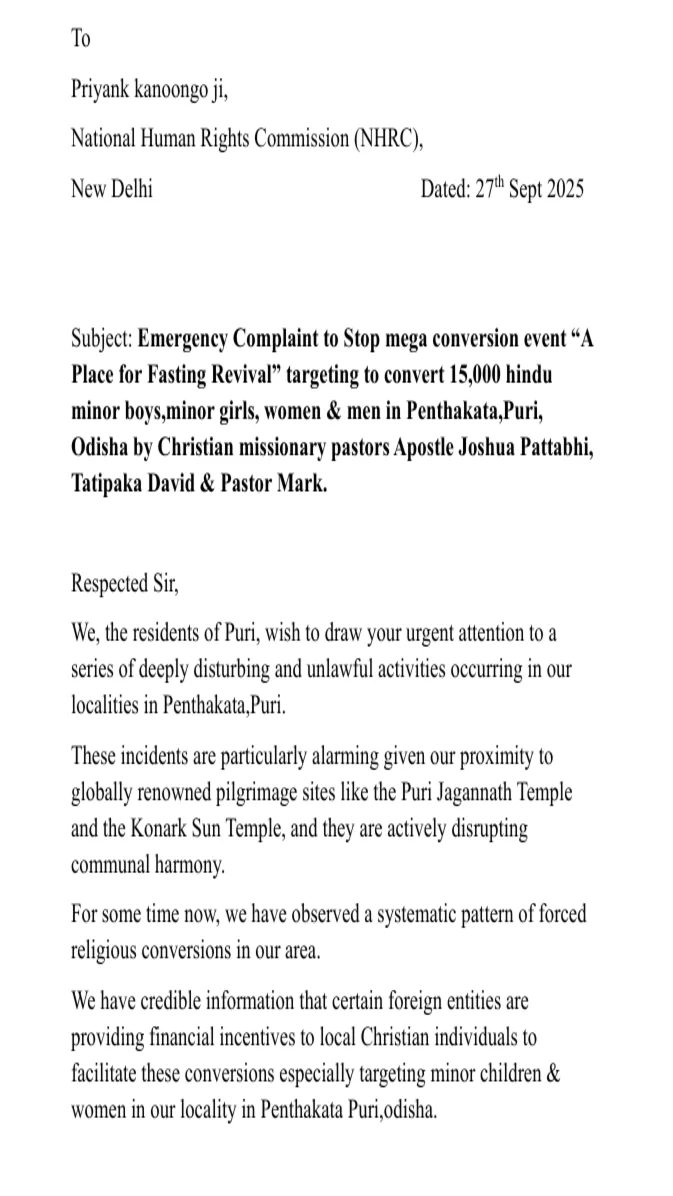
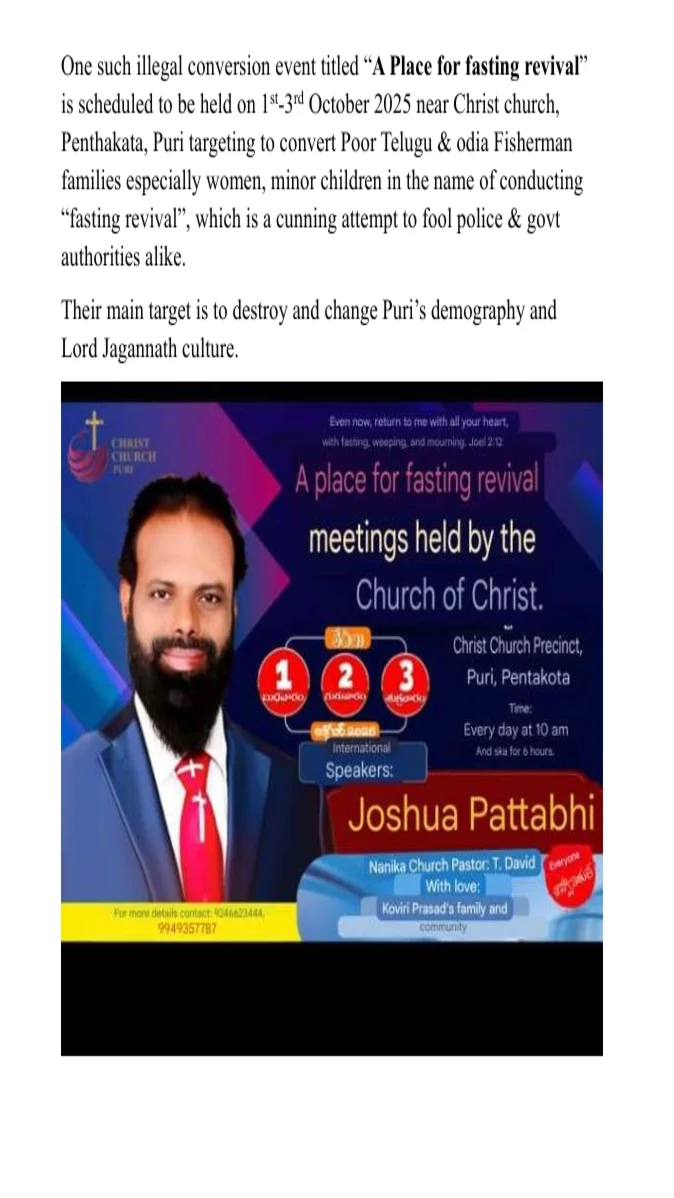
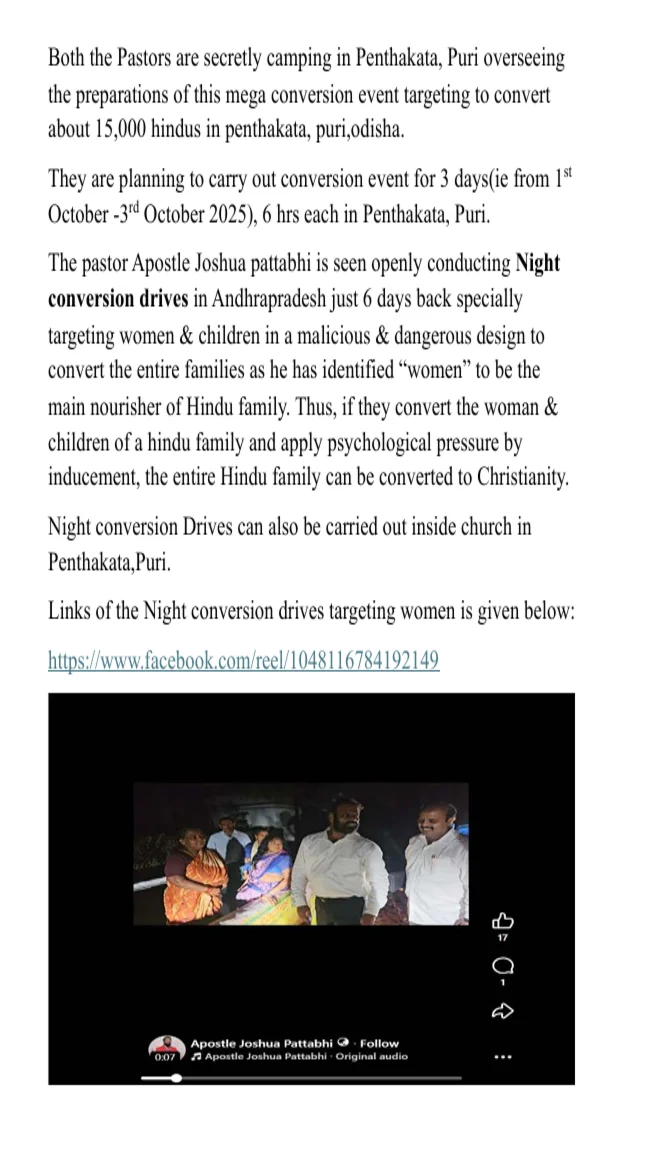
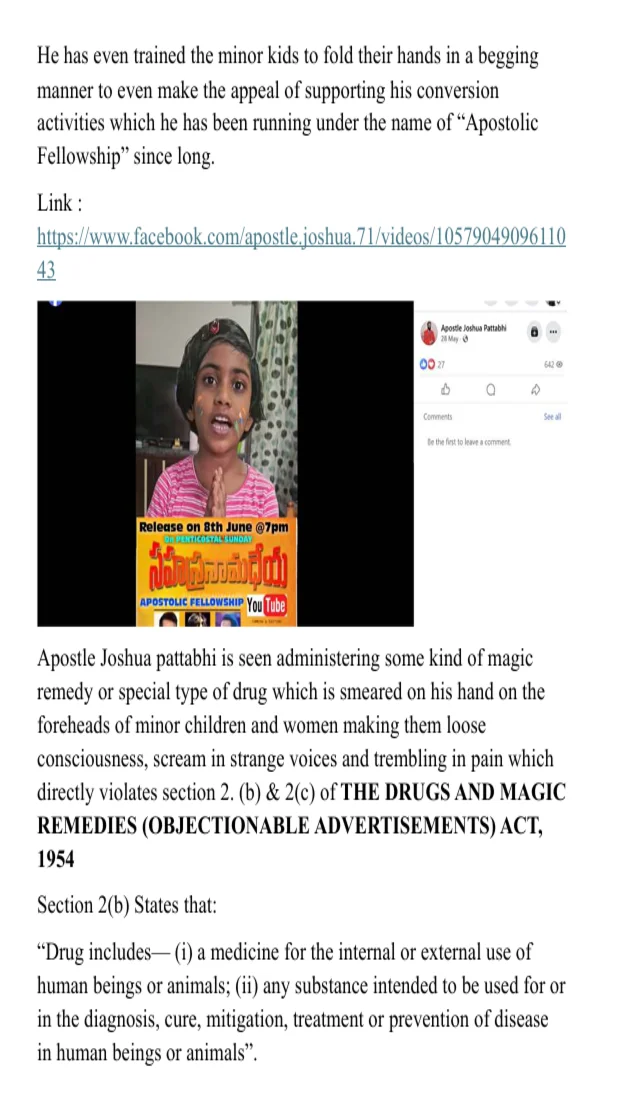
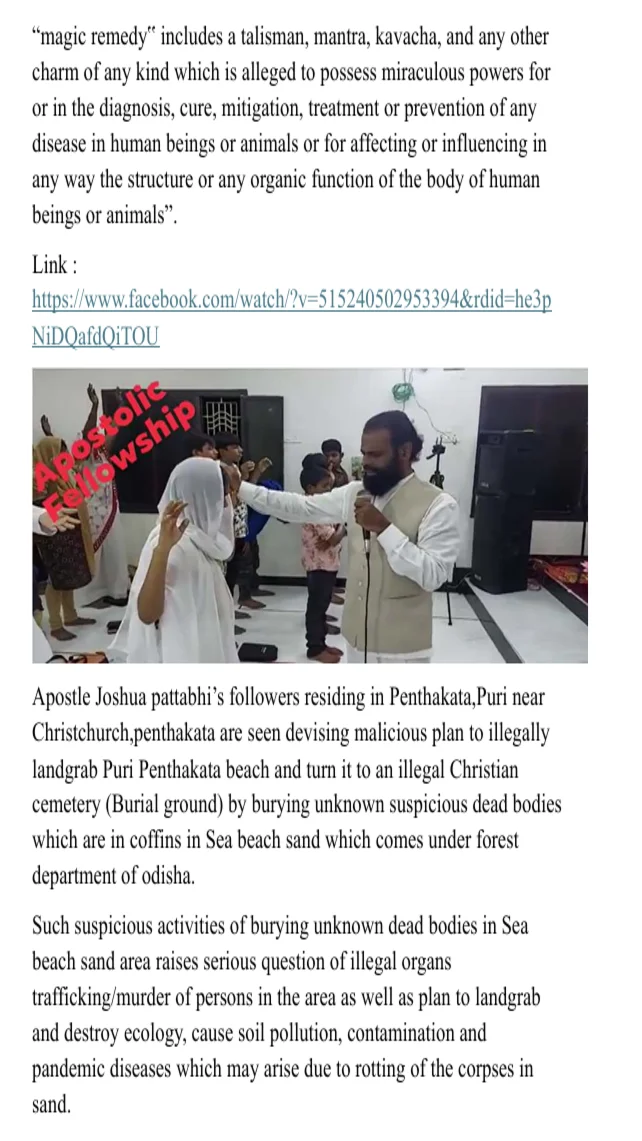
Hindu residents, including women and children, along the Odisha coast, particularly near the Jagannath Temple in Puri and the Konark Sun Temple, were targeted for religious conversion by two Christian pastors named Pastor Joshua Pattabhi and Tatipaka David. These conversion activities were carried out under the guise of revival events and healing sessions, aiming to alter the region’s religious demography. They were particularly targeting poor Telugu and Odia fishermen for conversion. The National Human Rights Commission (NHRC) took cognisance of these activities following a complaint from residents of Penthakata on 27 September 2025 and issued notices to the District Magistrate and Superintendent of Police, Puri, on 1 October 2025, directing the submission of an Action Taken Report within two weeks. Pastor Joshua Pattabhi operated from Apostolic Fellowship Ministries in Rajahmundry, Andhra Pradesh, and was the chief organiser of these conversion activities. His online sermons and YouTube videos depicted large-scale conversion activities across multiple states, including Odisha, Chhattisgarh, and Andhra Pradesh, often held late at night in order to avoid suspicion. Locals describe these as “night conversion drives,” with Pattabhi openly claiming that “if a woman and children converts, the whole family follows.” His sessions combined psychological persuasion, monetary inducements, and the use of substances (narcotics) that caused participants, particularly women and minors, to lose consciousness. Pattabhi publicly boasted of converting large numbers of minors, including 75 girls in Chhattisgarh for one night event, and frequently travelled abroad to solicit funding for his evangelical missions. In Puri, he replicated this model through discreet prayer meetings and healing sessions that specifically targeted women and children. Tatipaka David, also known as T. David, headed the Bethesda Revival Fellowship Church in Naringhapuram, Tamil Nadu, and acted as Pattabhi’s local enabler. He managed logistics, mobilisation, and recruitment while targeting poor women, minors, and disabled individuals with promises of money, medical assistance, and education. Christ Church in Penthakata functioned as a hub of his activities, working alongside Pastor Mark to expand the conversion network. It was also reported that followers of Pattabhi often carried out burials of unknown bodies on Penthakata beach in order to illegally claim land and convert the coastal stretch into Christian cemeteries. Geotagged videos were provided by locals who documented these activities, raising concerns over links to organ trafficking. The complainants also filed another petition stating that SP Prateek Singh and IIC Manas Chakra of the Sea Beach Police Station ignored prior warnings and allowed the conversion events to continue. After the petition was filed, the accused deleted many of his videos and Facebook posts in an attempt to destroy evidence. Based on the complaint, the NHRC directed the DM and SP of Puri to investigate violations of the Orissa Freedom of Religion Act, 1967, the Juvenile Justice (Care & Protection) Act, 2015, the Child Labour (Prohibition and Regulation) Act, 1986, the Scheduled Castes and Tribes (Prevention of Atrocities) Act, 1989, and the Drugs and Magic Remedies (Objectionable Advertisements) Act, 1954.
Case Images



Why it is Hate Crime ?
This case has been added to the tracker under the primary category- Predatory Proselytisation. Within this, the subcategory selected is- Proselytisation by grooming, brainwashing, manipulation, or subtle indoctrination. The tertiary category selected in this case is- Pattern of targeting Hindus and Conversion of minor. Religious brainwashing essentially means the often subtle and forcible indoctrination to induce someone to give up their religious beliefs to accept contrasting regimented ideas. Religious grooming or brainwashing also involves propaganda and manipulation. It involves the systematic effort, driven by religious malice and indoctrination, to persuade “non-believers’ to accept allegiance, command, or doctrine to and of a contrasting faith. Cases of such grooming or brainwashing are far more nuanced than direct threats, coercion, inducement and violence. In such cases, it is often seen that there is repeated, subtle and continual manipulation of the victim to induce disaffection towards their own faith and acceptance of the contrasting faith of the perpetrator. While subtle indoctrination is widely acknowledged as predatory, an element which is often understated in such conversions or the attempts of such conversion is the role of loyalty and trust which might develop between the perpetrator and the victim. Fiduciary relationships are often abused to affect such religious conversion. For example, an educator transmitting religious doctrine of a competing faith to a Hindu student. The Hindu student is likely to accept what the teacher is transmitting owing to existence of the fiduciary relationship. The exploitation of the fiduciary relationship to religiously indoctrinate victims would also be included in this category. Since the underlying animosity towards the victim’s faith forms the basis of predatory proselytization, such cases are considered religiously motivated hate crimes. The other subcategory selected is- Conversion/attempts to convert by inducement. Predatory Proselytisation is not just limited to threat, harassment, force and violence, but it also has contours of stealth. In several cases, the Hindu victim is exploited to convert, with non-Hindus taking advantage of their poverty. In such cases, the Hindu victim who is suffering financially is offered monetary benefits, including lucrative offers for jobs, health treatment, education, etc, to induce the victim into changing his/her religion. In such cases, the religious identity of the victim and the aim to disenfranchise him from his faith form the heart of the crime. Also, taking advantage of and exploiting an individual’s economic vulnerabilities is widely acknowledged as exploitation, forms of which are often penalised by law. Such cases therefore are considered religiously motivated hate crimes since the victim’s religious identity forms the very heart of the crime itself. This case has been added to the tracker because poor Hindu residents along the Odisha coast, including women and children, were targeted for religious conversion by two Christian pastors named Pastor Joshua Pattabhi and Tatipaka David. Hindus were lured to prayer meetings and “healing sessions” with promises of relief from personal troubles, health issues, and financial assistance. Prayer, often seen as a sacred and private act among Hindus, was misused here as bait for conversion rather than for genuine spiritual guidance. The participants were not invited to explore faith freely but were instead coerced into abandoning the religious beliefs that defined their identity and cultural heritage. This was a calculated attempt to strip Hindus of their agency and religious freedom, making it a religiously motivated crime. Reports indicate that such prayer meetings and night conversion drives had been occurring regularly across Puri and other coastal regions, suggesting a premeditated and organised operation rather than an isolated incident. The repetitive targeting of vulnerable Hindu communities demonstrates a systematic campaign aimed at religious conversion, revealing the clear religious motivation behind the activities. The accused offered money, health care, and other benefits to vulnerable individuals, particularly women, minors, and economically disadvantaged fishermen. Offering incentives or making false promises, especially when directed at vulnerable individuals in need, shows that these incentives were not acts of kindness or charity. Instead, they were calculated moves to exploit vulnerable Hindus because of their religion. By providing inducements or promising healing in exchange for conversion, the accused effectively coerced those who might have been desperate for assistance or hope. Such instances are seen in many cases where members of Christian missionary groups target socially and economically vulnerable Hindus to further their agenda of religious conversions. This form of coercion stripped people of their agency and dignity and resulted in coerced conversions. These were not random or isolated incidents, but rather cases deeply rooted in religious animosity towards Hindu victims. It is further important to note here that some of the victims were minors, which means the element of consent and genuine change of conscience was missing ab initio. Minors, due to their young age and lack of maturity, are particularly vulnerable to manipulation and coercion. They may not have the ability to fully understand the implications of converting to another religion, and the Christian perpetrators purposely targeted and exploited this vulnerability of the victims. Since this case exemplifies the use of coercion and manipulation to achieve religious conversion, it is a blatant act of religious hate, which is why it has been documented here in the hate tracker. The nature of these conversion efforts and their wider impact on the Hindu community indicate a targeted action against Hindus as a collective. When individuals or groups focus their efforts on converting members of a particular religion, in this case, Hindus, it demonstrates a fundamental disregard for the Hindu faith. Conversion, especially when not based on personal conviction but rather on external persuasion or pressure, is not simply about sharing a different belief system. It is an attempt to undermine the values, traditions, and identity of the Hindu community. The Christian faith, by its very theological foundations, places a strong emphasis on proselytisation. In pursuit of conversion objectives, Christian evangelists often employ unethical means, ranging from psychological pressure and misinformation to inducements such as money or jobs. In such cases, Christian missionary groups often target and brainwash socially and economically vulnerable Hindus to further their agenda of religious conversions. These were not random or isolated incidents but premeditated actions to weaken the Hindu faith and convert members of the community to Christianity. The case exemplifies religiously motivated coercion and manipulation, which is why it has been documented in the hate tracker. Disclaimer: The Hinduphobia Tracker records the incident based on when the victim’s ordeal began, or when the event occurred. However, the media reports covering the case do not specify the exact date when such conversion activities began. Therefore, for documentation purposes, we have recorded the date based on when the petition was filed with the NHRC - 27 September 2025.


Case Status
Complaint filed


Perpetrators Details
Perpetrators
Christian Extremists
Perpetrators Range
From 2 To 5
Perpetrators Gender
male
 Sources




