Hindu religious procession targeted near mosque, Hindu devotees brutally attacked by Muslims in Uttar Pradesh
 Ghazipur, Uttar Pradesh, India
  1 October, 2025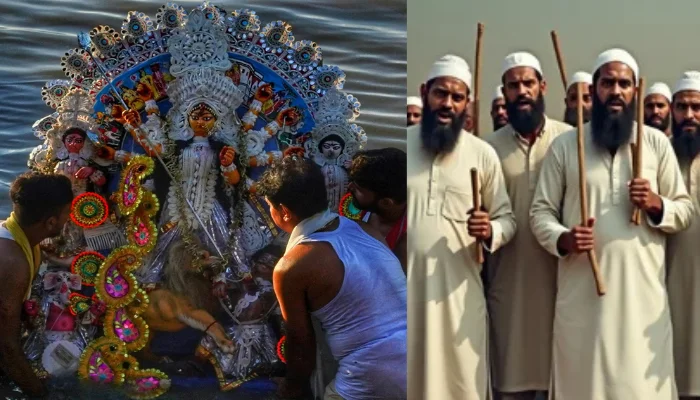
Case Summary
In Maharajganj Bazar in Ghazipur, Uttar Pradesh, a Durga Puja idol immersion procession was attacked by Muslims as it passed through a mosque. Hindu devotees were attacked by Muslim men with sharp swords, and Muslim women also took part in the attack by pelting stones. According to media reports, the incident occurred on 2nd October 2025. The idol of Goddess Durga had been installed at the Gandhi Chabutara in Maharajganj Bazar for many years. This year, devotees erected a grand pandal and installed the idol. The idol was taken for a procession through the market before immersion. During this, the procession passed through a mosque, and Hindus were celebrating by bursting crackers. Sparks from the fireworks landed on the tin shed of a Muslim person's shop, which resulted in violence by Muslims. They attacked the Hindu devotees with swords, and the Muslim women pelted stones and bricks. Angered by this, the Hindu devotees created a ruckus by blocking roads as a counter. The Hindu Committee members stated that when the immersion procession reached the mosque, some Muslims shouted abuses and tried to attack the Hindu devotees. During the incident, one devotee was injured by a sword. Some eyewitnesses, Shivmurti Jaiswal, Prem Jaiswal, Pappu Madhesia, and Madan Bind, along with others, tried to intervene and escaped unharmed. Upon learning of the incident, Circle Officer Shekhar Sengar, Police Inspector Deendayal Pandey, and outpost in-charge Ashok Singh arrived and cleared the blockade by promising to file a case. Based on a complaint from BJP District Treasurer Achhelal Gupta, a case was filed against Kitabuddin alias Soldier, Jamir, Aamir, and several Muslim women. Following this, the police acted promptly and handled the situation. After the blockade ended, the idol was immersed in the Maharajganj pond in the presence of the police. Outpost in charge, Ashok Singh, stated that a case had been registered based on the complaint. The matter was being investigated, and the accused would be arrested soon. Superintendent of Police Gyanendranath Prasad stated, "Reports of such an incident have been received. A case has been registered, and an investigation is underway. Strict action will be taken against whoever is found guilty."
Why it is Hate Crime ?
This case has been added to the tracker under the primary category- Attack not resulting in death. The subcategory selected is- Attack on religious procession. The outward celebration and display of religious symbols in an intrinsic part of Hinduism. Religious processions on various festivals are age-old traditions and a way to manifest faith and form a part of the religious practices of Hindus. On several occasions, such religious processions come under attack by non-Hindu mobs, in a manifestation of their animosity towards Hinduism and their practices. The reasons cited for such violent attacks are many and range from crossing a non-Hindu resident-dominated area to playing loud music, crossing from an area where there is a religious structure of another faith etc. The violent attacks are triggered by the outward display of religiosity by Hindus. The attacks are mainly a manifestation of religious supremacist doctrine which believes that idolatry, essentially the Hindu faith, is one that deserves to be annihilated since the very tenets of Hinduism, its practices and traditions are considered a sin in those doctrines. Since these attacks emanate from intrinsic and doctrinal animosity towards Hindus and Hinduism, it is considered a religiously motivated hate crime under this category. The other subcategory selected is- Attack against Hindu devotees. Hindu devotees are a few of the easiest targets of religiously motivated hate crimes because during the festival/procession/puja etc, for non-Hindus it is easy to profile their victims on the basis of religion. Hindu devotees come under attack on several occasions by individual non-Hindus or mobs of non-Hindus owing to their animosity against Hinduism, its symbols and tradition/practices. There are several instances of Hindu devotees being attacked while they worship in temples or temporary religious structures, during religious processions, doing bhajan/kirtan/puja in their own homes, in the residential society etc. These attacks are perpetrated by non-Hindus primarily because of their animosity towards Hindus and their faith. In some cases, the trigger for the violence may be non-religious, however, there are two elements that make these hate crimes. First, the Hindus who come under attack are attacked violently while indulging in religious activity. Whether they are in a place of worship or not is immaterial to the crime. When individuals are attacked while indulging in religious practices, the attack in itself is a hindrance to their freedom to practice religion and therefore constitutes a hate crime. Secondly, religious supremacist doctrines and ideologies deem religious practices of Hindus to be offensive ab initio since they are considered “sinful” by these ideologies, worthy to be annihilated by force or coercion. Driven by these religious supremacist ideologies and doctrines, the attacks against Hindu devotees stem from intrinsic animosity towards Hinduism. In some cases, the trigger for the violence may be non-religious, however, it develops into a religiously motivated crime during the course of the violence. Since these attacks stem from animosity towards Hindus and Hinduism, they are considered religiously motivated hate crimes under this category. The other subcategory selected is- Attacked for crossing 'Muslim Area'. One of the reasons that Hindus get attacked unprovoked specifically by Islamists is for crossing ‘Muslim areas’. Essentially, Muslim mobs often attack Hindus crossing or present in certain areas which have a majority Muslim population. It has often been cited as one of the reasons to blame Hindus for attacks against themselves, signalling that Hindus displaying religious symbols, taking our religious processions or crossing any area which is dominated by Muslim residents is a provocation in and of itself. These areas are mostly ghettoized areas where mobs mobilize quickly to attack Hindus for a variety of reasons like playing music during a religious procession, crossing a mosque, wearing a tilak or any other religious symbol in a Muslim-dominated area, praying at a local temple in that area etc. There have been cases where the few local Hindus of that area have been attacked on their way to the Temple for prayers as well, simply because the area is considered a Muslim-dominated area. Several times, it is entirely possible that the immediate trigger for the violence against Hindus was non-religious in nature, however, the violence became religiously motivated in nature because the area was Muslim dominated and the residents on the whole harboured animosity towards Hindus, evidenced from the actions of the mob, the slogans, and the nature of the attack. Such crimes are motivated by the religious identity of the victims and are therefore classified as hate crimes under this category. The other subcategory selected is- Communal Clash/Attack. Communal clash is a form of collective violence that involves clashes between groups belonging to different religious identities. For a communal clash between Hindus and non-Hindus to qualify as a religiously motivated hate crime, the trigger of the violence itself would have to be anti-Hindu in essence. For example, if there is a Hindu religious procession that comes under attack from a non-Hindu mob and after the initial attack, Hindus retaliate in self-defence, leading to a communal clash between the two religious communities. While at a later stage, both communities are involved in the clash/violence, the initial trigger of the violence was by the non-Hindu mob against the Hindus and therefore, it could safely be termed as an anti-Hindu violence. Further, the trigger would also have to be religiously motivated. In the cited example, the attack by the non-Hindu mob was against religious processions and therefore, can be concluded to be religiously motivated. In some cases, the trigger may be non-religious, however, it develops into religious violence against Hindus at a later stage. In such cases too, the foundational animosity towards Hindus becomes the motivating factor of the crime and therefore, it would be classified as a religiously motivated hate crime against Hindus under this category. This incident was a clear case of a hate crime against Hindus. The Muslim attackers initiated the violence over a mere spark from firecrackers that landed on one of their shops. Had they genuinely taken issue with this, they could have resolved it through legal channels or mature dialogue. Instead, they launched a violent and disproportionate attack against Hindu devotees. Such an overreaction to a minor spark was not random or isolated; it reflected premeditated violence with communal undertones targeting the Hindu community. The attackers targeted the Durga Puja idol immersion procession, a deeply significant religious ritual for Hindus. The procession marks the symbolic farewell of Goddess Durga as devotees carry her idol for immersion in a water body, signifying her return to her divine cosmic abode after being worshipped during the Durga Puja festival. These processions carry profound reverence for the Hindu community, symbolising both spiritual devotion and cultural identity. Attacking such a procession was a direct assault on Hindu religious practices and beliefs, constituting a religiously motivated crime. During the procession, Hindu devotees faced brutal attacks: Muslim men wielded swords, while Muslim women threw stones and bricks. This violent assault resulted in severe injuries to some Hindu devotees. This attack on devotees underlined deep-seated religious animosity and hostility towards the Hindu community, making it a religiously motivated crime. It is also important to note that the procession was passing through the vicinity of a mosque. Muslims consider areas near mosques or dargahs as 'Muslim areas,' meaning zones exclusive to Muslims. This particularly meant that Hindus were unwelcome. This sense of entitlement and superiority not only reflected deep-seated prejudice but also highlighted an attempt to assert religious dominance over public spaces. The assault on the Hindu devotees was motivated by this supremacist ideology, where Muslims in the area looked down upon Hindus, believing they had the right to dictate who could move freely through their area. This illustrated a dangerous mindset rooted in exclusion, intolerance, and religious animosity, making this case an ideal example of a religiously motivated crime. Taken together, these facts demonstrated that this was a communally motivated attack against Hindus, reflecting deep-rooted hostility towards their faith and community. Such actions were driven by religious animosity and targeted prejudice, fitting the parameters of a religiously motivated hate crime. Given that this case meets multiple criteria of a religiously motivated offence, it is being added to the hate crime database of the Hinduphobia Tracker. Disclaimer: Media reports did not specify the exact number of Hindu victims injured in the attack. However, they mentioned multiple devotees were harmed, including one who was severely injured by a sword. Named victims included Shivmurti Jaiswal, Prem Jaiswal, Pappu Madhesia, and Madan Bind, who, along with others, intervened and escaped unharmed. For the purposes of documentation, a conservative estimate of five victims is being maintained. Similarly, media reports did not specify the total number of attackers involved. They named a few individuals, including Kitabuddin alias Soldier, Jamir, Aamir, and referenced several Muslim women, but the exact number of female participants was not detailed. Therefore, for record-keeping, a conservative estimate of three perpetrators is being used, accounting for both male and female attackers due to the involvement of Muslim women in the violence.
Victim Details
Total Victim
5
Deceased
0
Gender
- Male 4
- Female 0
- Third Gender 0
- Unknown 1
Caste
- SC/ST 0
- OBC 0
- General 0
- Unknown 5
Age Group
- Minor 0
- Adult 4
- Senior Citizen 0
- Unknown 1


Case Status
Complaint filed


Perpetrators Details
Perpetrators
Muslim Extremists
Perpetrators Range
From 2 To 5
Perpetrators Gender
both
 Sources




