Hindu temple vandalised, temple idols desecrated by miscreants during Dussehra festival in Bihar
 Madhubani, Bihar, India
  1 October, 2025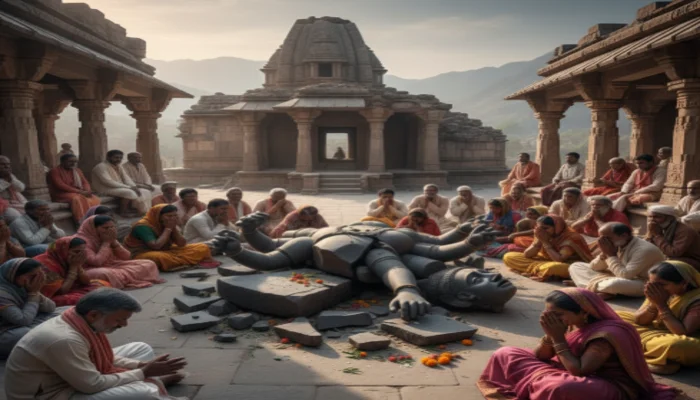
Case Summary
In Madhubani, Bihar, a Hindu temple was vandalised with multiple idols of deities desecrated by anti-social elements during the Dussehra festival, a revered Hindu festival. According to reports, some unidentified miscreants broke into the Shanidham Navagrah Temple at Gilesan Bazaar and vandalised more than a dozen idols of Hindu deities, including idols of Rahu-Ketu and other gods and goddesses. The next day, when the temple priest, Pawan Kumar Agarwal, arrived to perform the daily rituals, he found the temple gates open, with sacred items scattered across the premises and the idols desecrated. He stated that he locked the temple gate after performing the regular aarti in the evening. On receiving information, the police promptly arrived at the scene, conducted an investigation and reviewed the damage. As of the date of writing this report, the police registered a case and involved the forensic science laboratory (FSL) team and technical cell for further investigation. As the temple lacked CCTV surveillance, officers began collecting footage from nearby shops and establishments along the route leading to the temple. Superintendent of Police Yogendra Kumar confirmed that the FSL team was engaged in reviewing evidence and claimed that, on initial assessment, the act may have been carried out by a mentally unstable individual.
Why it is Hate Crime ?
This case has been added to the tracker under the primary category- Attack on Hindu religious representations. Within this, the subcategory selected is- Desecration of Hindu religious symbol. Icons and symbols or a religious representation of a spiritual ideal are widely revered in Hinduism. Iconography is of vital significance in the Hindu milieu. It helps connect people’s spiritual beliefs with the real world. Iconography within the Hindu faith takes several shapes and forms. Murtis are of most significance to Hindus, to which daily rituals, prayers and offerings are done. Besides the murtis, there are several other symbols which have deep significance in the Hindu faith – the Om and Swastika for example. Since these Hindu religious symbols hold paramount importance in Hinduism, any desecration of symbols, icons, murtis, religious representations and manifestations, is driven by animosity towards the faith itself which manifests itself through these murtis, icons and symbols. Therefore, any desecration of these Hindu religious symbols and representations is considered religiously motivated hate crimes under this category. The other subcategory selected in this case is- Attack on Temples. In Hinduism, a temple is the abode of the Deity. The Deity in the Temple is consecrated, thereby, making it a real, breathing entity. Hindus believe that not just the Deity but the temple premises itself are sacred to Hindus since Hindus hold the faith that the entire Temple space is an amalgamation of the divine energy of the deity. Given the central significance of Temples in Hindu Dharma, any attack against a Hindu Temple or its peripheral premises is an attack on the faith itself and is born out of animosity towards the faith, of which, the Temple is a central tenet. Any manner of attack against a Temple and/or its premises would therefore be considered a religiously motivated hate crime. This case has been included in the tracker because the perpetrators deliberately targeted a Hindu temple during the auspicious festival of Dussehra. A temple is an institution of profound spiritual significance within the Hindu faith. For Hindus, temples are not merely physical structures; they are consecrated spaces that embody the divine presence of deities. Acts of violence against such spaces constitute clear examples of religiously motivated hate crimes targeting Hindus and their places of worship. The attack also involved the intentional desecration of multiple sacred idols of Hindu deities, including Rahu-Ketu and other gods and goddesses. In Hinduism, idols are not simply artistic representations but revered embodiments of the divine, central to temple worship and spiritual life. Their desecration is therefore not just an act of destruction of property but a direct assault on the sanctity of the temple and the faith of the community. Such acts are rooted in hostility towards Hinduism and reflect deep-seated hatred against its symbols and practices. Beyond the physical damage, the psychological impact of such attacks is profound. For devotees, temples are places of solace, peace, and connection with the divine. When sacred temples are targeted and their idols vandalised, especially during an important festival like Dussehra, it demonstrates that the perpetrators deliberately intended to insult and hurt Hindu religious feelings. Such attacks disrupt the sense of security and belonging that the Hindu community finds in these institutions. The pain caused by idol desecration is not limited to tangible loss; it wounds the collective psyche of Hindus, leaving many feeling isolated, vulnerable, and marginalised. These acts are not simply incidents of vandalism; they are calculated assaults on the faith, identity, and spiritual dignity of the Hindu community. Furthermore, it is important to note that the police attempted to downplay the communal nature of the incident by claiming that the attack was committed by a mentally unstable person. In many such cases that involve the desecration of Hindu temples, a usual trope to shield the perpetrators is to attribute the crime to the mental health of the accused, claiming that the crime was committed since the perpetrators were ‘mentally ill’ or ‘mentally unstable’. The police and the media, in many such cases, where the crime has been committed against the Hindu faith, deny that the crime committed was in any way motivated by a religious bias and attribute it to the perpetrator’s mental health. Many a time, the police downplay incidents of low-level communal crime because it is their jurisdiction that comes under question. The police also often say that the crime was committed because the accused was mentally unstable, because they wish to ensure that, owing to the crime already committed, there is no further flare-up in the area. In fact, there are many cases where this strategy has been used by the media to downplay such incidents where the crime was committed by a Muslim perpetrator, for example, the attack on the Gorakhnath temple or the incident in Telangana where two Muslim women wearing a burqa tried to damage temple and church idols. Likewise, in this case too, the police attributed the act to the perpetrator's mental health. The use of the "mental illness" trope to justify crimes targeting Hindu temples or idols raises critical questions. If perpetrators were indeed mentally unstable, why did they specifically target Hindu idols and places of worship, leaving non-Hindu places of worship untouched? This selective focus suggests that such acts are not driven by mental health issues but by religious animosity. The repeated use of this narrative to downplay crimes against Hindus reflects a strategic effort to whitewash religious hatred, obscuring the true motivations and intentions behind the attacks. It is also important to mention here that, though the last update was that the miscreants were unknown, regardless, the action stemmed from hatred against Hinduism and resulted in the desecration of the sacred idols in the Hindu temple and would therefore be considered a religiously motivated hate crime. Such attacks underscore religious animosity, warranting their inclusion in the Hinduphobia Tracker under the hate crime database.


Case Status
Complaint registered


Perpetrators Details
Perpetrators
Unknown
Perpetrators Range
Unknown
Perpetrators Gender
unknown
 Sources




