Sacred Hindu traditions distorted: Hindu Durga Puja idols censored by Bangladesh administration
 Bangladesh
  30 September, 2025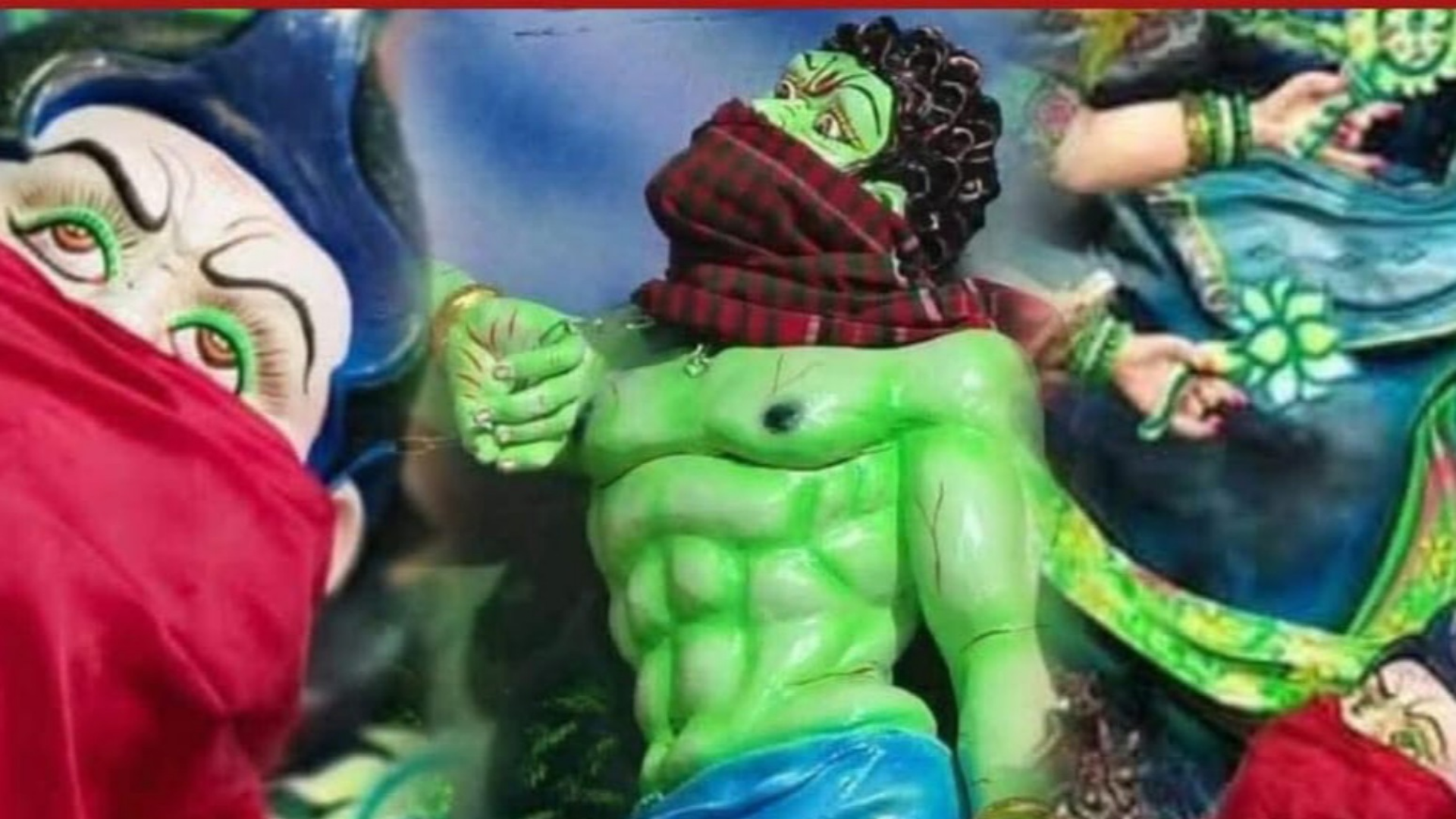
Case Summary
Hindu festival preparations were desecrated in Kushtia and Natore, Bangladesh, when local administrations forced Durga Puja organisers to cover the faces of Asurs in mandaps on the grounds that their beards and moustaches might “cause misunderstanding.” As per reports, a total of 33,355 Durga Pujas were held in Bangladesh, out of which 793 have been identified for investigation over the bearded demon. It is being claimed that with the beards, the Asura king was made to look like a Muslim, resulting in the allegations of provoking communal unrest. Amid the concerns of Durga Puja pandals displaying bearded Mahishasur idols, the Central Puja Announcement Council reportedly called for the removal of demons’ beards from the Mahishasur idols to avoid communal tension. Following the council’s statement, a decision was taken by the district administration to remove the beards from the faces of Mahishasur idols in 39 Durga Puja pandals in Kushtia. The district administration, police administration, and the local Puja Announcement Council jointly implemented this decision. In many pandals, the organisers, left with no alternative, were compelled to wrap sacred murtis with cloth, distorting both the faith and the artistry involved. In some cases, the beard was cut or removed to not offend Muslims. Organisers publicly condemned the act, stating that this was not communal harmony but outright coercion. They explained that Hindu scriptures traditionally depicted demons as terrifying figures, often with beards and moustaches, and the administration had no right to dictate how Asurs should appear. Sculptors who had crafted the idols denounced the move as state-backed vandalism, saying they were forced to mutilate their own work under the pretext of “peace.” Denying any conspiracy behind the bearded Mahishasur idols, District Puja Udjavan Morcha convenor Devesh Chandra Biswas termed the beard as the artist’s expression. “The beards and moustaches on the faces of demons are a figment of the artist’s imagination. Many sages and saints in Hindu scriptures sported beards. Beards on the faces of demons are nothing new. Rather, someone deliberately made this issue controversial to disrupt social harmony,” Biswas reportedly wrote in a Facebook post, which was deleted later. The Bangladesh government justified the directive as an attempt to maintain communal harmony, but the Hindu community saw it as blatant appeasement and institutionalised discrimination. Social media erupted with anger, with many questioning whether such interference would ever be imposed on the rituals of the majority community. Critics warned that this act set a dangerous precedent of policing Hindu traditions and censoring their expression to satisfy political motives. Instead of safeguarding minority rights, the Kushtia and Natore administrations undermined them, leaving the Hindu community humiliated during one of their most sacred festivals. The incident revealed how easily Hindu faith and culture could be censored with the direct complicity of the state. The shrouding of Durga idols was not mere overreach but a clear betrayal of the state’s duty to protect minorities. By yielding to Islamist demands, the administration signalled that Hindu rights could be trampled at will, reducing sacred traditions to bargaining chips for political expediency. This state-enabled humiliation foreshadowed the deeper persecution that followed once Bangladesh’s political order shifted. Since the ouster of Sheikh Hasina’s Awami League government on 5 August 2024, persecution of Hindus in Bangladesh has sharply intensified under the interim rule of Muhammad Yunus. Islamist extremists have taken advantage of the political vacuum to unleash widespread violence, marked by arson attacks on Hindu homes, abductions of women, and destruction of temples across the country. Reports indicate that Hindu teachers, professors, and officials have been forced to resign under pressure from Muslim students, while the community faces coercion to join Jamaat-e-Islami. Religious events have been repeatedly targeted: a Ganesh procession was attacked in Chittagong on 6 September; idol vandalism struck Mymensingh, Pabna, Rajshahi, Kishoreganj, and Dhaka ahead of Durga Puja; and on 29 November, three temples in Patharghata, Chittagong, were attacked after Jumma Namaz. Hindu voices have been further silenced, with the arrest of journalist Munni Saha on 30 November. On 22 May 2025, Hindu homes were set ablaze in Dahar Mashihati village, Jessore. Even ISKCON leaders such as Chinmoy Krishna Das Prabhu have been targeted, alongside efforts to ban ISKCON and brand Hindu protests as sedition. The cumulative record of mob violence, cultural censorship, forced resignations, and suppression of Hindu organisations demonstrates a systemic campaign of persecution against Bangladesh’s Hindu minority.
Why it is Hate Crime ?
The primary category in this case is: Restriction/ban on Hindu practices. The subcategory under this is: Restriction on expression of Hindu identity. An example of the state-affected prejudicial and targeted orders against the Hindu community would be a government denying the right of a Hindu or a group of Hindus to hold a religious procession owing to the animosity of non-Hindu groups. Denial of the religious right of the Hindus to assuage the non-Hindu group which harbours animosity to a point where it could lead to violence against Hindus is not only a failure of law and order but is a prejudicial order against Hindus, denying them their fundamental rights to express their religious identity. An example of a hate crime against Hindus by a non-Hindu would be a non-Hindu institution forcing its Hindu employees to abandon religious symbols that a Hindu would wear as an expression of faith owing to inherent prejudice against the faith professed by the victim or a non-Hindu group of people restricting a Hindu group from constructing a place of worship simply because the demography of the area in which the temple is being built is dominated by non-Hindus. Such actions are driven by religious animosity and/or prejudice against Hindus and their faith and would therefore be categorized as a hate crime. Another subcategory under this is: Administration restricting religious practice. In several cases, it is seen that the administration/state disallows a religious practice owing to prejudicial orders and concerns, targeted specifically against the Hindu community. Such restriction/prohibition would be considered documented as a hate crime because the orders are often a result of pressure by groups that harbour animosity towards Hinduism and Hindus. Often, the restriction by the authorities is driven by bias, hostility, or prejudice against the specific community being stopped from holding a religious practice, by pressure groups that harbour animosity towards Hindus, intrinsic to their faith. Since practices are intrinsic to the faith of the Hindus, such prejudicial restriction is considered a curtailing of the fundamental rights of the Hindu community. In several cases, for example, the authorities ban a Hindu religious practice due to pressure from groups opposed to the religion. In other instances the prohibition is selectively enforced against one religious group (Hindus) while others are allowed to proceed. There are still other cases where the authorities preemptively restrict a religious practice by Hindus because those who hold animosity towards Hindus may get “provoked” leading to them being violent, thereby assuaging the sentiments of those who hold animosity towards Hindus by curtailing the religious rights of Hindus. Such acts and orders are prejudiced, indicating discriminatory motives owing to the capitulation to groups that harbour animosity towards Hindus and therefore, would be categorized as a religiously motivated hate crime since the original pressure leading to the order itself is a result of hatred/bias/prejudice/religious hate against Hindus. This case has been included in the tracker because it constitutes a direct and state-backed restriction on the religious and cultural expression of Hindus in Bangladesh. The order issued by the administrations of Kushtia and Natore compelling Durga Puja organisers to cover the faces of Asurs in the mandaps is not an administrative triviality but a coercive act that intrudes upon the very substance of Hindu ritual practice. Hindu scriptures and artistic traditions have, for centuries, depicted Asurs with facial hair as part of their terrifying form. By demanding that such depictions be censored, the authorities effectively altered the theological and cultural character of the Puja, reducing the Hindu community’s ability to perform its rituals in accordance with its own scriptures and traditions. The order was not neutral in its application: it was targeted exclusively at Hindu practices and justified on the grounds that non-Hindu groups might take offence or that “misunderstandings” might arise. Such reasoning is deeply prejudicial, for it rewards the animosity of hostile groups by curtailing the rights of Hindus instead of protecting them. It establishes a precedent where Hindu expression is subordinated to the sentiments of those who harbour ill will towards it. In effect, the state chose to accommodate prejudice rather than to uphold constitutional guarantees of freedom of religion. The administrative involvement in this case distinguishes it from casual harassment or mob interference. The police and officials personally visited at least 38 mandaps in Kushtia and several more in Natore, issuing unequivocal instructions to conceal the idols. Organisers and sculptors were not given any space to contest the diktat; they were compelled to comply under the presence of state power. This element of compulsion transforms the action from a matter of voluntary adjustment to an overt suppression of religious identity enforced by government authority. The logic employed by the authorities was not one of maintaining equal order among communities, but of pre-emptively restraining Hindu practice in deference to the supposed sensitivities of non-Hindu groups. This pattern of capitulation is central to the definition of religiously motivated hate crimes against Hindus. It reflects not neutrality but a discriminatory posture in which the Hindu faith is treated as a liability to be managed rather than as a constitutionally protected right to be defended. The wider context in Bangladesh makes the discriminatory character of this directive even clearer. Since the fall of Sheikh Hasina’s government in August 2024, Hindus have faced arson attacks, destruction of temples, forced resignations of Hindu teachers and officials, coercion into Islamist organisations, and repeated vandalism of idols and processions. Within this broader campaign of persecution, the Kushtia and Natore orders fit seamlessly: they represent an official mechanism of curtailment that complements the mob violence and intimidation faced by Hindus elsewhere. Where mobs destroy idols, here the state itself compelled their disfigurement. It is for these reasons that this case has been documented in the Hinduphobia Tracker. It is a clear instance of the Hindu community being denied its right to practise its religion freely, its symbols being censored, and its traditions being altered by external authority in order to appease groups that are hostile to Hinduism. The involvement of the state converts the act into an institutionalised form of discrimination, illustrating how both direct violence and bureaucratic decrees can operate as instruments of a wider campaign of hate against Hindus. Disclaimer: It is important to clarify that none of the media sources covering this case have specified the exact date on which the administration restricted the expression. Therefore, for documentation purposes, we have recorded the date based on when the incident was reported in the media.


Case Status
Unknown


Perpetrators Details
Perpetrators
State and Establishment
Perpetrators Range
Unknown
Perpetrators Gender
unknown
 Sources




