IIT Bombay subverts scriptures and indulges in hate speech with play titled 'Raahovan' depicting Lord Ram as a 'devil' abusing Sita
 Mumbai, Maharashtra, India
  30 March, 2024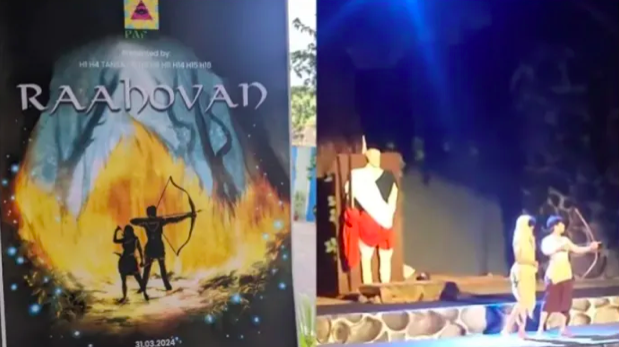
Case Summary
During the Performing Arts Festival (PAF) at IIT Bombay's Open Air Theatre (OAT) on March 31, a controversial play titled 'Raahovan' was performed by a group of students. The play "inspired" by the Ramayana, depicted Lord Ram, Goddess Sita, and Lord Lakshman in a derogatory manner, with vulgar dialogues and gestures. Videos of the play circulated on social media platforms, showcasing scenes where Lord Ram was portrayed as a 'devil' and depicted abusing Goddess Sita. In one scene, Lord Ram was seen accusing Goddess Sita of willingly leaving their hut to go with Ravana, insinuating that she had been "used" by him and would not be accepted back in the kingdom. The portrayal of Goddess Sita responding to Lord Ram's accusations with inappropriate language further deemed disrespectful to Hindu deities and beliefs, sparking outrage among the Hindu community. Some students condemned the play and demanded strict action against those involved. Despite the widespread condemnation, the institute authorities had not issued an official statement regarding the matter at the time of reporting.
Why it is Hate Crime ?
This case is being added to the primary category 'hate speech against Hindus' under 2 sub-categories. The first sub-category is 'subversion of scriptures'. Subverting the religious scriptures of Hindus has particularly devastating consequences. Subversion of the scriptures of Hindus is often done to justify or promote hatred, discrimination, or violence against specific individuals or groups of Hindus. Religious scriptures are often nuanced and those who harbour religious animosity towards Hindus often misquote or misrepresent the scripture to legitimise their animosity and hate towards the faith and its adherents. Any such misquoting of scriptures or subversion to justify hate, violence and discrimination against Hindus owing to religious animosity is hate speech and is categorised as such. The second sub-category is 'anti-Hindu slurs, mocking faith'. Anti-Hindu slurs and the deliberate mocking of the Hindu faith owing to religious animosity involve the usage of derogatory terms, stereotypes, or offensive references to religious practices, symbols, or figures. One of the common anti-Hindu slurs used against Hindus is “cow-worshipper” and “cow piss drinker”. The intention of using this term is to demean and mock Hindus as a group and their religious beliefs since Hindus consider the cow holy. Additionally, some symbols and the slurs attached to them have a historical context that exacerbates the insult, hate, stereotyping, dehumanisation and oppression against Hindus. Cow worship has been used for centuries to denigrate Hindus, insult their faith and oppress Hindus specifically as a religious group. There has been overwhelming documentation about how cow slaughter has been used to persecute Hindus with cow meat being thrown in temples and places of worship. There has also been overwhelming documentation where cow meat (beef) has been force-fed to Hindus to either forcefully convert them to Islam or denigrate their faith. Apart from cow worship, the Swastika – which holds deep religious significance for the Hindus – has also been misinterpreted and distorted to use as a slur against Hindus. Similarly, the worship of the Shivling has been used by supremacist ideologies and religions to denigrate Hindus owing to religious animosity. Such slurs and denigration stem out of inherent animosity and hate towards Hindus and their faith, therefore, it is categorised as hate speech targeted at Hindus specifically owing to their religious identity. In this case, the play, which featured vulgar dialogues and inappropriate gestures, mocked Hindu deities in a way that is deeply offensive to the religious sentiments of Hindus. By portraying Lord Ram as a 'devil' and accusing Goddess Sita of improper conduct with Ravana, the play crossed the boundaries of respectful representation and ventured into sacrilegious territory. Such misrepresentation of sacred figures, particularly in a religious context, is a form of iconoclasm—deliberate disrespect of religious symbols and beliefs and subversion of scriptures which legitimises the dehumanisation of Hindus and delegitimisation of their faith leading to stigmatisation.


Case Status
Unknown


Perpetrators Details
Perpetrators
Others
Perpetrators Range
Unknown
Perpetrators Gender
unknown
 Sources




