Hindus converted to Christianity through inducement and prayer gatherings
 Bara Banki, Uttar Pradesh, India
  17 May, 2025
Case Summary
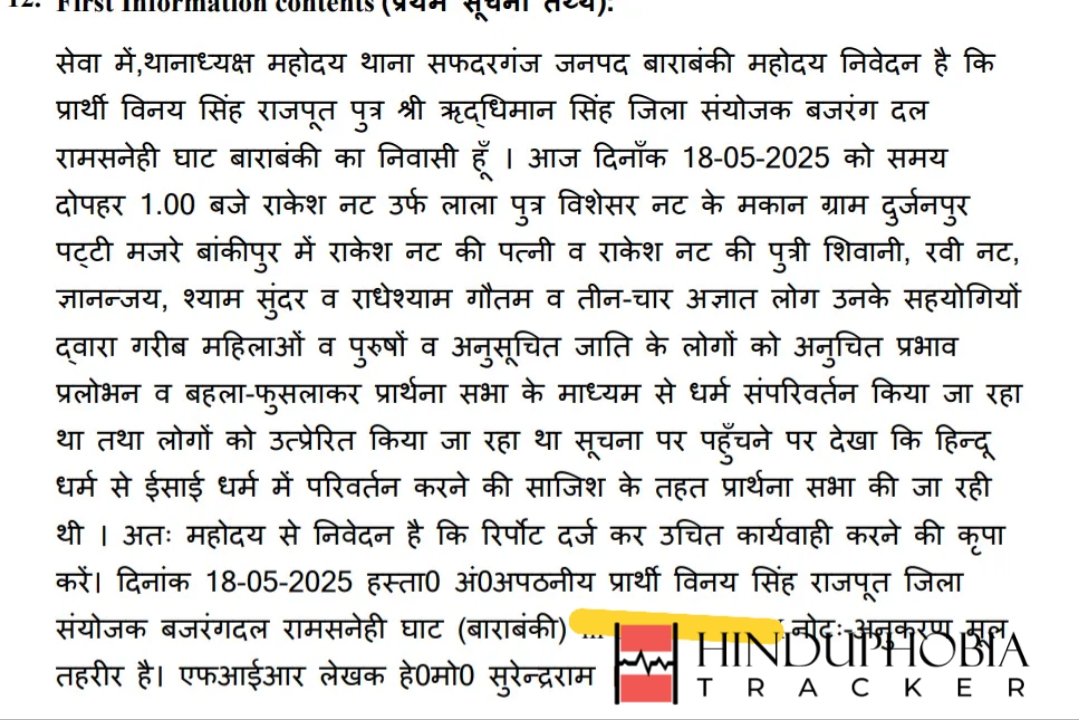
In Bankipur village under Safdarganj police station in the Barabanki district of Uttar Pradesh, a group was gathered on the rooftop of a house conducting conversion activities from Hinduism to Christianity. Hindus who were poor and who were from the Scheduled Cast community were targeted. Police detained 14 individuals and began an investigation. The incident occurred at a house located on the outskirts of Bankipur village under the Safdarganj police station. Members of the Vishwa Hindu Parishad (VHP), while passing by, heard unfamiliar chants from the rooftop and called in other associates. Upon further inspection, the chanting of the word "Hallelujah" was noted, prompting them to alert the police. According to the VHP’s Sirauli block president, the group initially refrained from entering and summoned others to the scene. Members of the Bajrang Dal also joined shortly afterwards. A WagonR car with a Lucknow registration number was found parked nearby, bearing a Christian cross, further raising suspicion. The complaint was filed by Vinay Singh Rajput, son of the late Mrityudhyan Singh, District Coordinator of Bajrang Dal. Hinduphobia tracker has a copy of the FIR, according to which, in village Mamna, Dujanpur Patti, Majre Bankipur, Rakesh Nat alias Lalu (son of Vishesar Nat), along with his wife, daughter Shivali, Ravi Nat, Jananjay, Shyam Sundar, Radheshyam Gautam, and three to four unidentified individuals, were involved in converting poor women, men, and Scheduled Caste individuals through undue influence, inducement, and misleading tactics in the form of a prayer meeting. Upon receiving the information, the complainant, along with others, reached the spot. It was observed that a prayer meeting was being held as part of a conspiracy to convert people from Hinduism to Christianity. Locals stated that this event had been taking place regularly every Sunday for some time. The timing—on a Sunday—was also noted, given its significance in the Christian faith. A few victims reported that they attended the event because they were promised of curing illness. Following the report, local police reached the location and took 14 individuals into custody for questioning. At the time of writing this report, authorities were investigating the extent of conversions carried out and identifying those who may be involved in organising such gatherings. Meanwhile, the family residing in the house denied any involvement in religious conversion.
Case Images
Why it is Hate Crime ?
This case has been added to the tracker un the primary category of - Predatory Proselytisation. The sub-category selected here is - Conversion/attempts to convert by inducement. Predatory Proselytisation is not just limited to threat, harassment, force and violence, but it also has contours of stealth. In several cases, the Hindu victim is exploited to convert, with non-Hindus taking advantage of their poverty. In such cases, the Hindu victim who is suffering financially is offered monetary benefits, including lucrative offers for jobs, health treatment, education, etc, to induce the victim into changing his/her religion. In such cases, the religious identity of the victim and the aim to disenfranchise him from his faith form the heart of the crime. Also, taking advantage of and exploiting an individual’s economic vulnerabilities is widely acknowledged as exploitation, forms of which are often penalised by law. Such cases therefore are considered religiously motivated hate crimes since the victim’s religious identity forms the very heart of the crime itself. The other sub-category selected is - Proselytisation by grooming, brainwashing, manipulation or subtle indoctrination, and within it, the tertiary category selected is - Pattern of targeting Hindus. Religious brainwashing essentially means the often subtle and forcible indoctrination to induce someone to give up their religious beliefs to accept contrasting regimented ideas. Religious grooming or brainwashing also involves propaganda and manipulation. It involves the systematic effort, driven by religious malice and indoctrination, to persuade “non-believers’ to accept allegiance, command, or doctrine to and of a contrasting faith. Cases of such grooming or brainwashing are far more nuanced than direct threats, coercion, inducement and violence. In such cases, it is often seen that there is repeated, subtle and continual manipulation of the victim to induce disaffection towards their own faith and acceptance of the contrasting faith of the perpetrator. While subtle indoctrination is widely acknowledged as predatory, an element which is often understated in such conversions or the attempts of such conversion is the role of loyalty and trust which might develop between the perpetrator and the victim. Fiduciary relationships are often abused to affect such religious conversion. For example, an educator transmitting religious doctrine of a competing faith to a Hindu student. The Hindu student is likely to accept what the teacher is transmitting owing to existence of the fiduciary relationship. The exploitation of the fiduciary relationship to religiously indoctrinate victims would also be included in this category. Since the underlying animosity towards the victim’s faith forms the basis of predatory proselytization, such cases are considered religiously motivated hate crimes. This case qualifies as a hate crime because the victims’ religious identity as Hindus was directly targeted, and the perpetrators employed a calculated strategy to exploit their vulnerabilities for religious conversion. The victims—poor Hindus and members of Scheduled Castes—were chosen based on their economic vulnerability and social standing, and subjected to religious conversion attempts under the guise of prayer meetings. Promises of healing and material benefits were used to lure them into abandoning their faith. The use of subtle yet systematic religious messaging, including chanting associated with Christianity and repeated gatherings on Sundays, points to a broader strategy of indoctrination. When faith is eroded not by open debate or consent, but through sustained emotional manipulation and exploitation of socio-economic dependence, it moves beyond mere conversion and enters the realm of predatory religious targeting. The recurring pattern of targeting Hindus under such pretences is what classifies this case as a religiously motivated hate crime, driven by antagonism towards a Hindu religious identity.


Case Status
Arrested


Perpetrators Details
Perpetrators
Christian Extremists
Perpetrators Range
From 10 to 100
Perpetrators Gender
both
 Sources




