Hindu fruit vendor brutally attacked by Muslim men for supporting India and criticising Pakistan
 Kasganj, Uttar Pradesh, India
  13 May, 2025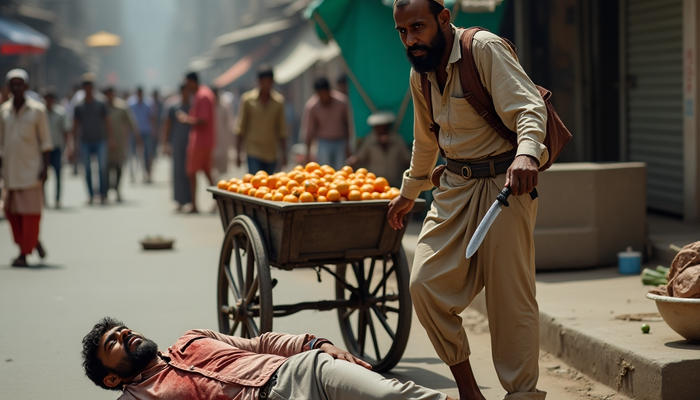
Case Summary
In Kasganj, Uttar Pradesh, a Hindu fruit vendor was violently attacked by two Muslim men after he expressed support for India and criticised Pakistan during a discussion on recent cross-border tensions. The incident occurred amidst heightened emotions following Operation Sindoor, India’s military strike in response to the Pahalgam Hindu massacre, where Hindu tourists were killed for their faith at point-blank range by Pakistan-backed Islamic terrorists and the subsequent Pakistan’s unprovoked retaliatory attacks along the Line of Control (LOC). The vendor’s remarks in support of India’s response to Pakistan’s aggression reportedly enraged the assailants, leading to the brutal assault. The police admitted the blood-soaked victim to the district hospital for medical examination. One of the perpetrators was arrested, while the other fled. Pujari Kushwaha, son of Mishrilal Kushwaha, a resident of Lavkush Nagar in the city, sells fruits from a handcart in the Gandhi Murti area. Chahat Miyan and his brother Guddu, both residents of Bilram, also sell fruits in the same area. When Kushwaha was selling fruits in the morning, Chahat Miyan and his brother arrived. They began discussing Operation Sindoor, and its aftermath, which resulted in Pakistan resorting to unprovoked firings across the Line of Control (LOC) using mortars and heavy-calibre artillery, resulting in 16 civilians being killed, and India responding to these unprovoked strikes. During these discussions, Pujari commented that two women, referring to Wing Commander Vyomika Singh and Colonel Sophia Qureshi of the Indian Army, had taught Pakistan a lesson. He also praised the Indian army and abused Pakistan. These statements enraged Chahat and Guddu. Chahat struck him with a fruit-cutting knife kept on the cart, while Guddu hit him on the head with a two-kilogram iron weight. As a result of the attack, Pujari Kushwaha collapsed to the ground, severely injured and covered in blood. His family members also reached the spot and took him in an injured state to the Kotwali police station. The police then admitted the injured Pujari Kushwaha to the district hospital for medical examination. Inspector Lokesh Bhati stated that the police were investigating the matter based on the fruit vendor’s complaint, and one of the perpetrators was arrested, while the other fled. India carried out ‘Operation Sindoor’ on May 7, 2025, destroying nine terrorist camps in Pakistan in response to the Pahalgam terror attack. The Pahalgam Hindu massacre was a deadly Islamic terrorist attack that took place on April 22, 2025, in the Pahalgam region of Jammu and Kashmir, where Islamic terrorists specifically targeted Hindu tourists, asking their religion before executing them. India strongly condemned this act of Islamic terrorism, particularly emphasising the brutality of targeting people solely based on their religious identity. The military operation was a firm retaliation aimed at dismantling the terror camps in Pakistan harbouring and training Islamic terrorists responsible for the Pahalgam Hindu massacre. Following Operation Sindoor, Pakistan launched unprovoked attacks across the Line of Control (LoC), deploying mortars and heavy-calibre artillery, which led to the death of 16 Indian civilians. Between May 7 and May 10, Pakistan escalated its aggression by orchestrating drone incursions across several locations in the Union Territory of Jammu & Kashmir and the states of Punjab, Rajasthan, and Gujarat. An estimated 300 to 400 drones were deployed to target Indian sites, many of which were successfully intercepted and neutralised by Indian forces. In response to these provocations, India carried out precise and powerful retaliatory strikes aimed at dismantling key Pakistani military assets and terror infrastructure, reaffirming its zero-tolerance stance against cross-border aggression and terrorism.
Why it is Hate Crime ?
This case has been added to the tracker under the primary category of: - Attack not resulting in death. Within it, the sub-category selected is: - Attacked for opposing radicals or trying to save victim. In several cases, Hindus are attacked for opposing religiously motivated crimes being committed against a fellow Hindu or simply for voicing an opinion opposing radical elements, who either have in the past or continue to persecute Hindus. In such cases, the initial attack against the victim, against which the Hindu was trying to defend the victim, would also need to be classified as a religiously motivated hate crime. Since the initial crime itself was religiously motivated, and the subsequent crime of attempting to save the victim or speaking against the radical elements ends up inviting a violent attack, it would also be classified as a religiously motivated hate crime under this category. This incident from Kasganj, Uttar Pradesh, qualifies as a religiously motivated hate crime under the category "attacked for opposing radicals or trying to save a victim", as the Hindu fruit vendor was targeted not for any personal grievance, altercation, or prior enmity, but solely for expressing views that opposed extremist sympathies. The attack was provoked by the vendor's vocal support for the Indian Army's response to terrorism and his condemnation of Pakistan’s actions—a position that directly challenged the ideological leanings of the assailants. His praise for Indian officers who acted against Pakistan-backed terror was met with violent retaliation, indicating that the motive was rooted in religious animosity, rather than a spontaneous personal dispute. This context makes it clear that the attack was not a random act of violence, but a targeted hate crime committed against someone who publicly stood against radicalism. Some may argue that the violent actions of the Muslim assailants in this case were driven more by anti-India and pro-Pakistan sentiments than by direct anti-Hindu animosity. However, attacking a Hindu individual specifically for supporting India and criticising Pakistan reflects not just allegiance to Pakistan, but also a deep-seated hostility toward Hindus. It's important to understand that radical Islamist ideology often harbours targeted animosity toward Hindus and perceives India as a Hindu collectivity. The very basis of the partition of India was that the Muslims believed that Islam was a nation unto itself, which could not survive with a Hindu collectivity like India. Further, Muslims often believe in transnational unity - or the Ummah - which is a belief that all Muslims across the world are a nation unto themselves and therefore, loyalty as far as the nation-state is concerned lies with the Muslim collectivity and not with a Hindu collectivity like India. Therefore, this attack is not merely an expression of geopolitical bias but reflects religiously motivated hate. Targeting a Hindu for supporting India, viewed by extremists as a Hindu collectivity, underscores the anti-Hindu nature of the assault. As such, this incident has been recorded in the hate crime database under the category of attacks driven by opposition to radicalism and religiously motivated animosity.
Victim Details
Total Victim
1
Deceased
0
Gender
- Male 1
- Female 0
- Third Gender 0
- Unknown 0
Caste
- SC/ST 0
- OBC 1
- General 0
- Unknown 0
Age Group
- Minor 0
- Adult 1
- Senior Citizen 0
- Unknown 0


Case Status
Case sub-judice


Perpetrators Details
Perpetrators
Muslim Extremists
Perpetrators Range
From 2 To 5
Perpetrators Gender
male
 Sources




