Hindu temple sanctity violated, Christian and Islamic prayers held at temple entrance in Andhra Pradesh
 Anantapur, Andhra Pradesh, India
  20 December, 2025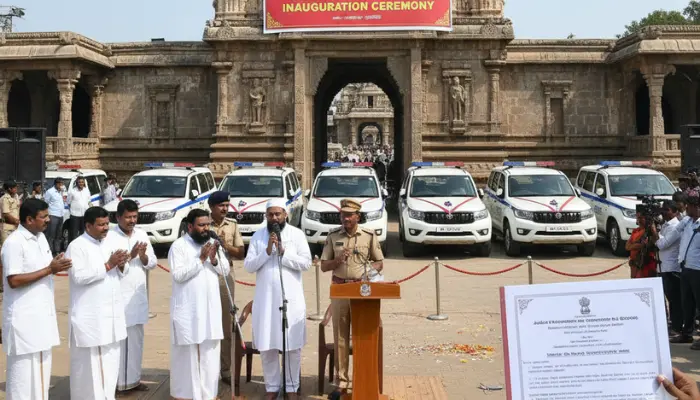
Case Summary
Hindu religious sanctity was violated when non-Hindu religious prayers were conducted at the temple entrance of the centuries-old Kadiri Sri Narasimha Swamy Temple in Andhra Pradesh during an official programme. The incident took place on 21 December 2025 during the inauguration of eight police vehicles and surveillance drones, an event linked to state administration. The programme was facilitated by Kandikunta Venkata Prasad, a sitting Member of the Legislative Assembly from the Telugu Desam Party. Senior state and police officials were present, including S. Satish Kumar. The public safety equipment inaugurated at the event was procured through Corporate Social Responsibility funds. During the ceremony, a Christian pastor and an Islamic cleric recited prayers at the entrance of the temple. This location was not a neutral public space but a consecrated Hindu religious site governed by Agamic traditions and reserved exclusively for Hindu ritual worship. The temple functioned under the Hindu Religious and Charitable Endowments Department of Andhra Pradesh. Visual recordings of the programme circulated publicly, clearly showing non-Hindu religious prayers being conducted at the temple entrance as part of the official event. The programme was organised under the supervision of state authorities. The act violated Andhra Pradesh Government Order Ms Number 746, which explicitly mandated the protection of Hindu temple sanctity and prohibited non-temple religious activities within temple premises.
Why it is Hate Crime ?
This case has been documented under the selected primary category: Attack on Hindu religious representations. Under this, the selected secondary category is: Breaking rules of place of worship. Sanatan Dharma is not a religion of one book, which is to say that while it has religious scriptures that form the central tenets of the faith, there are several traditions followed through thousands of years, mostly passed from generation to generation orally. One of these oral traditions or written traditions is the rules of specific temples. Certain temples have rules which are traditional rules, dependent on the worship of the presiding deities. These rules and traditions have been followed for thousands of years whether they find scriptural mention or not. Such traditions are based on the nature and rules of worship of the presiding deity of that temple. Any non-compliance of these traditions owing to animosity towards the faith or for the sake of activism stems not only from the lack of faith in the presiding deity but also disregard for the faith of the devotees of that deity/temple and implicit bias against the faith, the tradition and the deity itself. Since these specific traditions are central to the faith of the devotees of that specific temple and presiding deity, any non-compliance with these traditional rules would be considered a religiously motivated hate crime. Another secondary category selected is: Defiling religious customs. Sanatan Dharma is not a religion of one book, which is to say that while it has religious scriptures that form the central tenets of the faith, there are several traditions followed through thousands of years, mostly passed from generation to generation orally. There are several such customs and traditions that are followed by various Hindus and Hindu sects. Defiling of these traditions and customs is a breach of an individual or group’s religious practices. Such practices can range from dietary restrictions like not eating non-vegetarian food for a certain period of the year, not eating non-vegetarian food at all, not eating beef since the cow is considered holy in Hinduism, the sanctity of religious customs followed in the house (like many ISCKON devotees), etc. Any malicious action leading to the breach of such traditions or defilement of these traditions owing to animosity towards the faith or for the sake of activism stems not only from the lack of faith in the religion itself but also from disregard for the faith of the devotees who follow the customs/traditions and implicit bias against the faith, the tradition itself. Since these specific traditions are central to the faith of the devotees of that specific sect of Hindus, any non-compliance with these traditional rules would be considered a religiously motivated hate crime. In this case, the location itself was not an ordinary public venue but a consecrated Hindu temple governed by Agamic traditions. The Kadiri Sri Narasimha Swamy Temple existed as a sacred religious space with defined ritual boundaries meant exclusively for Hindu worship. In Hindu practice, the temple entrance was not a neutral threshold but a spiritually significant zone marking the transition into sacred space. Any activity conducted there carried religious meaning, not merely ceremonial value. Secondly, the act involved the recitation of non-Hindu religious prayers by a Christian pastor and an Islamic cleric at the temple entrance. Religious prayers were not symbolic gestures but expressions of specific theological worldviews. Introducing prayers from other faiths into a Hindu temple context disrupted the religious continuity of the space and altered its ritual character. This action directly affected the integrity of Hindu worship practices and diluted the exclusivity of a sacred Hindu site. Thirdly, the event was not private or incidental but an official programme linked to state authority. A sitting Member of the Legislative Assembly facilitated the programme, and senior police officials were present. The presence of state representatives gave institutional legitimacy to the act. When state power intersected with religious activity inside a consecrated space, the responsibility to respect religious boundaries became absolute. Instead of protecting neutrality, the state appeared to endorse the breach of Hindu religious space. Fourthly, the act occurred in violation of the Andhra Pradesh Government Order, which mandated the protection of Hindu temple sanctity and explicitly prohibited non-temple religious activities within temple premises. Legal safeguards existed precisely to prevent such intrusions. The disregard for this order transformed the incident from a cultural lapse into an institutional failure, reinforcing the perception that protections for Hindu religious spaces were treated as negotiable. Fifthly, the asymmetry of religious accommodation was evident. Comparable religious intrusions were not permitted inside churches or mosques during state programmes. The Hindu temple alone was subjected to boundary violations under the justification of inclusivity. This unequal treatment created a pattern where Hindu religious norms were expected to adjust, while other faith spaces remained insulated. Such an imbalance pointed to evident religious bias and prejudice, which arises from an innate animosity against the Hindu faith. Sixthly, the emotional and spiritual impact on Hindu devotees was substantial. Visual recordings of the incident circulated publicly, amplifying the sense of humiliation and injury. For devotees, the temple represented faith, continuity, and collective identity. Seeing their sacred space used for non-Hindu religious invocations under state supervision caused distress, alienation, and a loss of trust in institutions meant to safeguard religious dignity. Finally, when these elements were viewed together, the incident meets the threshold of a religiously motivated hate crime, in effect, if not in explicit intent. A protected religious space was intruded upon, legal protections were disregarded, state authority facilitated the act, and a specific faith community suffered harm because of its religious identity. The cumulative impact targeted Hindu religious practice and dignity, making the incident not merely administrative insensitivity but a form of religious discrimination that inflicted collective harm. Thus, it is added to the tracker. Disclaimer on perpetrator count- The perpetrator count has been recorded as one because responsibility for the event rests with the single authority that organised and permitted the programme at the temple. Although multiple individuals participated in the prayers, the violation occurred due to administrative approval by the organiser. Accordingly, responsibility has been attributed to the primary decision maker rather than all participants.


Case Status
Unknown


Perpetrators Details
Perpetrators
State and Establishment
Perpetrators Range
One Person
Perpetrators Gender
male
 Sources




