Hindu community targeted in organised conversion operation disguised as healing programme in Bikaner, Rajasthan
 Bijnor, Uttar Pradesh, India
  24 December, 2025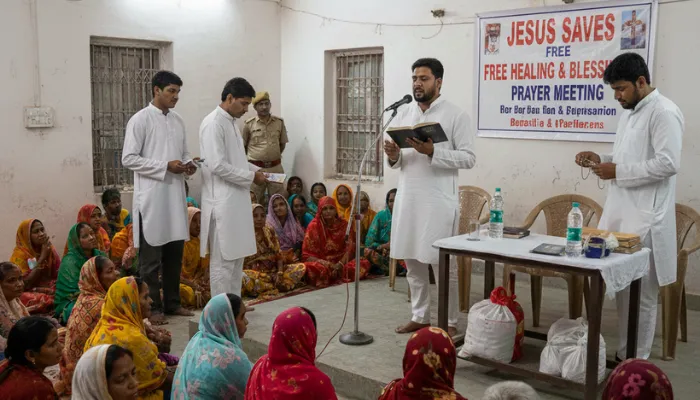
Case Summary
Hindu residents were subjected to an organised attempt at unlawful religious conversion by Christian evangelists inside a private residence in the Momasar village in Shri Dungargarh, Bikaner district in Rajasthan. Late on 25 December 2025, villagers reported that people were being called to the residence under the pretext of curing illnesses and were being pressured to abandon their faith. Following complaints from residents, members of the Vishwa Hindu Parishad and Bajrang Dal arrived early the next morning. They informed police that groups had been gathering at the house, where attendees were influenced in matters of faith under the guise of healing and personal assistance. Activists noted that similar activities had been reported previously but had not been addressed by authorities, allowing organisers to continue their operations. Police reached the premises and found around 31 people present. Based on a written complaint from VHP members, an FIR was registered against three individuals under the Rajasthan Prohibition of Unlawful Conversion of Religion Act. The Station House Officer reported that attendees were being lured under the pretext of healing and pressured into converting, necessitating a formal investigation. As part of the inquiry, police conducted searches and took more than two dozen individuals for questioning at the Shri Dungargarh police station. Hindu activists at the scene reiterated that the programme was deliberately designed to encourage religious conversion under promises of healing, financial support, and personal assistance. Authorities confirmed that the investigation was ongoing to determine whether any unlawful conversion had taken place and to verify the precise nature of the activities at the house. Police action aimed to restore public confidence and ensure that any use of inducement or coercion in matters of faith was thoroughly examined. The incident attracted wider attention amid heightened vigilance by the Rajasthan administration and police over reports of unlawful religious conversion across the state. Law enforcement agencies were instructed to monitor suspicious gatherings and take prompt action wherever undue influence or pressure to change religion was found, underscoring the commitment to protecting the religious rights of Hindu communities.
Why it is Hate Crime ?
This case had been documented under the selected primary category: Predatory proselytisation. Under this, the selected secondary category is: Proselytisation by grooming, brainwashing, manipulation, or subtle indoctrination. Under this, the selected tertiary category is: Pattern of targeting Hindus. Religious brainwashing essentially means the often subtle and forcible indoctrination to induce someone to give up their religious beliefs to accept contrasting regimented ideas. Religious grooming or brainwashing also involves propaganda and manipulation. It involves the systematic effort, driven by religious malice and indoctrination, to persuade “non-believers’ to accept allegiance, command, or doctrine to and of a contrasting faith. Cases of such grooming or brainwashing are far more nuanced than direct threats, coercion, inducement and violence. In such cases, it is often seen that there is repeated, subtle and continual manipulation of the victim to induce disaffection towards their own faith and acceptance of the contrasting faith of the perpetrator. While subtle indoctrination is widely acknowledged as predatory, an element which is often understated in such conversions or the attempts of such conversion is the role of loyalty and trust which might develop between the perpetrator and the victim. Fiduciary relationships are often abused to affect such religious conversion. For example, an educator transmitting religious doctrine of a competing faith to a Hindu student. The Hindu student is likely to accept what the teacher is transmitting owing to existence of the fiduciary relationship. The exploitation of the fiduciary relationship to religiously indoctrinate victims would also be included in this category. Since the underlying animosity towards the victim’s faith forms the basis of predatory proselytization, such cases are considered religiously motivated hate crimes. Another selected secondary category is: Conversion/attempts to convert by inducement. Predatory Proselytisation is not just limited to threat, harassment, force and violence, but it also has contours of stealth. In several cases, the Hindu victim is exploited to convert, with non-Hindus taking advantage of their poverty. In such cases, the Hindu victim who is suffering financially is offered monetary benefits, including lucrative offers for jobs, health treatment, education, etc, to induce the victim into changing his/her religion. In such cases, the religious identity of the victim and the aim to disenfranchise him from his faith form the heart of the crime. Also, taking advantage of and exploiting an individual’s economic vulnerabilities is widely acknowledged as exploitation, forms of which are often penalised by law. Such cases therefore are considered religiously motivated hate crimes since the victim’s religious identity forms the very heart of the crime itself. This particular incident was religiously motivated because the activity was directed exclusively at Hindu residents of Momasar village. The gathering was organised inside a private house in a Hindu-dominated locality, and people from the area were specifically mobilised on the basis of their Hindu identity. The objective was not general outreach but targeted engagement with Hindus, indicating a conscious selection of a religious group for influence and conversion. Secondly, the method used demonstrated deliberate deception. Individuals were invited under the pretext of curing illnesses and offering personal assistance, which masked the true religious nature of the programme. Such misrepresentation removed the possibility of informed consent and transformed the interaction into an act of manipulation. The use of false pretences shows intent to override the religious autonomy of Hindu attendees rather than respect their freedom of belief. Thirdly, inducement and psychological pressure formed the core mechanism of the operation. Promises related to healing, financial support, and personal benefits were used to influence attendees. This exploitation of vulnerability, particularly among economically or physically distressed individuals, reflected a coercive approach aimed at breaking religious resistance rather than encouraging voluntary spiritual inquiry. Fourthly, the presence and display of religious symbols, literature and structured religious messaging confirmed that the gathering was organised for conversion rather than social service. The environment was carefully curated to promote one faith while devaluing the existing beliefs of Hindu participants. This imbalance reinforced a power dynamic where Hindu identity was positioned as something to be abandoned or corrected. Fifthly, the incident caused fear, anxiety and unrest within the Hindu community, which is a defining outcome of hate-motivated acts. Residents felt threatened not merely at an individual level but as a collective, as the activity suggested an organised attempt to alter the religious composition of the locality. The social harm extended beyond those present at the house and affected the wider community’s sense of security. Finally, when examined as a whole, the case met the essential criteria of a religiously motivated hate crime. The organisers targeted Hindus specifically, employed deceit and inducement to undermine their faith, and created an atmosphere of coercion that threatened the religious dignity and freedom of a specific community. The intent, method and impact collectively demonstrated hostility toward Hindu religious identity rather than a neutral or lawful religious exercise. It is thus added to the tracker. Disclaimer: Based on media reports, 31 individuals were recorded as being present at the location. Since the case was registered against three persons, the remaining 28 individuals have been treated as affected victims for documentation purposes. However, there is a strong possibility that the actual number of victims was higher, as the investigation was ongoing and several individuals were taken in for questioning, indicating that the scale of the activity may have extended beyond those formally identified.
Victim Details
Total Victim
28
Deceased
0
Gender
- Male 0
- Female 0
- Third Gender 0
- Unknown 28
Caste
- SC/ST 0
- OBC 0
- General 0
- Unknown 28
Age Group
- Minor 0
- Adult 0
- Senior Citizen 0
- Unknown 28


Case Status
Complaint filed


Perpetrators Details
Perpetrators
Christian Extremists
Perpetrators Range
From 2 To 5
Perpetrators Gender
unknown
 Sources




