Hindus lured with inducements for Christian conversion; women discouraged from applying vermilion and worshipping Hindu deities
 Aurangabad, Bihar, India
  24 December, 2025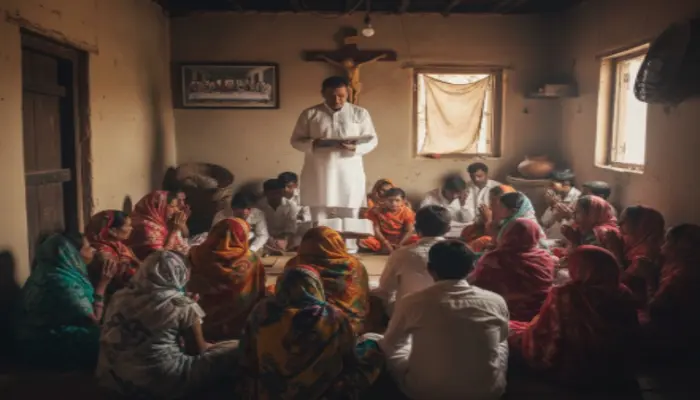
Case Summary
In the Khiriyawan village of Aurangabad district, Bihar, Hindu villagers were targeted for religious conversion and were offered inducements by Christian missionaries under the guise of a healing meeting. According to reports, on 25 December 2025, around two to three hundred Hindus were made to gather at the residence of Dr Ramnandan Goswami. The Christian missionaries had organised a religious gathering under the guise of a satsang, where illegal religious conversion activities were taking place. Local villagers became aware of the nature of the gathering and began protesting, escalating tensions in the area. They also informed the police, following which Panchayat head representative Ranjit Yadav and Sarpanch representative Sushil Kumar Singh also reached the spot. During the commotion, several Hindu women and young girls attempted to leave the premises. Members of Vishwa Hindu Parishad and Bajrang Dal, two Hindu organisations, including provincial cow protection department head Dr Sant Prasad, district co-minister Naveen Pathak and Bajrang Dal representative Hrithik Kumar, arrived and opposed the ongoing conversion activity. Sub-Inspector Laxman Prasad of Madanpur police station reached the scene with his team, arrested two Christians, one woman and one man, and took them to the police station for questioning. As of the date of writing this report, the investigation was ongoing. Hindu activists revealed that vulnerable villagers across the district had been targeted for conversion through offering inducements such as money, medical assistance and education, and that Hindu women were discouraged from observing Hindu religious practices, including applying vermilion and worshipping deities. It was stated that a similar programme had been organised at the same location the previous year, which was halted following local opposition, after which the administration had assured action. Naveen Pathak, a Hindu activist, stated that poor and Dalit Hindu communities were specifically targeted, with people encouraged to believe in faith healing and exorcism and promised cures for illnesses as part of the conversion process. A local resident, Randhir Sav, said that healing meetings (Changai Sabha) were held every Wednesday to push people towards conversion and expressed concern that, despite the absence of any Christian families in the village, individuals were being brought in from outside to facilitate these conversions.
Why it is Hate Crime ?
This case is documented under the primary category: Predatory Proselytisation. The first subcategory is: Proselytisation by grooming, brainwashing, manipulation or subtle indoctrination. Under this, the tertiary category selected is: Pattern of targeting Hindus. Religious brainwashing essentially means the often subtle and forcible indoctrination to induce someone to give up their religious beliefs to accept contrasting regimented ideas. Religious grooming or brainwashing also involves propaganda and manipulation. It involves the systematic effort, driven by religious malice and indoctrination, to persuade “non-believers’ to accept allegiance, command, or doctrine to and of a contrasting faith. Cases of such grooming or brainwashing are far more nuanced than direct threats, coercion, inducement and violence. In such cases, it is often seen that there is repeated, subtle and continual manipulation of the victim to induce disaffection towards their own faith and acceptance of the contrasting faith of the perpetrator. While subtle indoctrination is widely acknowledged as predatory, an element which is often understated in such conversions or the attempts of such conversion is the role of loyalty and trust which might develop between the perpetrator and the victim. Fiduciary relationships are often abused to affect such religious conversion. For example, an educator transmitting religious doctrine of a competing faith to a Hindu student. The Hindu student is likely to accept what the teacher is transmitting owing to existence of the fiduciary relationship. The exploitation of the fiduciary relationship to religiously indoctrinate victims would also be included in this category. Since the underlying animosity towards the victim’s faith forms the basis of predatory proselytization, such cases are considered religiously motivated hate crimes. The other sub-category selected here is - Conversion/ attempts to convert by inducement. Predatory Proselytisation is not just limited to threat, harassment, force and violence, but it also has contours of stealth. In several cases, the Hindu victim is exploited to convert, with non-Hindus taking advantage of their poverty. In such cases, the Hindu victim who is suffering financially is offered monetary benefits, including lucrative offers for jobs, health treatment, education, etc, to induce the victim into changing his/her religion. In such cases, the religious identity of the victim and the aim to disenfranchise him from his faith form the heart of the crime. Also, taking advantage of and exploiting an individual’s economic vulnerabilities is widely acknowledged as exploitation, forms of which are often penalised by law. Such cases therefore are considered religiously motivated hate crimes since the victim’s religious identity forms the very heart of the crime itself. The other sub-category selected here is - Attempting to convert/converting by denigrating Hinduism. In several cases, Hindus are converted or an attempt is made to convert Hindus by denigrating their faith, Hinduism. In such cases, the Hindus associate with the non-Hindu perpetrators often by choice and then, the attempt to convert them by insulting their faith, showing the faith down etc begins. An example of this would be a non-Hindu gathering where the Hindus are attending the gathering of their own free will. However, once they attend the gathering, there is an explicit attempt to convert them by abusing their faith and hailing the faith of the perpetrator. The denigration of the Hindu faith is often based on misrepresentation of the Hindu faith, its doctrine and scriptures and insult to espoused traditions if not blatant lies about Hindu beliefs and ways. Such conversions or attempts at conversions are driven by animosity towards the Hindu faith and are therefore documented as religiously motivated hate crimes. This case has been added to the tracker because Hindu villagers were targeted for forced conversion and offered inducements by Christian missionaries under the guise of a healing meeting. Firstly, what was presented as a simple satsang or a religious gathering inside a private residence was in reality a covert attempt at religious conversion. The gathering was not a genuine community prayer meeting but a calculated effort to exploit the trust of Hindu villagers and influence them into abandoning their faith. By conducting such gatherings, the Christian perpetrators sought to manipulate vulnerable Hindus, taking advantage of their emotional and social circumstances to push them towards conversion. Such acts are a result of deep-seated animosity towards Hindus and their faith, making it a religiously motivated crime. Secondly, a local Hindu resident also stated that healing meetings (Changai sabha) were also held to push Hindus towards conversion. The Changai Sabha format, often described publicly as a faith healing gathering, is a well-recognised tool in organised Christian proselytisation networks. These meetings usually employ songs, testimonies and emotionally charged prayer sessions to influence and induce vulnerable individuals without openly declaring the underlying objective, religious conversions. The absence of transparency is itself central to the method. People attend believing they are seeking comfort, healing or spiritual support, only to be gradually drawn into teachings that undermine their own religious identity and introduce them to the Christian framework presented as the only path to relief. Thirdly, it was also revealed that Hindus were offered inducements in the form of money, medical assistance and education. Offering incentives or making false promises, especially when directed at vulnerable individuals in need, shows that these incentives are not acts of kindness or charity. Instead, they are calculated moves to exploit vulnerable Hindus because of their religion. By providing inducements or promising healing in exchange for conversion, the accused were effectively blackmailing those who might have been desperate for assistance or hope. Such instances are seen in many cases where members of Christian missionary groups target socially and economically vulnerable Hindus to further their agenda of religious conversions. This form of coercion strips people of their agency and dignity and results in coerced conversions. These are not random or isolated incidents, but rather cases deeply rooted in religious animosity towards Hindu victims. Fourth, it was also revealed that Hindu women were discouraged from observing Hindu religious practices, including applying vermilion and worshipping deities. Asking Hindu women to remove vermilion or stop worshipping deities was not a casual request but a calculated attempt to strip them of their Hindu identity, both symbolically and spiritually. By forcing them to erase these sacred signs, the perpetrators enacted a ritualised denigration of Hindu womanhood and the domestic-cultural continuity it represents. Such acts convey the implicit message that Hindu symbols are inferior or impure, and that spiritual legitimacy can only be achieved through the acceptance of another faith. Furthermore, prohibiting Hindus from worshipping deities was a brutal act that constituted a clear instance of the denigration of their Hindu faith and beliefs, directly attacking their religious sentiments. Banning veneration of beloved gods and goddesses, central to daily prayers, aarti, and life milestones, severed their spiritual lifeline, humiliating them and enforcing alien practices that clashed with their Hindu identity. The Christian faith, by its very theological foundations, places a strong emphasis on proselytisation. In pursuit of conversion objectives, Christian evangelists often employ unethical means, ranging from psychological pressure and misinformation to inducements such as money or jobs. Such acts are deeply rooted in religious animosity towards Hindu victims, and thus, this case is being added to the hate crime database of the tracker. Disclaimer: Media reports stated that around 300 Hindu villagers, including men and women, were targeted for conversion in Khiriyawan village of Aurangabad district, Bihar, but no gender-wise breakdown was provided. For documentation clarity, the Hinduphobia Tracker has applied a proportional demographic estimate based on India’s Census 2011 and NFHS-5 (2019–21) rural population data. Accordingly, the 300 participants are estimated as 150 men (50%) and 150 women (50%), reflecting an equal gender distribution consistent with typical rural family demographics.
Victim Details
Total Victim
300
Deceased
0
Gender
- Male 150
- Female 150
- Third Gender 0
- Unknown 0
Caste
- SC/ST 0
- OBC 0
- General 0
- Unknown 300
Age Group
- Minor 0
- Adult 0
- Senior Citizen 0
- Unknown 300


Case Status
Arrested


Perpetrators Details
Perpetrators
Christian Extremists
Perpetrators Range
From 2 To 5
Perpetrators Gender
both
 Sources




