Hindus subjected to temple demolition threats by Christian preacher for opposing illegal conversions
 Ooty, Tamil Nadu, India
  22 December, 2025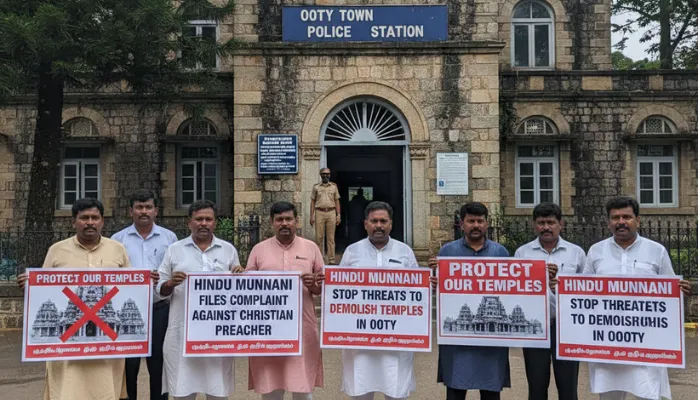
Case Summary
In the Nilgiris district of Tamil Nadu, Hindus faced threats of demolition of Hindu temples from a Christian preacher, Dinakaran. This happened because Hindus opposed illegal Christian prayer meetings, where Dalit Hindus were being converted to Christianity under the guise of attending religious prayer gatherings. When Hindus opposed this, the pastor issued threats to demolish Hindu temples. This occurred in Kasturibai Colony, Ooty, a predominantly Scheduled Caste Hindu residential area that had two longstanding temples serving as the heart of community life and the spiritual identity of the residents. The accused Dinakaran conducted illegal prayer meetings and lured Hindus under the pretext of prayer meetings to convert to Christianity. Despite repeated objections and formal complaints to the police, Dinakaran and his associates entered the area multiple times to conduct gatherings, disturbing the daily life and religious harmony of the Hindu community. The situation escalated when Dinakaran returned once again to conduct another prayer meeting. Hindu residents confronted him and his group, emphasising that the locality already had established temples and that such gatherings were unwelcome. During the confrontation, the accused and his group threatened to mobilise a large crowd and demolish the two Hindu temples to make way for their prayers. This direct threat to Hindu places of worship created alarm and heightened tensions in the colony. In response, office-bearers of Hindu Munnani, a Hindu organisation, together with local residents, submitted a formal complaint at the Ooty West Police Station on 23rd December 2025, detailing the repeated disturbances, the intimidation faced by Hindu families, and the threat to destroy their temples. Police officials confirmed receipt of the complaint and stated that the matter would be investigated under the law. At the time of reporting, Dinakaran and his associates had not issued any response, while Hindu residents continued to demand firm protection for their temples, their faith, and the peace of their community.
Why it is Hate Crime ?
This case has been added to the primary category- Hate Speech against Hindus. The secondary category selected is- Violent Threats. Violent threats, explicit, implicit or implied, is the most dangerous form of hate speech since it goes beyond discriminatory and prejudicial language to express the intent of causing harm to an individual or a group of people based on their religious identity and faith. There could be several different kinds of threats that are issued to Hindus based on religious animosity. An explicit threat would mean the direct threat of violence towards an individual Hindu, a group of Hindus or Hindus at large. Physical violence, death threats, threats of destruction of property belonging to Hindus and threats of genocide would mean explicit threats against Hindus for their religious identity. Implicit threats may not be a direct threat but implied through the use of symbols of actions – for example – in the Nupur Sharma case, other than explicit threats, there were also implicit threats when Islamists took to the streets to burn and beat her effigies. It implies that they want to do the same to Nupur Sharma – thereby is considered an implicit threat. Violent threats can be delivered in person, through letters, phone calls, graffiti, or increasingly through social media and other online platforms. It would be important to understand that a threat – explicit or implicit, online or offline – to an individual who happens to be a Hindu does not qualify as a religiously motivated threat. Such a threat, while vile and dangerous, could be owing to non-religious reasons and/or personal animosity. To qualify as a religiously motivated threat, it would need to exhibit an indication that the individual is being targeted for religious reasons and/or owing to his/her religious identity as a Hindu. Another primary category selected is: Predatory Proselytisation. Under this, the chosen secondary category is: Proselytisation by grooming, brainwashing, manipulation or subtle indoctrination. Under this, the chosen tertiary category is: Pattern of targeting Hindus. Religious brainwashing essentially means the often subtle and forcible indoctrination to induce someone to give up their religious beliefs to accept contrasting regimented ideas. Religious grooming or brainwashing also involves propaganda and manipulation. It involves the systematic effort, driven by religious malice and indoctrination, to persuade “non-believers’ to accept allegiance, command, or doctrine to and of a contrasting faith. Cases of such grooming or brainwashing are far more nuanced than direct threats, coercion, inducement and violence. In such cases, it is often seen that there is repeated, subtle and continual manipulation of the victim to induce disaffection towards their own faith and acceptance of the contrasting faith of the perpetrator. While subtle indoctrination is widely acknowledged as predatory, an element which is often understated in such conversions or the attempts of such conversion is the role of loyalty and trust which might develop between the perpetrator and the victim. Fiduciary relationships are often abused to affect such religious conversion. For example, an educator transmitting religious doctrine of a competing faith to a Hindu student. The Hindu student is likely to accept what the teacher is transmitting owing to existence of the fiduciary relationship. The exploitation of the fiduciary relationship to religiously indoctrinate victims would also be included in this category. Since the underlying animosity towards the victim’s faith forms the basis of predatory proselytization, such cases are considered religiously motivated hate crimes. Another selected primary category is: Attack not resulting in Death. Under this, the selected secondary category is: Attacked for opposing radicals or trying to save victim. In several cases, Hindus are attacked for opposing religiously motivated crimes being committed against a fellow Hindu or simply for voicing an opinion opposing radical elements, who either have in the past or continue to persecute Hindus. In such cases, the initial attack against the victim, against which the Hindu was trying to defend the victim, would also need to be classified as a religiously motivated hate crime. Since the initial crime itself was religiously motivated and the subsequent crime of attempting to save the victim or speaking against the radical elements ends up inviting a violent attack, it would also be classified as a religiously motivated hate crime. Under this category, cases where the attack led to the death of the Hindu victim/s would be documented. This case exemplifies a blatant religiously motivated hate crime, as the Christian pastor Dinakaran issued violent threats to demolish Hindu temples in Nilgiris district, Tamil Nadu, simply because local Hindus resisted his illegal prayer meetings aimed at converting them to Christianity. Temples are not mere physical structures for Hindus; they pulse with divine life, standing as sacred sanctuaries where devotees gather for rituals, festivals, and solace that anchor their very identity and religious bonds. By vowing to raze these holy sites by mobilising crowds to erase them from the landscape, Dinakaran, the Christian preacher, laid bare his deep-seated animosity towards the Hindu faith, retaliating against those defending their spiritual heritage. This violent response to opposition reveals a calculated intent to intimidate and dominate, marking it as undeniable anti-Hindu hatred fuelled by religious bigotry. The accused's acts went deeper: he lured vulnerable Scheduled Caste Hindus in Kasturibai Colony, Ooty, into his gatherings under the guise of prayer meetings, manipulating them to abandon their ancestral faith for Christianity. These were no benign assemblies; they formed part of a pattern of coercive conversions that stripped Hindus of their faith, traditions, preying on trust to erode Hindu devotion from within. When residents pushed back by lodging complaints and confronting him to protect their community, the accused escalated with threats to demolish their longstanding temples, turning defence into a trigger for vengeance. This manipulation, followed by violent ultimatums, screams religious vendetta, targeting Hindus not for any crime, but for safeguarding their right to worship freely. When Hindus stood firm against these forcible conversions disguised as prayer meetings, Dinakaran's retort was to threaten wholesale destruction of their temples by rallying a mob, a direct assault on their sacred spaces and sentiments born of mere resistance to predatory proselytising. Protecting one's faith and community from such encroachments should never invite annihilation; yet here, the accused weaponised religious difference to bully and terrorise, punishing Hindus for shielding others from radical Christian overreach. This backlash against self-preservation underscores the hate crime's core: an attack on Hindu resilience and identity, driven by religious intolerance that demands submission. Given that this incident meets the parameters of a religiously motivated hate crime, it has been added to the Hinduphobia Tracker's hate crime database. Disclaimer: The Hinduphobia Tracker records incidents based on when the crime occurred, rather than when the media reports it. In this case, media reports did not specify the exact date of the crime. Hindu organisations filed the police complaint on 23 December 2025, so this date serves as the indicative date of the incident. This is selected for documentation purposes only.


Case Status
Complaint filed


Perpetrators Details
Perpetrators
Christian Extremists
Perpetrators Range
One Person
Perpetrators Gender
male
 Sources




