Anti-Hindu prejudice: Western media outlet downplays and whitewashes murder of Hindu man over false blasphemy allegation
 United States
  21 December, 2025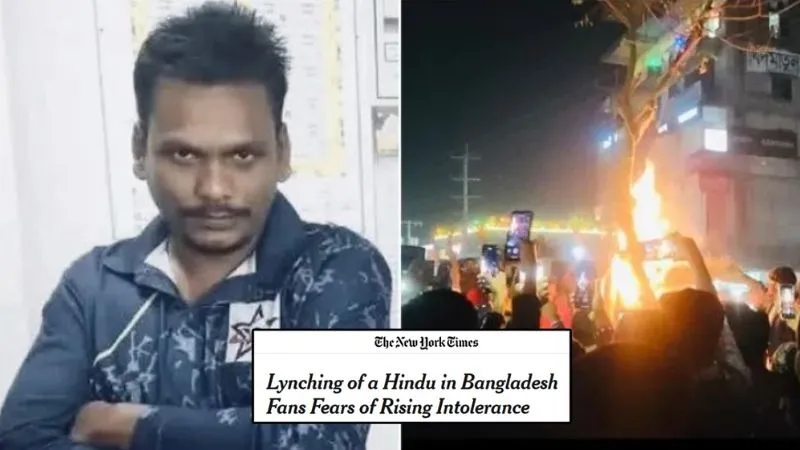
Case Summary
The brutal murder of Hindu man Dipu Chandra Das, whom a Muslim mob lynched in Bangladesh over a fake blasphemy allegation, received downplayed and whitewashed coverage from Western news outlets such as the New York Times (NYT). Dipu Chandra Das, a young Hindu textile factory worker in Mymensingh, Bangladesh, was brutally assaulted by a Muslim mob over a false allegation of blasphemy. His body was hanged from a tree and burnt by the mob. A video of the brutal incident surfaced on 18th December 2025. Foreign media, which typically promotes the Muslim victimhood narrative, stayed silent on this. Several days later, on 22nd December 2025, the American media organisation, the New York Times, published an article on the murder of Dipu Chandra Das. The New York Times became the first foreign media outlet to cover the brutal murder of the Hindu youth in Bangladesh. However, this coverage followed an anti-Hindu narrative that avoided portraying Muslims perpetrators as the oppressors. The New York Times article, written by Saif Hasnat and Mujib Mashal, cleverly targeted India with false comparisons. While highlighting atrocities against a Hindu, it portrayed Hindus in India as oppressors and spared blame for the Muslim perpetrators who killed Dipu. The headline of the NYT article, "Lynching of a Hindu in Bangladesh: Fans Fear of Rising Intolerance," revealed its agenda. The brutal murder of a Hindu youth underwent distortion and portrayal as part of a larger pattern of religious intolerance in South Asia. The article employed a play on words to discuss fear spread across South Asia by "religious intolerance." This implied that religious intolerance extended beyond Muslims; all of South Asia grappled with it. Muslims themselves fell victim. The article downplayed the murder of a Hindu youth by a Muslim mob, yet blamed the entire South Asia for such incidents. The New York Times, which often promotes the Muslim-victimhood agenda, refrained from identifying the killers of Dipu as "Muslims." It stated that Dipu Das was targeted and attacked by his "co-workers." Dipu Das was killed for allegedly insulting the Prophet Muhammad. The New York Times, however, presented this as fact, noting that Muslims retaliated by killing a Hindu man for commenting on their religion. The New York Times wrote, “But this brutal killing, which occurred amid a wave of riots and mob violence, raised concerns about the tense leadership vacuum that persisted in Bangladesh since student-led protests ousted an authoritarian prime minister last year.” The New York Times obscured crimes committed by Muslims within the protests in Bangladesh. It refused to acknowledge that Islamic fundamentalist ideology drove these acts and that Hindus faced ongoing persecution in Bangladesh. The New York Times dragged India into its agenda-driven article, stating, “Hindu vigilante groups in India targeted Muslims and other minorities, particularly those accused of possessing beef.” It cited this example: “A migrant worker suffered a beating to death by a mob in southern India last week. Police say the mob mistook him for a Bangladeshi—India’s ruling Hindu nationalist politicians refer to Muslim migrants as Bangladeshis. Ram Narayan Baghel, 31, came from the lowest rung of India’s rigid caste system.” Here, the New York Times cited one example to claim Hindus acted as oppressors, while ignoring Bangladeshi infiltrators who illegally enter and reside in India through fake identity cards, and usurp privileges meant for Indians. While the New York Times failed to identify the accused in the murder of a Hindu youth in Bangladesh as Muslim, it defamed the entire Hindu community in one instance. The New York Times reported very late on the brutal murder of Hindu youth Dipu Chandra Das in Bangladesh. It pursued its agenda in the story, pushing its narrative instead of focusing on the Hindu community. In conclusion, regarding Dipu Das's murder in Bangladesh, the New York Times avoided calling the attackers a "Muslim mob," despite this being true.
Why it is Hate Crime ?
The primary category selected in this case is- Hate Speech against Hindus. The subcategory selected is- Anti-subversion and prejudice. The tertiary category selected is- Anti-Hindu fake news or downplaying. Hate speech is defined as any speech, gesture, conduct, writing, or display that is prejudicial against a specific individual and/or group of people, which is leading to or may lead to violence, prejudicial action or hate against that individual and/or group. Media plays a specific and overarching reach in perpetuating prejudicial attitudes towards a community owing to unfair, untrue coverage and/or misrepresentation/misinterpretation, selective coverage and/or omission of facts of/pertaining to issues affecting a specific religious group. This type of bias can dehumanise the victim group, making it easier for others to justify harmful actions against them, which aligns with the objectives of hate speech laws aimed at preventing such harm. It is often observed that the media takes a prejudicial stand against the Hindu community driven by their need to shield the aggressor community which happens to be a numeric minority, however, is the one perpetrating violence against Hindus. For example, the media is often quick to contextualise religiously motivated crimes against Hindus, omit or misrepresent facts that point towards religiously motivated hate crimes, justify and/or downplay religiously motivated hate crimes or simply present fake news to stereotype Hindus. Such media bias leads to the denial of persecution and is often used to dehumanise Hindus, leading to justification for violence against them. For example, the media covered several fake allegations of Hindus targeting Muslims and forcing them to chant Jai Shree Ram. Most of these cases were proved false and fabricated after police investigation. These fake news reports were subsequently never retracted or clarified. Such fake news led to the justification of violence and dehumanisation of Hindus based on the argument that since Hindus targeted Muslims and forced them to chant Jai Shree Ram, the dehumanisation of Hindus and violence against them was par for the course and merely a retaliation. Such media bias leads to prejudicial portrayal of Hindus and offers a justification for violence against them and therefore, is considered hate speech under this category. Dipu Chandra Das faced selective targeting solely for his Hindu identity when a violent Muslim mob in Bangladesh beat, burned, and killed him over a fabricated blasphemy allegation on 18th December 2025. This young Hindu textile worker from Mymensingh endured lynching, his body hung from a tree and set ablaze, in a textbook case of religiously motivated violence perpetrated by Muslim extremists driven by Islamist ideology that demands lethal retribution for perceived insult against Islam. Instead of reporting this unvarnished truth and condemning the Islamist aggression against vulnerable Hindu minorities in Bangladesh, the New York Times deliberately launched anti-Hindu propaganda, systematically downplaying the brutality and whitewashing the Muslim perpetrators to shield them from accountability. The New York Times framed Dipu Chandra Das's horrific murder as merely raising alarms about vague "religious intolerance" across the entire South Asia region, wilfully ignoring that this savagery unfolded exclusively in Bangladesh amidst rising anti-Hindu pogroms. This insidious tactic lumped the targeted killing of a Hindu man with unrelated events elsewhere, drawing grotesque false equivalences by dragging in isolated incidents from India to dilute focus on Bangladesh's systemic Hindu persecution. Such calculated fact-twisting minimised the gravity of Hindu victimhood, steadfastly avoiding any assertion that Dipu died explicitly because of his Hindu identity, and instead recast the lynching as just one symptom of generic regional intolerance that somehow implicates Hindus universally. The New York Times refused to identify the perpetrators clearly as Muslim extremists or a rampaging Muslim mob, euphemistically labelling them Dipu's innocuous "co-workers" despite video evidence showing a religiously charged frenzy. This deliberate obfuscation concealed Muslim perpetrators committing brazen, religiously motivated crimes against Hindus, protecting Islamist aggressors while systematically erasing Hindu victims like Dipu from the narrative's centre. Rumours spread that Dipu abused Prophet Muhammad, but no evidence ever supported this claim—it emerged as a proven false pretext for mob violence—yet the New York Times uncritically ran with the narrative, shielding Islamist aggression, minimising the brutal, religiously motivated killing of an innocent Hindu man, and thereby engaging in its own form of religiously motivated hate speech against Hindus. The New York Times displayed blatant double standards by aggressively highlighting "Hindu vigilantes" in India with condemnatory vigour, amplifying rare incidents to demonise the entire Hindu community, while soft-pedalling the Muslim mob that savagely killed Dipu as mere faceless colleagues unworthy of scrutiny. This pernicious framing positioned Muslims perpetually as hapless victims of Hindu aggression and cast Hindus as inherent perpetrators, exposing the outlet's deep-seated prejudice against Hinduism and the global Hindu community. Such selective outrage, narrative inversion, and consistent prioritisation of Islamist protection over Hindu lives constituted clear religiously motivated hate speech that dehumanises Hindu victims and emboldens their persecutors. This case meets all parameters of religiously motivated hate speech and has been added to the Hinduphobia Tracker's hate crime database.


Case Status
Unknown


Perpetrators Details
Perpetrators
Others
Perpetrators Range
Unknown
Perpetrators Gender
unknown
 Sources




