Hindu father-son duo religiously-profiled, brutally attacked and threatened with death/- by Muslim man in Gujarat
 Khambhat, Gujarat, India
  20 December, 2025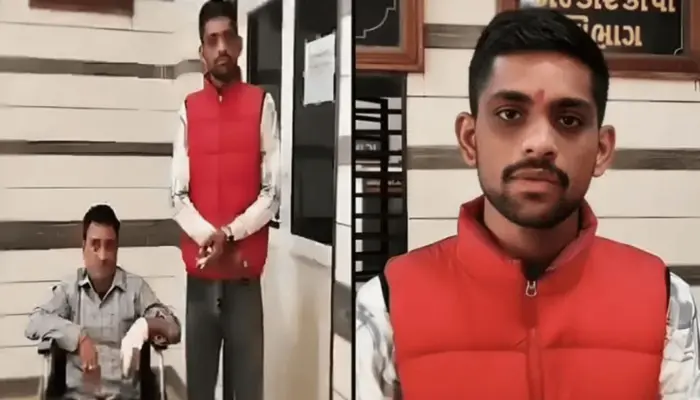
Case Summary
In the Peeth Bazaar area of Khambhat city, Gujarat, a Hindu father and son were religiously profiled and stabbed inside their shop by a Muslim man named Moinuddin Syed. While carrying out the attack, the accused declared that his father, Sajjad Hussain, had told him to kill members of the Rawal Hindu community. According to reports, on 21 December 2025, the victim, Nihal Rawal, who ran Chamundha General Store, was sitting with his father, Sanjaybhai, at their shop, minding their business, when the accused, Moinuddin Syed, entered the shop holding a knife and began abusing them. During the attack, the accused shouted that his father, Sajjad Hussain, had instructed him to kill two or three members of the Rawal Hindu community. The accused then attempted to stab Nihal, who managed to block the assault by pushing the shop counter forward. When Moinuddin attacked again, Sanjaybhai intervened with a chair, but the knife still struck his left hand, causing bleeding. Local people gathered soon after, and Moinuddin was apprehended and taken to his home. During this time, Moinuddin’s father, Sajjad Hussain, brother, Mohammad Sohaib, and mother, Tejbibanisha Sajjadhusain Syed, began threatening the victim’s family. At the police station, Sajjad Hussain openly threatened Nihal Rawal, declaring that his son would roam freely with a knife, and warned that Nihal would be killed if he pursued the complaint, all of which was recorded in the FIR. Based on the complaint filed by the victim, the Khambhat City Police registered cases against Moinuddin and his family members under multiple sections of the IPC and the Gujarat Police Act and initiated further investigation. The victim also revealed that Moinuddin had previously attacked Kamlesh Rawal, Anil Rawal and Gopalbhai Rawal, and that he had assaulted around six individuals in total, all belonging to the Hindu Rawal community, establishing a clear pattern of repeated targeting of the members of the Hindu community. However, several media reports claimed that Moinuddin was mentally unstable. Nihal Rawal stated that Moinuddin’s conduct, speech and movements were normal and purposeful, and that his actions showed deliberate targeting rather than random violence. He pointed out that if Moinuddin were genuinely mentally unstable, he would have attacked indiscriminately, including members of his own family or nearby Muslims, which never happened, as every attack was directed solely at members of the Rawal Hindu community.
Why it is Hate Crime ?
The primary category selected in this case is- Attack not resulting in death. The subcategory selected is- Attacked for Hindu identity. In several cases, Hindus are attacked merely for their Hindu identity without any perceived provocation. A classic example of this category of religiously motivated hate crime is a murder in 2016. 7 ISIS terrorists were convicted for shooting a school principal in Kanpur because they got ‘triggered’ seeing the Kalava on his wrist and tilak that he had put. In this, the Hindu victim had offered no provocation except for his Hindu religious identity. The motivation for the murder was purely religious, driven by religious supremacy. Such cases where Hindus are targeted merely for their religious identity would be documented as a hate crime under this category. The case has been added to the tracker because of the deliberate and targeted nature of the attacks against members of the Rawal Hindu community. The accused did not commit a random act of violence; he specifically entered the shop of Nihal Rawal with a knife and shouted that his father, Sajjad Hussain, had instructed him to kill two or three members of the Rawal Hindu community. This declaration makes the religiously motivated nature of the crime evident, as it shows premeditation based on the victims’ religious identity rather than a personal dispute or spontaneous altercation. The accused attempted to stab Nihal and his father, demonstrating a willingness to inflict serious physical harm. Furthermore, the accused had assaulted at least three other members of the Hindu community, Kamlesh Rawal, Anil Rawal, and Gopalbhai Rawal, all from the Rawal Hindu community, underlining the religion-based targeting. This repeated targeting confirms that his intent was not random or personal but focused solely on members of the Hindu Rawal community, highlighting the communal and ideologically motivated character of the attacks. Additionally, when Nihal attempted to file a complaint at the police station, Moinuddin’s father, Sajjad Hussain, openly threatened the victim, warning that his son would roam freely with a knife and that he would kill Nihal if he pursued the complaint. These actions were aimed not only at preventing legal recourse for the immediate victims but also at intimidating and silencing the wider Hindu community, creating an atmosphere of fear and subjugation. The threats, combined with repeated attacks, indicate that the goal was not merely to assault individual Hindus but to terrorise a community based on its religious identity. This case also reflects a recurring pattern in communal incidents targeting Hindus, where the perpetrator is portrayed as “mentally unstable” by the media or the police. The police and the media, in many such cases, where the crime has been committed against the Hindu faith by a non-Hindu perpetrator, deny that the crime committed was in any way motivated by a religious bias and attribute it to the perpetrator’s mental health. Many a time, the police downplay incidents of low-level communal crime because it is their jurisdiction that comes under question. The police also often say that the crime was committed since the accused was mentally unstable, because they wish to ensure that, owing to the crime already committed, there is no further flare-up in the area. In fact, there are many cases where this strategy has been used by the media to downplay such incidents where the crime was committed by a Muslim perpetrator, for example, the attack on the Gorakhnath temple or the incident in Telangana where two Muslim women wearing a burqa tried to damage temple and church idols. The use of the "mental illness" trope to justify crimes targeting Hindus by Muslim perpetrators raises critical questions. If the perpetrator, in this case, was indeed mentally unstable, why did he specifically targeted Rawal Hindu community? This selective focus suggests that such acts are not driven by mental health issues but by religious animosity. The repeated use of this narrative to downplay crimes against Hindus reflects a strategic effort to whitewash religious hatred, obscuring the true motivations and intentions behind the attacks. Taken together, the targeted assaults, the explicit communal declarations during the attack, and the threats made to prevent the victims from seeking justice all demonstrate that the incident was motivated by religious hatred against Hindus. It constitutes a calculated attempt to harm, intimidate, and instil fear in the Hindu community. Such actions are motivated by religious animosity against Hindus; therefore, this case has been added to the hate crime database of the tracker. Disclaimer: Media reports stated that the accused attacked approximately six different individuals from the Rawal community. Therefore, the victim count in this case has been recorded as '6', including Nihal Rawal and his father, Sanjaybhai Rawal.
Victim Details
Total Victim
6
Deceased
0
Gender
- Male 6
- Female 0
- Third Gender 0
- Unknown 0
Caste
- SC/ST 0
- OBC 0
- General 6
- Unknown 0
Age Group
- Minor 0
- Adult 2
- Senior Citizen 0
- Unknown 4


Case Status
Complaint registered


Perpetrators Details
Perpetrators
Muslim Extremists
Perpetrators Range
From 2 To 5
Perpetrators Gender
both
 Sources




