Hindu temple illegally encroached and reconstruction obstructed in Vidisha, Madhya Pradesh
 Vidisha, Madhya Pradesh, India
  22 December, 2025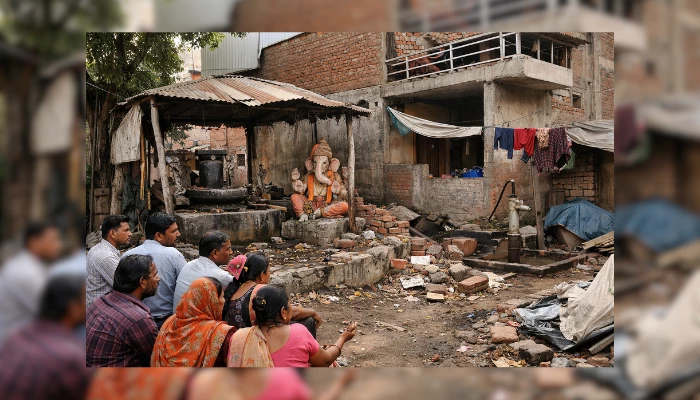
Case Summary
The Hindu residents of Ward No. 3, Vidisha, submitted a formal representation during a public hearing before the district administration, seeking administrative intervention for the removal of illegal encroachments on temple land and for addressing obstructions to the reconstruction of the old Shiva Ganesh temple situated near the Mohangiri Mata well. The memorandum was addressed to the Additional District Magistrate, Anil Damor, and the Sub Divisional Magistrate, Kshitij Sharma. The residents stated that the temple structure is in an advanced state of disrepair and requires urgent renovation and reconstruction to prevent further deterioration. In addition to seeking permission for reconstruction, the residents requested administrative action to clear unlawful occupations on land adjoining the temple premises. According to the submission, certain individuals have encroached upon portions of temple land. It was stated that one individual constructed a canopy approximately two and a half feet in width and a raised platform on temple property, while others undertook borewell drilling on nearby encroached land. These constructions were said to be obstructing the proposed redevelopment of the temple. The residents further stated that those responsible for the encroachments have engaged in verbal abuse and intimidation, thereby generating tension within the locality and raising concerns about potential escalation. They informed the administration that the reconstruction of the temple is intended to be funded through voluntary contributions from members of the local Hindu community and requested that encroachments be removed to ensure that the work proceeds without conflict. In response, the Additional District Magistrate assured the residents that the matter would be examined and appropriate action taken in accordance with the law.
Why it is Hate Crime ?
The primary category selected in this case is- Attack on Hindu religious representations. The subcategory selected is Encroachment or illicit takeover of temple land/land near the temple. In Hinduism, a temple is the abode of the Deity. The Deity in the Temple is consecrated, thereby making it a real, breathing entity. Hindus believe that not just the Deity but the temple premises itself are sacred to Hindus since Hindus hold the faith that the entire Temple space is an amalgamation of the divine energy of the deity. Not only the Temple but the Temple premises in its entirety are considered sacred by Hindus. In several cases, the premises of the Temple and/or religious centre are illicitly taken over by institutions belonging to other faiths, like the Waqf board or the Church. Other times, the temple property, land or the property of religious centres are illicitly encroached byupon non-Hindu groups. Any illicit takeover or encroachment is a crime an initio; however, when non-Hindu groups illicitly take over or encroach on the sacred land of Hindus, it is an affront to the Hindu community and is therefore classified as a religiously motivated hate crime under this category. This case reflects more than a routine land dispute because the property in question is not merely real estate but land intrinsically tied to a functioning Hindu place of worship. The obstruction concerns the reconstruction of an old Shiva Ganesh temple, a site of religious significance to the local Hindu community. When encroachment directly interferes with the physical space of a temple and prevents its renovation, the impact extends beyond civil disagreement into the domain of religious interference. The residents have stated that portions of temple land were occupied and permanent structures such as a canopy and raised platform were constructed on that land. Additional borewell activity on adjoining encroached land has further obstructed redevelopment efforts. These actions have, according to the complaint, impeded the community’s ability to restore and maintain a site dedicated to worship. Interference with temple land directly affects the community’s right to practise and preserve its religious traditions. The matter is compounded by reported verbal abuse and threats directed at residents seeking to rebuild the temple. When attempts to restore a religious structure are met with intimidation, the issue moves beyond property encroachment and enters the realm of hostility directed at a community’s religious expression. The intimidation creates an environment in which the exercise of faith is constrained by fear of escalation. Temple land carries both spiritual and cultural value. It is not only the structure of the shrine but also the surrounding land that enables rituals, gatherings, and communal participation. Encroachment that obstructs reconstruction restricts the community’s collective religious life. In this sense, the conduct described in the complaint directly affects Hindu religious representation and practice. For these reasons, the case is categorised as an attack on Hindu religious representations, specifically involving encroachment or illicit takeover of temple land. The harm lies not merely in disputed boundaries but in the obstruction of a community’s effort to maintain and revitalise its sacred space.


Case Status
Complaint filed


Perpetrators Details
Perpetrators
Unknown
Perpetrators Range
Unknown
Perpetrators Gender
unknown
 Sources




