Anti-Hindu hate speech: Indian politician justifies religious persecution of Hindus in Bangladesh
 Bhopal, Madhya Pradesh, India
  22 December, 2025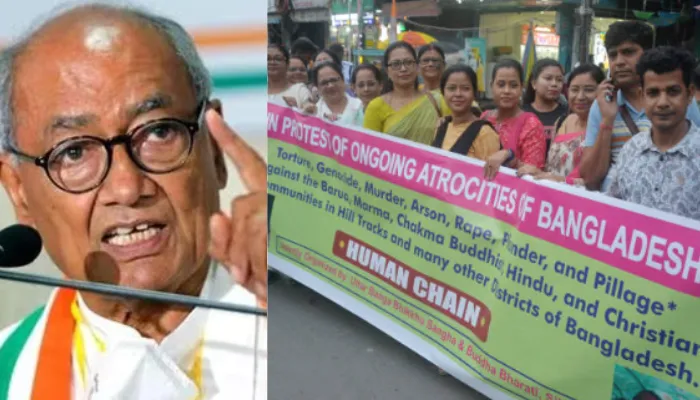
Case Summary
While Hindus in Bangladesh faced targeted violence by Muslim extremists, an anti-Hindu statement justifying the targeted violence came from senior Congress leader and former Madhya Pradesh Chief Minister Digvijay Singh. The accused made his statement during a public interaction in Bhopal on 24th December 2025. Singh stated that Hindus and Christians faced attacks in Bangladesh and described the violence as a consequence of the atmosphere created by actions taken against minorities in India. He claimed that when minorities faced vilification in India, similar extremist thinking gained strength in neighbouring countries, creating conditions that encouraged hostility and attacks against Hindus. Here, the accused tried to justify anti-Hindu violence in Bangladesh by falsely claiming that Hindus target minorities in India, making the attacks on Hindus in Bangladesh just a "reaction" to this. In reality, there is no state-backed persecution of minorities in India, which, in fact, is the case in Bangladesh with the Hindus. Singh also referred to the Chief Advisor of Bangladesh, Muhammad Yunus, highlighting the responsibility of influential figures and institutions in Bangladesh to intervene and restore communal harmony. However, he did not identify or condemn the Muslim perpetrators for the targeted attacks on Hindus, nor did he address the widespread anti-Hindu hate speech by Muslim extremists that fuelled the violence in Bangladesh. The remarks of Singh sparked immediate criticism from the Bharatiya Janata Party (BJP), which accused Singh of defaming India and diverting attention from the plight of Hindus in Bangladesh. BJP Member of Legislative Assembly (MLA) Rameshwar Sharma stated Singh's statement diluted the reality of anti-Hindu persecution and undermined India's moral position internationally. Notably, the accused, Digvijay Singh, made his statement just days after a Hindu man named Dipu Chandra Das was brutally murdered and his body was set ablaze by Muslim radicals over an unproven allegation of blasphemy in Bhaluka town of Bangladesh on 18th December 2025. The Hinduphobia Tracker has previously highlighted that the persecution of Hindus in Bangladesh has increased manifold since the fall of Sheikh Hasina’s Awami League government on August 5, 2024. After her violent ouster, Bangladesh has plunged into chaos as Islamist extremists have taken advantage of the political turmoil to unleash a wave of terror and violence against the Hindu community. The Islamist mobs have attacked Hindu homes, burned them to the ground, and abducted women in a horrific descent into anarchy. Several temples have been destroyed in various parts of the Islamic country in a major crackdown on Hindus. Reports have exposed how Muslim students forced around 60 Hindu teachers, professors, and government officials to resign. Exiled Bangladeshi activist Asad Noor has also revealed that the minority Hindu community is now being coerced into joining ‘Jamaat-e-Islami’. Hindu religious events have been repeatedly targeted. On 6th September, a procession carrying Lord Ganesha’s idol was attacked in Chittagong. Ahead of Durga Puja, multiple incidents of idol vandalism occurred, including attacks in Mymensingh, Pabna, Rajshahi, Kishoreganj, and Dhaka. On 29th November, a violent Muslim mob attacked three temples in Patharghata, Chittagong, immediately after Jumma Namaz. The crackdown on Hindu voices has also escalated. On 30th November, Hindu journalist Munni Saha was arrested in Dhaka. Muslim mob attacks have increased in Bangladesh, for example, on 22nd May 2025, a Muslim mob carried out arson attacks selectively on Hindu homes in Dahar Mashihati village in Abhaynagar upazila in Jessore district of Bangladesh. Even ISKCON leader Chinmoy Krishna Das Prabhu and his aides have been targeted, and attempts have been made to ban ISKCON and suppress Hindu protests through sedition charges. These arbitrary actions point to a systematic pattern of persecution under Muhammad Yunus’s interim government.
Why it is Hate Crime ?
This case has been documented as a hate crime under the chosen primary category: Hate speech against Hindus. Under this, the secondary category is: Anti-Hindu Subversion and prejudice. Hate speech is defined as any speech, gesture, conduct, writing, or display that is prejudicial against a specific individual and/or group of people, which is leading to or may lead to violence, prejudicial action or hate against that individual and/or group. Media plays a specific and overarching reach in perpetuating prejudicial attitudes towards a community owing to unfair, untrue coverage and/or misrepresentation/misinterpretation, selective coverage and/or omission of facts of/pertaining to issues affecting a specific religious group. This type of bias can dehumanise the victim group, making it easier for others to justify harmful actions against them, which aligns with the objectives of hate speech laws aimed at preventing such harm. It is often observed that the media takes a prejudicial stand against the Hindu community driven by their need to shield the aggressor community which happens to be a numeric minority, however, is the one perpetrating violence against Hindus. For example, the media is often quick to contextualise religiously motivated crimes against Hindus, omit or misrepresent facts that point towards religiously motivated hate crimes, justify and/or downplay religiously motivated hate crimes or simply present fake news to stereotype Hindus. Such media bias leads to the denial of persecution and is often used to dehumanise Hindus, leading to justification for violence against them. For example, the media covered several fake allegations of Hindus targeting Muslims and forcing them to chant Jai Shree Ram. Most of these cases were proved false and fabricated after police investigation. These fake news reports were subsequently never retracted or clarified. Such fake news led to the justification of violence and dehumanisation of Hindus based on the argument that since Hindus targeted Muslims and forced them to chant Jai Shree Ram, the dehumanisation of Hindus and violence against them was par for the course and merely a retaliation. Such media bias leads to prejudicial portrayal of Hindus and offers a justification for violence against them and therefore, is considered hate speech under this category. This case involving Digvijay Singh's remarks stood as a clear example of religiously motivated hate speech because it deliberately targeted Hindus through rhetoric that demeaned their faith, misrepresented their victimhood, and indirectly legitimised violence against them. Hindus in Bangladesh endured physical attacks, arson on homes, brutal murders, and sustained verbal hostility from Muslim extremists solely due to their faith identity. Despite this, the accused, Digvijay Singh, falsely claimed that minorities faced persecution in India by Hindus, portraying the persecution of Hindus in Bangladesh as a mere reaction. This attempt to justify violence committed against Hindus due to their Hindu identity, by making false claims of minority persecution in India, exposed deep-seated religious animosity towards the Hindu community. The accused essentially blamed Hindus for the persecution of other Hindus rather than the Muslim extremists who, driven by religious motivations and ideological hostility towards Hindus, killed and maimed them. This deliberate attempt to shift the blame onto Hindus showcases the deep-seated religious animosity that the accused holds towards the Hindu community, making it an instance of anti-Hindu hate speech. When Singh made such statements, they reached far and wide through media and social platforms, emboldening Muslim extremists in Bangladesh to continue unleashing violence against Hindus and justify it under the garb of a reaction to so-called atrocities against minorities in India, which does not exist, unlike the systematic oppression of Hindus in Bangladesh. These words travelled instantly to radical Muslim networks, providing perpetrators with moral cover to go on a violent rampage against Hindu minorities in Bangladesh. This marked not the first time Digvijay Singh made such anti-Hindu remarks. He previously attempted to link the revered Hindu organisation Rashtriya Swayamsevak Sangh (RSS) to the 26/11 Mumbai Islamic terror attacks carried out by Pakistani terrorists from Lashkar-e-Taiba. Singh inaugurated Aziz Burney's book 26/11: RSS Ki Saazish? (26/11, An RSS Conspiracy?) twice, in Delhi and Mumbai, promoting false narratives that exonerated Pakistan while framing RSS as perpetrators alongside his lobby of anti-Hindu leftists and Islamists. This history exposed his deep-seated religious animosity towards the Hindu community, where he repeatedly demonised Hindu organisations. His current justification of violence against Hindus in Bangladesh thus constituted not a one-off lapse but a continuation of calculated anti-Hindu rhetoric. Given that this case meets the parameters of an anti-Hindu hate speech, it is being added to the hate crime database of the Hinduphobia Tracker. Disclaimer: The Hinduphobia Tracker records the date of an incident based on when the crime occurs rather than when the media reports it. In this case, the media first reported the incident on 23rd December 2025, though reports did not specify the exact date Digvijay Singh made his anti-Hindu remark. Therefore, for documentation purposes, 23rd December 2025 serves as the indicative date of the incident.


Case Status
Unknown


Perpetrators Details
Perpetrators
Others
Perpetrators Range
One Person
Perpetrators Gender
male
 Sources




