Hindu residents targeted in organised conversion activity disguised as healing ceremony, linked to a wider conversion plan in Shahjahanpur, Uttar Pradesh
 Shahjahanpur, Uttar Pradesh, India
  21 December, 2025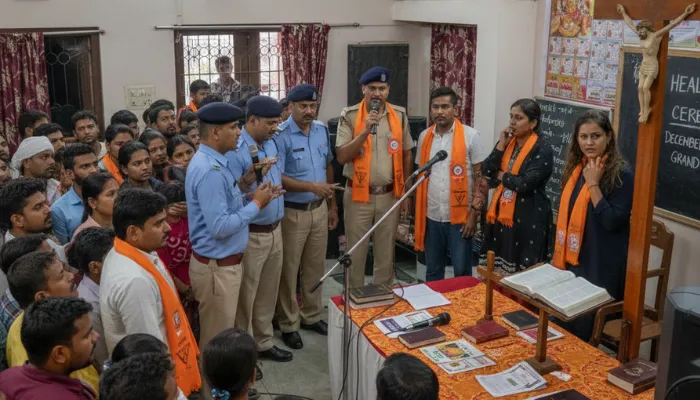
Case Summary
Hindu people in Uttar Pradesh's Shahjahanpur were subjected to an organised religious conversion operation when a so-called healing ceremony was conducted inside a residential house in Kailashnagar Colony, under the Roza police station area. The programme was organised on 22, December 2025 at the house of Ramadevi on Mohammadi Road. A stage had been set up inside the house, where a cross, Bible and other Christian religious materials were prominently displayed, indicating that the gathering was structured around religious propagation rather than any genuine medical or social service. People from nearby localities were mobilised for the meeting under the pretext of healing and miraculous cures. However, the content and conduct of the programme were focused on persuading Hindu attendees to abandon their faith and adopt Christianity. The conversion activity came to light after the Vishva Hindu Parishad received information that religious change was being actively promoted during the gathering. VHP department minister Ashneel Singh reached the spot with other workers and objected, stating that the event was being used as a systematic platform for conversion. Following the exposure of the conversion attempt, police intervention took place. Inspector Rajiv Singh of Roza police station arrived at the location and halted the programme. During the police action, a large number of attendees panicked and fled the scene, with reports indicating that around 150 women escaped from the premises. Four individuals, i.e, Vivek, Vipin, Monu and a woman named Angel, were apprehended from the site for their role in organising and conducting the conversion activity. The house owner, Ramadevi, fled the scene and remained absconding, after which the police initiated a search operation to trace her whereabouts. The arrested individuals were taken into custody, questioned, produced before the court, and subsequently sent to jail. Statements recorded during questioning revealed the conversion strategy and inducements used at the gathering. Attendees Ramesh and Lakhan told the police and VHP representatives that they were brought to the meeting with assurances of monetary benefits and assistance in arranging marriages if they agreed to change their religion. A written complaint submitted by VHP workers stated that nearly 200 people had gathered at the house and that Hindu deities were insulted during the programme, reinforcing the coercive, provocative and targeted nature of the conversion effort. Superintendent of Police Rajesh Dwivedi confirmed that preparations had also been underway for a larger programme planned around 25 December, indicating a deliberate expansion of conversion activities rather than an isolated incident. A case was registered under relevant legal provisions, including the Uttar Pradesh Prohibition of Unlawful Conversion of Religion Act, and police launched a detailed investigation into recruitment methods, inducements offered and the wider network supporting the operation. Call detail records of the accused were obtained to trace contacts, coordination and funding channels behind the conversion activity. The incident was part of a continuing and well-documented pattern of organised conversion activities in Shahjahanpur. Earlier investigations conducted in July 2025 had uncovered a wider conversion network operating from residential houses in areas such as Nai Basti Reti and Sindhauli, where healing meetings had functioned as fronts for religious conversion. Those probes had revealed multiple FIRs, several arrests and a coordinated structure backed by substantial financial resources. According to police investigations and court records from the earlier cases, approximately ₹4 crore linked to conversion activities had been traced to accounts associated with the accused. The funding trail had included foreign contributions, with regular inflows in foreign currency. Tamil Nadu-linked Christian missionary organisations, including Jesus Redeems Ministries and Mission Upholders Trust, had been named in connection with the financial transfers. Some of these organisations had been registered under the Foreign Contribution Regulation Act (FCRA), raising concerns about the misuse of legally received foreign funds for organised conversion activities targeting Hindus. Courts, while hearing related cases from earlier crackdowns, had denied bail to the culprit, taking note of the organised nature of the operations, the scale of funding involved and the deliberate targeting of vulnerable Hindu individuals through inducements and psychological manipulation. The Shahjahanpur incident, therefore, reflected not a standalone episode but a structured, recurring and externally supported conversion network operating under the guise of healing ceremonies.
Why it is Hate Crime ?
This case had been documented under the selected primary category: Predatory proselytisation Under this, the selected secondary category is: Proselytisation by grooming, brainwashing, manipulation, or subtle indoctrination. Under this, the selected tertiary category is: Pattern of targeting Hindus. Religious brainwashing essentially means the often subtle and forcible indoctrination to induce someone to give up their religious beliefs to accept contrasting, regimented ideas. Religious grooming or brainwashing also involves propaganda and manipulation. It involves the systematic effort, driven by religious malice and indoctrination, to persuade “non-believers’ to accept allegiance, command, or doctrine to and of a contrasting faith. Cases of such grooming or brainwashing are far more nuanced than direct threats, coercion, inducement and violence. In such cases, it is often seen that there is repeated, subtle and continual manipulation of the victim to induce disaffection towards their own faith and acceptance of the contrasting faith of the perpetrator. While subtle indoctrination is widely acknowledged as predatory, an element which is often understated in such conversions or the attempts of such conversion is the role of loyalty and trust which might develop between the perpetrator and the victim. Fiduciary relationships are often abused to affect such religious conversion. For example, an educator transmitting religious doctrine of a competing faith to a Hindu student. The Hindu student is likely to accept what the teacher is transmitting owing to existence of the fiduciary relationship. The exploitation of the fiduciary relationship to religiously indoctrinate victims would also be included in this category. Since the underlying animosity towards the victim’s faith forms the basis of predatory proselytization, such cases are considered religiously motivated hate crimes. Another selected secondary category is: Attempt to convert/converting by denigrating Hinduism. In several cases, Hindus are converted, or an attempt is made to convert Hindus by denigrating their faith, Hinduism. In such cases, the Hindus associate with the non-Hindu perpetrators often by choice and then, the attempt to convert them by insulting their faith, showing the faith down etc begins. An example of this would be a non-Hindu gathering where the Hindus are attending the gathering of their own free will. However, once they attend the gathering, there is an explicit attempt to convert them by abusing their faith and hailing the faith of the perpetrator. The denigration of the Hindu faith is often based on misrepresentation of the Hindu faith, its doctrine and scriptures and insult to espoused traditions if not blatant lies about Hindu beliefs and ways. Such conversions or attempts at conversions are driven by animosity towards the Hindu faith and are therefore documented as religiously motivated hate crimes. Another selected secondary category is: Conversion/attempts to convert by inducement. Predatory Proselytisation is not just limited to threat, harassment, force and violence, but it also has contours of stealth. In several cases, the Hindu victim is exploited to convert, with non-Hindus taking advantage of their poverty. In such cases, the Hindu victim who is suffering financially is offered monetary benefits, including lucrative offers for jobs, health treatment, education, etc, to induce the victim into changing his/her religion. In such cases, the religious identity of the victim and the aim to disenfranchise him from his faith form the heart of the crime. Also, taking advantage of and exploiting an individual’s economic vulnerabilities is widely acknowledged as exploitation, forms of which are often penalised by law. Such cases therefore are considered religiously motivated hate crimes since the victim’s religious identity forms the very heart of the crime itself. This incident involved targeting individuals specifically because of their religion. The gathering was designed to convert Hindus to another faith, using a staged ceremony with Christian symbols in a predominantly Hindu area. This shows that the victims were chosen based on their Hindu identity, which is a key element in a religiously motivated hate crime. Secondly, the methods used were coercive and exploitative, indicating malicious intent. Attendees were offered money and assistance with marriage if they converted, which manipulates vulnerable individuals to abandon their faith. Moreover, Hindu deities were insulted during the proceedings, and objections were met with aggression. These actions are not neutral persuasion; they are intended to demean and intimidate Hindus, reflecting hostility toward the religion itself. Thirdly, the incident demonstrates premeditation and organised targeting. It was not an isolated act; investigations revealed a network, mobilisation strategies, external funding, and links to previous similar events in the district. This indicates systematic planning aimed at undermining the Hindu community, which distinguishes it from ordinary interpersonal disputes or religious discussions. Finally, the impact on the Hindu community and public order further reinforces its classification as a hate crime. The event caused panic, disrupted communal harmony, and threatened the social cohesion of the Hindu society in that area. The combination of deliberate targeting, coercion, insult to religious beliefs, and organised execution clearly shows that the perpetrators acted out of hostility toward a particular religion. In conclusion, this is a religiously motivated hate crime because it involved intentional targeting of Hindus, coercion to abandon their faith, insult to religious symbols, organised planning, and disruption of religious and social harmony. Every aspect of the operation demonstrates hostility specifically based on religion, fulfilling the criteria for a hate crime motivated by religious bias. It is thus added to the tracker. Disclaimer: Reports indicate that a large gathering was present at the conversion programme, with police sources stating that approximately 150 women fled the premises during the intervention. While a complaint submitted by Hindu organisations mentioned that nearly 200 people had gathered, this higher figure could not be independently verified. For documentation purposes, the victim count has therefore been conservatively recorded as 150 individuals, reflecting the minimum number directly impacted and observed during the incident. Since no precise age or gender breakdown is available beyond references to women fleeing the site, the victims have been documented primarily as adult women.
Victim Details
Total Victim
150
Deceased
0
Gender
- Male 0
- Female 150
- Third Gender 0
- Unknown 0
Caste
- SC/ST 0
- OBC 0
- General 0
- Unknown 150
Age Group
- Minor 0
- Adult 150
- Senior Citizen 0
- Unknown 0


Case Status
Arrested


Perpetrators Details
Perpetrators
Christian Extremists
Perpetrators Range
From 2 To 5
Perpetrators Gender
both
 Sources




