Tribal Hindu villagers brainwashed and converted by Christian missionaries and government teachers in Shivpuri, Madhya Pradesh
 Shivpuri, Madhya Pradesh, India
  20 December, 2025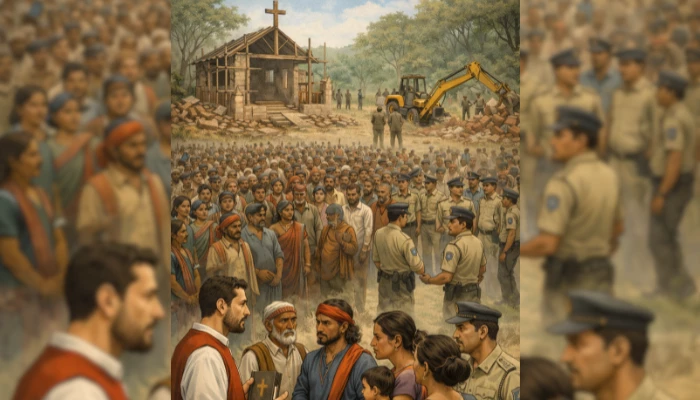
Case Summary
400 tribal Hindu villagers and 45 Bhil families were brainwashed and converted in Badarwas tehsil of Shivpuri district, Madhya Pradesh, on the false premise that their ailments and diseases would be cured. The conversion activities were carried out by Christian missionaries with the involvement of government teachers and patwaris on the false promise that their ailments and diseases would be cured. For the past six years, government teachers and patwaris were converting tribal and Bhil families. VHP and Bajrang Dal activists received a complaint regarding these activities. A villager, Hamir Bhil, informed them that families in the tribal villages of Agra Panchayat, Gudhal Dang, and Rampuri were being converted, and that this religious conversion had been continuing for the last six years. Upon receiving this information, Bajrang Dal and VHP members reached Gudhal Dang village and found that nearly 400 tribal villagers and nearly 45 Bhil families had been converted by Christian missionaries. They immediately informed the police administration and forest department and lodged a formal complaint at the police station. Following the complaint, local residents, along with teams from the police, administration, and forest department, reached the site of construction. As per the complaint received, Badarwas police station in-charge Rohit Dubey stated that government teachers and the patwari were carrying out religious conversions by constructing an illegal church on forest department land. The main accused named in the case include Anita Bhagat, a teacher at the Government Primary School, Gudal; Rajwati, a teacher at the Agra Primary School; Virendra Kumar Tirki, a teacher at Piprauda Basai; and Sohanchandra Penkra, the patwari of the Agra constituency. According to the complaint, villagers were brainwashed into believing that conversion would relieve them of illnesses and diseases. Those who refused to convert were beaten by the missionaries. Meanwhile, a joint team of police, revenue, and forest department officials demolished the illegal church structure under construction on forest land using a JCB machine. The church was being built without any permission from the concerned department. Several Christian religious scriptures were recovered from the site.
Why it is Hate Crime ?
This case is documented under the two primary category: Predatory Proselytisation, under which it is documented in two sub-categories. The first subcategory is: Conversion/attempts to convert by inducement. Predatory Proselytisation is not just limited to threat, harassment, force and violence, but it also has contours of stealth. In several cases, the Hindu victim is exploited to convert, with non-Hindus taking advantage of their poverty. In such cases, the Hindu victim who is suffering financially is offered monetary benefits, including lucrative offers for jobs, health treatment, education, etc, to induce the victim into changing his/her religion. In such cases, the religious identity of the victim and the aim to disenfranchise him from his faith form the heart of the crime. Also, taking advantage of and exploiting an individual’s economic vulnerabilities is widely acknowledged as exploitation, forms of which are often penalised by law. Such cases, therefore, are considered religiously motivated hate crimes since the victim’s religious identity forms the very heart of the crime itself. The victims in this case were tribal and Bhil villagers, who traditionally follow indigenous Hindu and animistic belief systems. They were specifically targeted because of their religious identity, making the act religiously motivated rather than incidental. The conversions were not random or voluntary expressions of faith but were directed at a clearly identifiable religious group, satisfying the core criterion of a hate crime. The second subcategory selected is- Proselytisation by grooming, brainwashing, manipulation, or subtle indoctrination. The tertiary category selected is- Pattern of targeting Hindus. Religious brainwashing essentially means the often subtle and forcible indoctrination to induce someone to give up their religious beliefs to accept contrasting regimented ideas. Religious grooming or brainwashing also involves propaganda and manipulation. It involves the systematic effort, driven by religious malice and indoctrination, to persuade “non-believers’ to accept allegiance, command, or doctrine to and of a contrasting faith. Cases of such grooming or brainwashing are far more nuanced than direct threats, coercion, inducement and violence. In such cases, it is often seen that there is repeated, subtle and continual manipulation of the victim to induce disaffection towards their own faith and acceptance of the contrasting faith of the perpetrator. While subtle indoctrination is widely acknowledged as predatory, an element which is often understated in such conversions or the attempts of such conversion is the role of loyalty and trust which might develop between the perpetrator and the victim. Fiduciary relationships are often abused to affect such religious conversion. For example, an educator transmitting religious doctrine of a competing faith to a Hindu student. The Hindu student is likely to accept what the teacher is transmitting owing to existence of the fiduciary relationship. The exploitation of the fiduciary relationship to religiously indoctrinate victims would also be included in this category. Since the underlying animosity towards the victim’s faith forms the basis of predatory proselytization, such cases are considered religiously motivated hate crimes. The villagers were induced to convert on the false premise that conversion would cure illnesses and remove diseases. Exploiting medical vulnerability and lack of access to healthcare to induce religious conversion constitutes religious coercion, which transforms the act into a hate-based offense. Such deception strips individuals of informed consent and weaponises religion against a vulnerable population. Moreover, the conversion activities continued for approximately six years across multiple villages, indicating organised, sustained, and systematic targeting, not an isolated incident. The Hate crimes are often identified by patterns rather than single events, and the duration and scale of this activity meet that threshold. The conversion of approximately 400 tribal villagers and 45 Bhil families demonstrates mass targeting, not individual choice. The scale itself reflects a collective harm inflicted upon a religious community, a key indicator used in hate crime classification. The other primary category is Attack not resulting in death; the sub-category in this is: Attacked for refusal to convert. When there is pressure, threat or coercion employed upon the Hindu victim to convert to a different religion, in several cases, the victim refuses to succumb to the pressure/threats. Once the victim refuses, the perpetrator proceeds to attack/assault the victim owing to his/her refusal to convert. In such cases, the pressure/threat/intimidation/coercion/violence itself is driven by animosity towards the victim’s Hindu faith. The violence then is another hate crime driven by the victim’s refusal to abandon his professed faith, Hinduism, and convert to the religion of a non-Hindu perpetrator. Since the victim’s faith is at the heart of the pressure to convert and the ensuing violence towards the victim, such cases are considered religiously motivated hate crimes. According to the complaint, villagers who refused to convert were beaten. The use of physical force to compel religious change elevates the incident from religious proselytisation to religious persecution. Violence or intimidation used to suppress the religious freedom of a group is a defining element of hate crimes under both domestic and international human rights frameworks. The involvement of government teachers and patwaris aggravated the offence. As public servants, they hold positions of trust and authority. Their participation in religious conversion activities represents an abuse of state power to interfere with the religious identity of a community. When state-linked actors participate in or enable religious targeting, the gravity of the hate crime increases significantly. In addition to it, the construction of an illegal church on forest department land for the purpose of facilitating conversions constitutes religious imposition through unlawful means. The use of illegally occupied land to conduct religious activities targeting a specific community further evidences intent and organisation. Given that this case fulfils every parameter of a religiously motivated crime targeting based on Hindu identity, coercive indoctrination, violation of faith, and patterned aggression, it has been duly added to the hate crime database of the Hinduphobia Tracker. Disclaimer: In this case, it is reported that approximately 45 Bhil families and around 400 tribal villagers were converted to Christianity. While the number of tribal villagers is stated directly, the exact number of individuals within the 45 Bhil families is not specified. Due to this lack of clarity, we have relied on the most recent Indian census data, which indicates that the average family size in India is approximately 4.8 members per household. For the purpose of standardised estimation, we have considered an average of 5 members per family. Based on this approach, the estimated number of individuals from the Bhil families is 225 (45 families × 5 members. Combined with the 400 tribal villagers, the estimated total number of victims in this case is approximately 625 individuals. The Hinduphobia Tracker records incidents based on when an event occurred or when the victim's ordeal began. It is important to clarify that none of the media sources covering this case has specified the exact date when the conversion activities began. Therefore, for documentation purposes, we have recorded the date based on when the incident was reported in the media, 21 December 2025.
Victim Details
Total Victim
625
Deceased
0
Gender
- Male 0
- Female 0
- Third Gender 0
- Unknown 625
Caste
- SC/ST 0
- OBC 0
- General 0
- Unknown 625
Age Group
- Minor 0
- Adult 0
- Senior Citizen 0
- Unknown 625


Case Status
Complaint registered


Perpetrators Details
Perpetrators
Christian Extremists
Perpetrators Range
From 2 To 5
Perpetrators Gender
male
 Sources




