Hindu temple idols vandalised by miscreants in Bangladesh amidst ongoing persecution of Hindus
 Netrokona District, Bangladesh
  19 December, 2025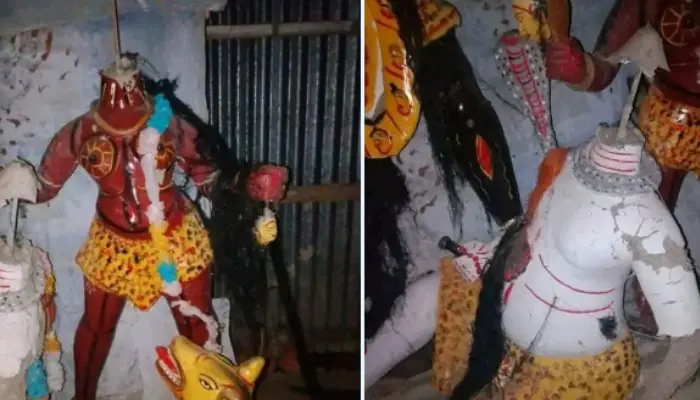
Case Summary
In Deotukone village of Nogua union in Durgapur upazila of Netrakona district in Bangladesh, a Hindu temple was targeted and attacked by unknown miscreants. The attackers also desecrated the sacred idols present inside the temple. According to media reports, the miscreants entered the temple at around 11:30 pm on 20th December 2025 and broke several idols, including the idols of Lord Shiva and Goddess Kali. After carrying out vandalism, the perpetrators fled the scene. When the matter came to light in the morning of 21st December 2025, extreme tension and anger arose in the area. Members of the local Hindu community saw this incident as an insult to their religious sentiments and demanded exemplary punishment by quickly identifying the culprits. Local residents said that the Kali temple had been a centre of trust for religious people for a long time. A planned attack on such a holy place was very worrying and condemnable. They expressed fear that such an incident could pose a threat to communal harmony. A fresh wave of anti-Hindu violence prevailed across Bangladesh following the death of Sharif Osman Bin Hadi. This escalation occurred against the backdrop of ongoing anti-Hindu violence that had persisted since the ouster of the Sheikh Hasina government in August 2024, during which Hindu homes, temples, and religious spaces were repeatedly attacked, and the Hindu community faced intimidation, arson, and mob attacks. In the aftermath of Hadi’s death, Hindu homes were selectively targeted and set ablaze in multiple localities by Muslim mobs, forcing families to flee and rendering many homeless. The violence was not sporadic but patterned, with Muslim mobs targeting Hindu neighbourhoods, properties, and religious symbols with impunity. One of the many victims of this wave of violence was a Hindu man named Dipu Chandra Das, who was brutally lynched by a Muslim mob over false allegations of blasphemy. Such targeting of innocent Hindus over fabricated charges illustrated the vulnerability of the Hindu minority under conditions of rising communal hostility. Posters and written materials calling for the extermination of Hindus were displayed in public spaces, signalling an alarming normalisation of genocidal rhetoric. Combined with acts of physical violence, arson, and vandalism, these developments demonstrated a coordinated campaign designed to terrorise the Hindu community and assert Islamic dominance. Notably, Sharif Osman Bin Hadi was a Muslim political activist and student leader known for his anti-Hindu and anti-India stance. He was actively involved in the political unrest that followed the fall of Sheikh Hasina’s government and was killed in Dhaka in December 2025 during clashes, after which Hindus were blamed and subsequently targeted.
Why it is Hate Crime ?
This case is being added to the tracker under the primary category- Attack on Hindu religious representations. The subcategory selected is- Desecration of Hindu religious symbol. Icons and symbols or a religious representation of a spiritual ideal are widely revered in Hinduism. Iconography is of vital significance in the Hindu milieu. It helps connect people’s spiritual beliefs with the real world. Iconography within the Hindu faith takes several shapes and forms. Murtis are of most significance to Hindus, to which daily rituals, prayers and offerings are done. Besides the murtis, there are several other symbols which have deep significance in the Hindu faith – the Om and Swastika for example. Since these Hindu religious symbols hold paramount importance in Hinduism, any desecration of symbols, icons, murtis, religious representations and manifestations, is driven by animosity towards the faith itself which manifests itself through these murtis, icons and symbols. Therefore, any desecration of these Hindu religious symbols and representations is considered religiously motivated hate crimes under this category. The other subcategory selected is- Attack on Temples. In Hinduism, a temple is the abode of the Deity. The Deity in the Temple is consecrated, thereby, making it a real, breathing entity. Hindus believe that not just the Deity but the temple premises itself are sacred to Hindus since Hindus hold the faith that the entire Temple space is an amalgamation of the divine energy of the deity. Given the central significance of Temples in Hindu Dharma, any attack against a Hindu Temple or its peripheral premises is an attack on the faith itself and is born out of animosity towards the faith, of which, the Temple is a central tenet. Any manner of attack against a Temple and/or its premises would therefore be considered a religiously motivated hate crime. This case exemplifies a clear instance of an anti-Hindu hate crime, as the perpetrators deliberately targeted a Hindu temple in Deotukone village, Bangladesh, for a vicious attack and vandalism. Hindu temples hold profound significance as the divine abodes of Hindu deities, places where the sacred presence of gods manifests for devotees. These institutions stand as deeply revered centres of worship, community gathering, and spiritual solace for all Hindus, embodying centuries of faith and cultural heritage. By choosing to storm and desecrate such a holy site, the attackers revealed their religiously motivated intent to humiliate and terrorise the Hindu community, stripping away any doubt that this was a hate-driven assault aimed squarely at Hindus and their beliefs. The perpetrators' deliberate desecration of the temple idols further cements the religious hatred fuelling this crime. These idols are far more than mere physical objects; they serve as living manifestations of the divine deities, invoked through ancient rituals and revered in daily worship by countless devotees who pour their hearts into prayers and offerings. The attackers, fully aware of the sacred role these idols play, vandalised them with brutal intent, shattering what the Hindu community holds most dear. This calculated violation of such potent symbols of the Hindu faith exposes raw animosity towards Hinduism itself, its rituals, and its people, marking the act as a textbook example of a religiously motivated hate crime. This temple attack gains even greater urgency when viewed alongside the brutal murder just days earlier of a Hindu man, Dipu Chandra Das, in Bhaluka town, Bangladesh. Muslim extremists savagely killed him and set his body ablaze over an unproven blasphemy allegation on 18th December 2025. These back-to-back assaults on Hindus, first a Hindu man's life extinguished in flames, then a temple desecrated, reveal not an isolated outburst but a chilling pattern of selective, impunity-laced violence against Bangladesh's Hindu minority. Such rapid escalation underscores a pervasive climate of religiously motivated hate crimes targeting Hindus, demanding urgent recognition and action. Even without the perpetrators' religious identity being confirmed, their fixation on a Hindu temple and its idols demonstrates deep-seated anti-Hindu animosity as the driving force behind the crime. This was no random act but a premeditated strike rooted in hatred for the Hindu faith and identity. Accordingly, this case has been added to the hate crime database of the Hinduphobia Tracker.


Case Status
Unknown


Perpetrators Details
Perpetrators
Unknown
Perpetrators Range
Unknown
Perpetrators Gender
unknown
 Sources




