Hindu singer harassed and nearly assaulted by Muslim politician for performing Hindu religious song
 Purba Medinipur district, West Bengal, India
  19 December, 2025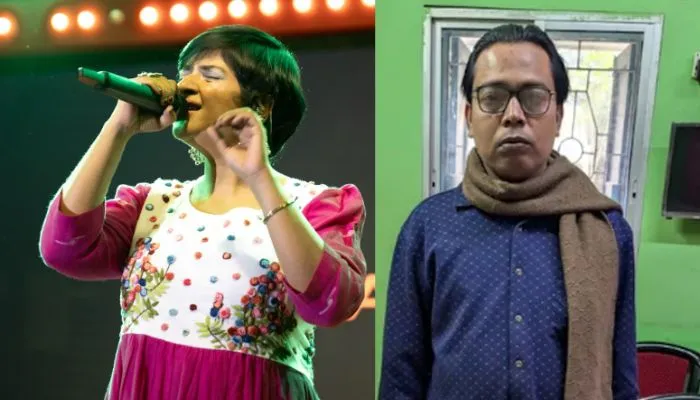
Case Summary
In West Bengal, a Hindu female singer, Lagnajita Chakraborty, was targeted for harassment and attempted physical assault by a Muslim Trinamool Congress (TMC) politician named Mehboob Malik. This attack occurred over the Hindu victim singing 'Jago Maa', a song dedicated to the goddess Durga. The accused harassed and nearly assaulted her over this and forced her to instead sing "secular songs". According to media reports, the victim, Lagnajita Chakraborty, was subjected to this attack right in the middle of her live concert at South Point Public School, a private school, in East Midnapore's Bhagwanpur, on 20th December 2025. The programme started normally at around 7 pm, but Mehboob Malik lost control when Lagnajita started singing a Hindu religious song titled “Jago Maa” from the film Devi Chowdhurani. He went up to the stage, told her to stop singing the song and switch to a secular song instead. Malik was the main organiser of the event and was also the owner of the private school. Chakraborty revealed, “He rushed to the stage when I began singing the religious song, and he attempted to beat me.” He started shouting at her and said, “Onek Jago Maa hoyeche, ebar kichu secular gaa (enough of Jago Maa, now sing some secular song).” The victim also stated that the Officer-in-Charge of the Bhagwanpur police station initially refused to register a case against Malik. However, the police registered a case later and arrested him. Malik's involvement was confirmed by senior police officer Mitun Dey, who said that an inquiry was initiated against the Officer-in-Charge and another officer at the Bhagwanpur station for neglect. Mitun Dey stated, “We took action against them.” The accused's brother, Masud Mallik, called the charge a lie. He claimed, “She was singing a religious song from her movie. We asked her to sing a secular song since it was a school function. She stopped performing and headed to the police station.” Chakraborty rejected this claim by saying, “I have faith in the police, and I would like them to take this seriously.” The Bharatiya Janata Party (BJP) intervened, citing that Malik was a member of the ruling political party, Trinamool Congress. BJP leader Shankudeb Panda said, “West Bengal is in the grip of Jihadis (Muslim extremists). They give direction to the singers about what they could and could not sing.” He stated that when Chakraborty went to file the complaint at a police station, Mamata Banerjee's police initially refused to register the complaint. Even the Trinamool Congress did not react to this incident or issue any statement.
Why it is Hate Crime ?
The primary category selected in this case is- Attack not resulting in death. The subcategory selected is- Attacked for Hindu identity. In several cases, Hindus are attacked merely for their Hindu identity without any perceived provocation. A classic example of this category of religiously motivated hate crime is a murder in 2016. 7 ISIS terrorists were convicted for shooting a school principal in Kanpur because they got ‘triggered’ seeing the Kalava on his wrist and tilak that he had put. In this, the Hindu victim had offered no provocation except for his Hindu religious identity. The motivation for the murder was purely religious, driven by religious supremacy. Such cases where Hindus are targeted merely for their religious identity would be documented as a hate crime under this category. Another primary category selected is- Restriction/ban on Hindu practices. The subcategory selected is- Restriction on expression of Hindu identity. An example of the state-affected prejudicial and targeted orders against the Hindu community would be a government denying the right of a Hindu or a group of Hindus to hold a religious procession owing to the animosity of non-Hindu groups. Denial of the religious right of the Hindus to assuage the non-Hindu group which harbours animosity to a point where it could lead to violence against Hindus is not only a failure of law and order but is a prejudicial order against Hindus, denying them their fundamental rights to express their religious identity. An example of a hate crime against Hindus by a non-Hindu would be a non-Hindu institution forcing its Hindu employees to abandon religious symbols that a Hindu would wear as an expression of faith owing to inherent prejudice against the faith professed by the victim or a non-Hindu group of people restricting a Hindu group from constructing a place of worship simply because the demography of the area in which the temple is being built is dominated by non-Hindus. Such actions are driven by religious animosity and/or prejudice against Hindus and their faith and would therefore be categorized as a hate crime. In this case, the targeted harassment and near-assault of a Hindu female singer by a Muslim politician exemplifies deep-seated religious animosity towards her Hindu identity. The victim endured sustained intimidation solely for expressing her Hindu faith through "Jago Maa", a sacred devotional song invoking Goddess Durga, the revered Hindu goddess who represents courage and righteousness. Such songs are a core element of Hindu worship during Navratri and beyond. This attack was not random but precisely motivated by her visible Hindu religiosity: the accused reacted with fury to the song's lyrics glorifying Durga, harassing and advancing physically to silence the Hindu victim. Targeting a Hindu woman for such religious expression constitutes a direct assault on Hindu faith practices, marking this as a religiously motivated hate crime driven by prejudice against Hindu devotional traditions. The accused, a member of the Trinamool Congress (TMC), West Bengal's ruling party, deliberately weaponised his political authority to escalate the intimidation. He demanded she cease her Durga bhajan and switch to supposed "secular" songs, explicitly aiming to erase her Hindu identity in a public space. This was no mere policy enforcement but a calculated abuse of state-backed power to humiliate her faith, suppress Durga worship, and impose an anti-Hindu secularism that vilifies and suppresses the Hindu faith. Such targeted restriction of Hindu religious expression reveals religious animosity as the core motivating factor behind the crime, transforming political power into a tool for faith-based oppression and qualifying this as a religiously motivated crime. The police initially refused to file a complaint against the accused, Mehboob Malik, despite clear evidence of the Hindu singer's harassment and attempted physical assault for singing "Jago Maa". This deliberate inaction exemplifies deep-seated, institutionalised prejudice and discrimination against Hindus in West Bengal, where authorities routinely dismiss crimes targeting Hindu religious expression while shielding Muslim perpetrators from the ruling TMC. By ignoring the victim's plea over her public devotion to Goddess Durga, a sacred Hindu practice, the police perpetuated anti-Hindu bias, emboldening religious animosity and underscoring systemic protection of those who attack Hindu faith symbols and devotees. Altogether, this case meets the parameters of a religiously motivated hate crime against the Hindu woman and her faith. Therefore, this case is being added to the hate crime database of the Hinduphobia Tracker.
Victim Details
Total Victim
1
Deceased
0
Gender
- Male 0
- Female 1
- Third Gender 0
- Unknown 0
Caste
- SC/ST 0
- OBC 0
- General 1
- Unknown 0
Age Group
- Minor 0
- Adult 1
- Senior Citizen 0
- Unknown 0


Case Status
Arrested


Perpetrators Details
Perpetrators
Muslim Extremists
Perpetrators Range
One Person
Perpetrators Gender
male
 Sources




