Hindu man pressured to convert to Christianity; attacked with stones and threatened with death for resisiting
 Jhabua, Madhya Pradesh, India
  18 December, 2025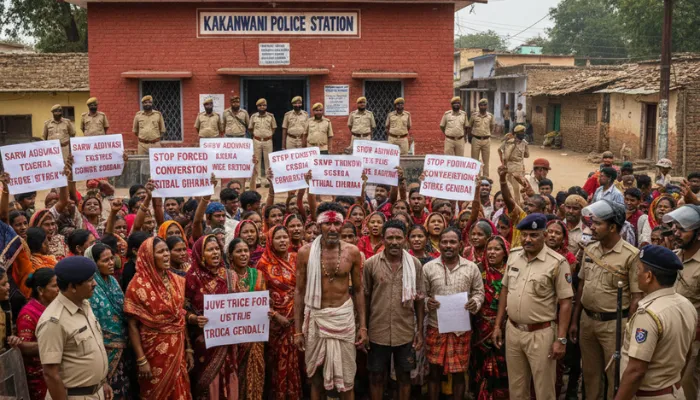
Case Summary
A Hindu tribal man was pressured to abandon his faith by two Christian pastors and 5 others. He was also brutally attacked with stones and threatened with death when he resisted the conversion attempt. The incident occurred in Madrani village of Jhabua district under the jurisdiction of the Kakanwani police station in Madhya Pradesh. A man, identified as Gendal Damor, was intercepted while returning home on 19th December, 2025. He was confronted by a group of seven individuals, including two Christian pastors, who attempted to compel him to convert to Christianity. When he resisted, he was subjected to physical violence, threatened with death and attacked with stones, resulting in serious injuries. Following the incident, police registered an FIR against all seven individuals named in the case. The FIR was filed under provisions of the Madhya Pradesh Freedom of Religion Act, which prohibited conversion through force, coercion or intimidation, along with other relevant sections related to assault and criminal intimidation. Police initiated an investigation, recorded statements and increased security presence in the village as tensions escalated after the attack. The assault prompted strong reactions from the local tribal community. Members of Sarva Adivasi Samaj and other tribal organisations gathered at the police station to protest, demanding the immediate arrest of those named in the FIR and strict enforcement of the law. A memorandum was submitted to the district administration, expressing concern over repeated interference in tribal religious practices and warning that such incidents endangered social harmony and the cultural identity of indigenous communities in the region. In the aftermath, the situation in Madrani village remained tense. Reports emerged of stone-throwing near the residences of those named in the case, prompting the deployment of additional police personnel to prevent further unrest. Police officials confirmed that the investigation continued and assured the community that action would be taken in accordance with the law.
Why it is Hate Crime ?
This case has been documented under the selected primary category: Predatory Proselytisation Under this, the secondary category selected is: Harrasment, threats, coersion for conversion. Harassment covers a wide range of behaviours of an offensive nature. It is commonly understood as behaviour that demeans, humiliates, and intimidates a person, including threats and coercion. Harassment and threats, in this case, find their root on discriminatory grounds which has the effect of nullifying a person’s rights or infringing upon his freedom to exercise his right specifically owing to the victim’s religious identity. Verbal and physical threats and psychological or physical harassment are often used against Hindu victims because they choose to practice their professed religion. Religious harassment also includes forced and involuntary conversions by harassment, threats or coercion. Coercion includes intimidatory tactics like force-feeding a Hindu victim beef to convert to another religion, forceful circumcision etc. In several cases documented, non-Hindu perpetrators or those who harbour specific animosity towards Hinduism, harass victims simply based on their religious identity. Such cases often also include harassment to ensure the Hindu victim abandons his/her professed religion and adopts the religion of the perpetrator. Such cases, where Hindu victims are harassed to convert to the perpetrator’s religion, are rooted in animosity towards the victim’s religious identity and are therefore documented as religiously motivated hate crimes. Another selected primary category is: Attack not resulting in death. Under this, the secondary category selected is: Attack for refusal to convert. When there is pressure, threat or coercion employed upon the Hindu victim to convert to a different religion, in several cases, the victim refuses to succumb to the pressure/threats. Once the victim refuses, the perpetrator proceeds to attack/assault the victim owing to his/her refusal to convert. In such cases, the pressure/threat/intimidation/coercion/violence itself is driven by animosity towards the victim’s Hindu faith. The violence then is another hate crime driven by the victim’s refusal to abandon his professed faith, Hinduism, and convert to the religion of a non-Hindu perpetrator. Since the victim’s faith is at the heart of the pressure to convert and the ensuing violence towards the victim, such cases are considered religiously motivated hate crimes. This case from Madrani village in Jhabua district, Madhya Pradesh, represents a clear instance of a religiously motivated hate crime when critically examined. The victim, a Hindu tribal man named Gendal Damor, was specifically targeted because of his religious identity. The assailants, a group of seven individuals including two Christian pastors, stopped him while he was returning home and attempted to coerce him into abandoning his faith and adopting an alien one, Christianity. The nature of the attack, i.e., pressure to convert combined with physical assault, death threats, and stone-throwing, demonstrates that the violence was not incidental or personal, but a deliberate attempt to punish and intimidate the victim for adhering to his religion and not converting. A detailed examination of the methods employed reveals a structured effort to manipulate the victim’s beliefs. The coercion involved multiple layers: first, direct confrontation and verbal pressure to convert; second, threats of death to instil fear and enforce compliance; and third, physical violence through beating and stone-throwing, which served both as punishment and a psychological tool to demonstrate the consequences of resisting conversion. The use of multiple perpetrators, including religious figures, indicates that the act was coordinated and not an isolated altercation, reflecting patterns of targeted proselytisation by force, which inherently carries elements of hate and discrimination against the victim’s religious identity. The case also shows the broader social implications of such actions. The involvement of organised religious figures attempting to convert a Hindu individual in a coercive manner highlights the systemic dimension of the threat, suggesting that such incidents can destabilise social harmony and undermine the rights of vulnerable groups to freely practice their religion. Legally, the registration of a First Information Report (FIR) under the Madhya Pradesh Freedom of Religion Act reinforces the recognition that the incident involved coercion linked to religious belief. The law specifically prohibits force, allurement, or intimidation to induce conversion, and the police investigation reflects the state’s acknowledgement of the religiously motivated nature of the crime. Critically, the case illustrates multiple dimensions of religiously motivated hate: the targeting of an individual due to faith, the use of intimidation and physical violence to enforce conversion, and the potential for communal tension resulting from such acts. The attackers’ actions sought to undermine the victim’s autonomy over his religious choices, imposing their beliefs through fear and coercion. Such conduct goes beyond mere criminal assault; it is an attack on the victim’s identity and community, fulfilling the criteria of a hate crime as it is motivated by bias against a protected characteristic, in this case, religion. Thus, it is added to the tracker. In summary, this incident in Madrani village cannot be seen in isolation. It demonstrates a coordinated, faith-based targeting of a vulnerable individual, the use of violence and threats to force religious change, and the wider communal impact that accompanies such attacks. Every aspect of the case, from the selection of the victim, the methods employed, to the social response, supports the conclusion that the act was a religiously motivated hate crime, aimed at punishing the victim for his beliefs and intimidating the broader community.
Victim Details
Total Victim
1
Deceased
0
Gender
- Male 1
- Female 0
- Third Gender 0
- Unknown 0
Caste
- SC/ST 1
- OBC 0
- General 0
- Unknown 0
Age Group
- Minor 0
- Adult 1
- Senior Citizen 0
- Unknown 0


Case Status
Complaint registered


Perpetrators Details
Perpetrators
Christian Extremists
Perpetrators Range
From 5 to 10
Perpetrators Gender
male
 Sources




