Hindu temple premises used for Christian prayers, non vegetarian food prepared and served, inducements offered to promote conversion
 Bilaspur, Chhattisgarh, India
  16 December, 2025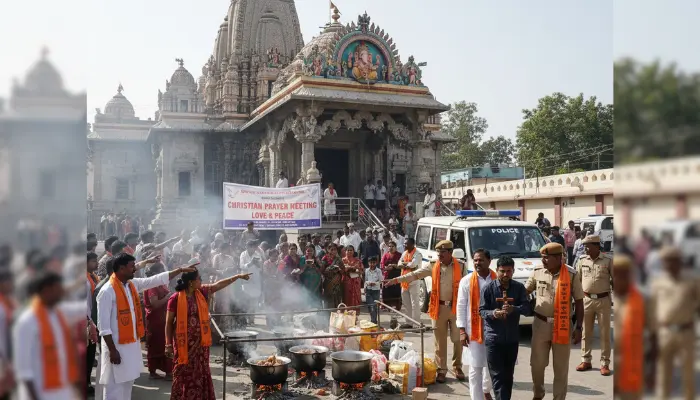
Case Summary
Hindu temple witnessed a Christian prayer meeting around its premises in Ganesh Nagar’s Chuchuhiyapara area of Bilaspur. During which non‑vegetarian food was being prepared at the venue, drawing concern because of the religious sensitivity of the location. Around 150 to 200 people were present at the gathering, and members of the Vishwa Hindu Parishad and Bajrang Dal said that poor and innocent people were being drawn to the meeting with the promise of food and gifts, raising questions about activities related to religious conversion near the temple. After receiving information about the situation, activists informed the police. Sirgitti police reached the site, stopped the prayer meeting, and took a pastor and another individual into custody for questioning. Police identified the pastor as a resident of Janjgir‑Champa district, while the other person was from Bilaspur. The police began an investigation into the incident to examine the circumstances surrounding the meeting and the activities conducted there, and further action was underway based on the findings.
Why it is Hate Crime ?
This incident has been documented under the primary category of: Predatory Proselytisation. Under which, the secondary category selected is: Conversion/ attempts to convert by inducement. Predatory Proselytisation is not just limited to threat, harassment, force and violence, but it also has contours of stealth. In several cases, the Hindu victim is exploited to convert, with non-Hindus taking advantage of their poverty. In such cases, the Hindu victim who is suffering financially is offered monetary benefits, including lucrative offers for jobs, health treatment, education, etc, to induce the victim into changing his/her religion. In such cases, the religious identity of the victim and the aim to disenfranchise him from his faith form the heart of the crime. Also, taking advantage of and exploiting an individual’s economic vulnerabilities is widely acknowledged as exploitation, forms of which are often penalised by law. Such cases therefore are considered religiously motivated hate crimes since the victim’s religious identity forms the very heart of the crime itself. Another primary category selected is: Attack on Hindu religious representations. Under which, the secondary category selected is: Defiling religious customs. Sanatan Dharma is not a religion of one book, which is to say that while it has religious scriptures that form the central tenets of the faith, there are several traditions followed through thousands of years, mostly passed from generation to generation orally. There are several such customs and traditions that are followed by various Hindus and Hindu sects. Defiling of these traditions and customs is a breach of an individual or group’s religious practices. Such practices can range from dietary restrictions like not eating non-vegetarian food for a certain period of the year, not eating non-vegetarian food at all, not eating beef since the cow is considered holy in Hinduism, the sanctity of religious customs followed in the house (like many ISCKON devotees), etc. Any malicious action leading to the breach of such traditions or defilement of these traditions owing to animosity towards the faith or for the sake of activism stems not only from the lack of faith in the religion itself but also from disregard for the faith of the devotees who follow the customs/traditions and implicit bias against the faith, the tradition itself. Since these specific traditions are central to the faith of the devotees of that specific sect of Hindus, any non-compliance with these traditional rules would be considered a religiously motivated hate crime. The other subcategory selected is- Breaking rules of place of worship. Sanatan Dharma is not a religion of one book, which is to say that while it has religious scriptures that form the central tenets of the faith, there are several traditions followed through thousands of years, mostly passed from generation to generation orally. One of these oral traditions or written traditions is the rules of specific temples. Certain temples have rules which are traditional rules, dependent on the worship of the presiding deities. These rules and traditions have been followed for thousands of years whether they find scriptural mention or not. Such traditions are based on the nature and rules of worship of the presiding deity of that temple. Any non-compliance of these traditions owing to animosity towards the faith or for the sake of activism stems not only from the lack of faith in the presiding deity but also disregard for the faith of the devotees of that deity/temple and implicit bias against the faith, the tradition and the deity itself. Since these specific traditions are central to the faith of the devotees of that specific temple and presiding deity, any non-compliance with these traditional rules would be considered a religiously motivated hate crime. This case constituted a religiously motivated hate crime because of the manner in which things unfolded. First, the incident occurred near a Hindu temple premises, a space that holds sacred significance for the Hindu community. The choice of location was central to the harm, as temple premises are governed by specific religious norms and practices. The presence of a Christian prayer meeting in this setting immediately placed the activity in a religion-specific context rather than a neutral public one. Second, during the gathering, non-vegetarian food was prepared near the temple premises, which directly conflicted with Hindu religious customs associated with ritual purity around temples. This act affected not just individuals present but the broader Hindu community connected to the temple, turning the incident into a collective religious offence rather than a private dispute. Third, the gathering reportedly involved poor and vulnerable individuals being drawn with food and gifts. The concern arose because religious influence was exercised in a setting where economic vulnerability intersected with faith, and where the religious identity of the surrounding community was predominantly Hindu. The method used made religious identity a key factor in how the activity operated. Finally, Hindu organisations and police intervention and investigation that followed, confirmed that the matter involved religious sensitivities and community impact. The authorities halted the meeting and questioned those involved, acknowledging that the issue arose from activities affecting religious harmony and the sanctity of a Hindu religious space. Viewing in totality, the location, actions, method, and impact, it demonstrated that the harm was structured around Hindu religious identity. The incident is therefore added to the tracker.


Case Status
Complaint filed


Perpetrators Details
Perpetrators
Christian Extremists
Perpetrators Range
From 2 To 5
Perpetrators Gender
male
 Sources




