Hindu judge issued death threats by Muslims over sentencing Islamic extremists involved in murder of Hindu politician
 Alappuzha, Kerala, India
  29 January, 2024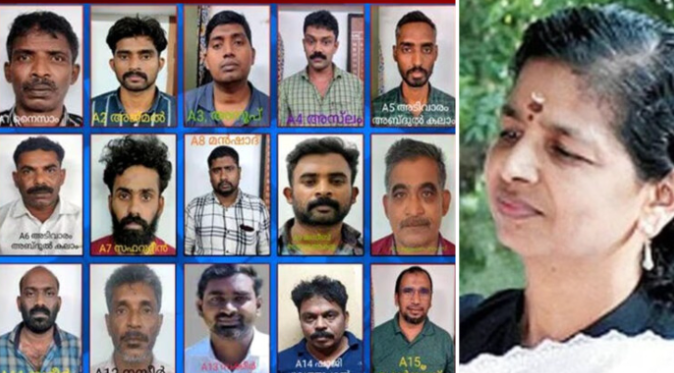
Case Summary
A Hindu female judge named Judge VG Sridevi was subjected to death threats by Muslims for issuing the death penalty to several Islamic extremists linked to the Popular Front of India (PFI) and the Social Democratic Party of India (SDPI), Islamic terror groups, involved in the murder of Hindu BJP leader Ranjith Sreenivasan. Ranjith Sreenivasan, the BJP OBC Morcha state secretary, was brutally attacked and killed at his home on 19th December 2021. His murder occurred shortly after K.S. Shan, the state secretary of the Social Democratic Party of India, was killed on the night of 18th December 2021 while returning home in Alappuzha. A total of 15 Muslim extremists, all affiliated with the now-banned Popular Front of India, were arrested in connection with Sreenivasan’s murder. Judge VG Sridevi, who sentenced the terrorists linked to the banned PFI and SDPI for the murder of Ranjith Sreenivasan, faced death threats from Muslim extremists on social media, leading to increased security measures. Alappuzha South Police filed six cases against the individuals issuing threats, resulting in two arrests. The judge, serving in Kerala’s Mavelikkara Additional District Sessions Court, handed down death sentences to all 15 convicts on 30th January 2024 for the murder. Following the sentencing, Islamic radicals launched a hate campaign against Judge Sridevi online, prompting the Kerala Police to enhance her security. Two suspects were apprehended in Thiruvananthapuram and Alappuzha. Notably, the PFI and SDPI are both Islamic terrorist organisations linked to numerous anti-Hindu and anti-India activities. The Popular Front of India and its political wing, the Social Democratic Party of India, were involved in the targeted murders of several Hindus. On 22nd September 2016, Sasikumar, a Hindu Munnani leader, was chased and brutally hacked to death by PFI members in Coimbatore. The National Investigation Agency charged the accused linked to the PFI in this murder, which aimed to terrorise Hindu organisations and incite communal tensions. Similarly, on 5th February 2019, Ramalingam, a Pattali Makkal Katchi worker, was hacked to death; the NIA attributed this crime to PFI activists. Additionally, RSS (Rashtriya Swayam Sevak Sangh) worker Rudresh was brutally killed near Shivajinagar in Bangalore on 16th October 2016 by five Muslim assailants, all linked to PFI. This was done to create fear in the minds of Hindus and Hindu organisations like the RSS. Furthermore, leaked documents such as 'Mission 2047,' recovered from PFI leadership during NIA raids, reveal a strategic plan to transform India into an Islamic nation by systematically killing Hindus, dismantling Hindu organisations, forcibly converting Hindus to Islam, and desecrating Hindu temples. This long-term, organised blueprint aims to destabilise Hindu societal structures and impose Islamic rule. It explicitly states that democratic and secular institutions will be manipulated to facilitate the establishment of Islamic rule in India, underscoring the violent and subversive intent driving the Popular Front of India’s activities.
Why it is Hate Crime ?
This case is being added to the tracker under the primary category- Hate Speech against Hindus. Within this, the subcategory selected is- Violent Threats. Violent threats, explicit, implicit or implied, is the most dangerous form of hate speech since it goes beyond discriminatory and prejudicial language to express the intent of causing harm to an individual or a group of people based on their religious identity and faith. There could be several different kinds of threats that are issued to Hindus based on religious animosity. An explicit threat would mean the direct threat of violence towards an individual Hindu, a group of Hindus or Hindus at large. Physical violence, death threats, threats of destruction of property belonging to Hindus and threats of genocide would mean explicit threats against Hindus for their religious identity. Implicit threats may not be a direct threat but implied through the use of symbols of actions – for example – in the Nupur Sharma case, other than explicit threats, there were also implicit threats when Islamists took to the streets to burn and beat her effigies. It implies that they want to do the same to Nupur Sharma – thereby is considered an implicit threat. Violent threats can be delivered in person, through letters, phone calls, graffiti, or increasingly through social media and other online platforms. It would be important to understand that a threat – explicit or implicit, online or offline – to an individual who happens to be a Hindu does not qualify as a religiously motivated threat. Such a threat, while vile and dangerous, could be owing to non-religious reasons and/or personal animosity. To qualify as a religiously motivated threat, it would need to exhibit an indication that the individual is being targeted for religious reasons and/or owing to his/her religious identity as a Hindu. Another primary category selected is- Attack not resulting in death. The subcategory selected is- Attacked for opposing radicals or trying to save victim. In several cases, Hindus are attacked for opposing religiously motivated crimes being committed against a fellow Hindu or simply for voicing an opinion opposing radical elements, who either have in the past or continue to persecute Hindus. In such cases, the initial attack against the victim, against which the Hindu was trying to defend the victim, would also need to be classified as a religiously motivated hate crime. Since the initial crime itself was religiously motivated and the subsequent crime of attempting to save the victim or speaking against the radical elements ends up inviting a violent attack, it would also be classified as a religiously motivated hate crime under this category. In this case, the threats made by Muslim extremists against Judge VG Sridevi vividly demonstrate deep-seated religious animosity. This Hindu female judge was subjected to death threats for sentencing fifteen Islamic radicals linked to the banned Popular Front of India (PFI) and Social Democratic Party of India (SDPI) for the brutal murder of Hindu BJP leader Ranjith Sreenivasan. It is also important to note that BJP workers and politicians are widely perceived as representatives of the Hindu community by Islamist extremists, which means their targeted murders by the PFI are driven by religious hostility. The fact that Judge Sridevi was targeted specifically after delivering justice in a case involving Islamist terrorists reflects direct and explicit hostility towards her Hindu identity. Her role as a judge opposing Islamic radicals became the basis for violent intimidation, exposing animosity not only towards her judicial decision but also towards her religious identity. Such threats are more than mere expressions of dissent; they amount to issuing violent threats to kill a Hindu woman merely for performing her judicial duty. This blatant attempt to intimidate and threaten violence against a judge exercising lawful authority exemplifies religious hatred in its most dangerous form. The Islamist elements’ readiness to endanger the life of a Hindu female judge over a verdict underscores the prevalence of extremist mindsets within the Indian Muslim community that seek to undermine the rule of law through fear and coercion. This episode clearly manifests how religious animosity can escalate into harassment that jeopardises personal safety and judicial independence. Moreover, the Islamist extremist nature of the PFI—known for a wide spectrum of violent anti-Hindu activities, including targeted murders, forced conversions, and terror campaigns—intensifies this display of religious hatred. The PFI’s actions, documented extensively in multiple high-profile cases involving political assassinations of Hindu leaders and attacks on Hindu organisations, indicate a radicalised agenda that glorifies violence against Hindus. The willingness of Muslim extremists in this case to rally behind PFI terrorists rather than the Hindu judge highlights entrenched communal hostility, demonstrating the extent of radicalisation within the Indian Muslim community. This case stands as a stark example of an anti-Hindu hate crime driven by Islamist fanaticism. It exposes the dangerous extremity of radicalisation that fuels targeted violence against Hindus and Indian institutions. Therefore, this case is being added to the hate crime database of the Hinduphobia Tracker.
Victim Details
Total Victim
1
Deceased
0
Gender
- Male 0
- Female 1
- Third Gender 0
- Unknown 0
Caste
- SC/ST 0
- OBC 0
- General 0
- Unknown 1
Age Group
- Minor 0
- Adult 1
- Senior Citizen 0
- Unknown 0


Case Status
Case sub-judice


Perpetrators Details
Perpetrators
Muslim Extremists
Perpetrators Range
From 5 to 10
Perpetrators Gender
unknown
 Sources




