Hindu villagers targeted in conversion attempt hidden inside unauthorised healing meeting in Pratapgarh, Uttar Pradesh
 Pratapgarh, Uttar Pradesh, India
  19 November, 2025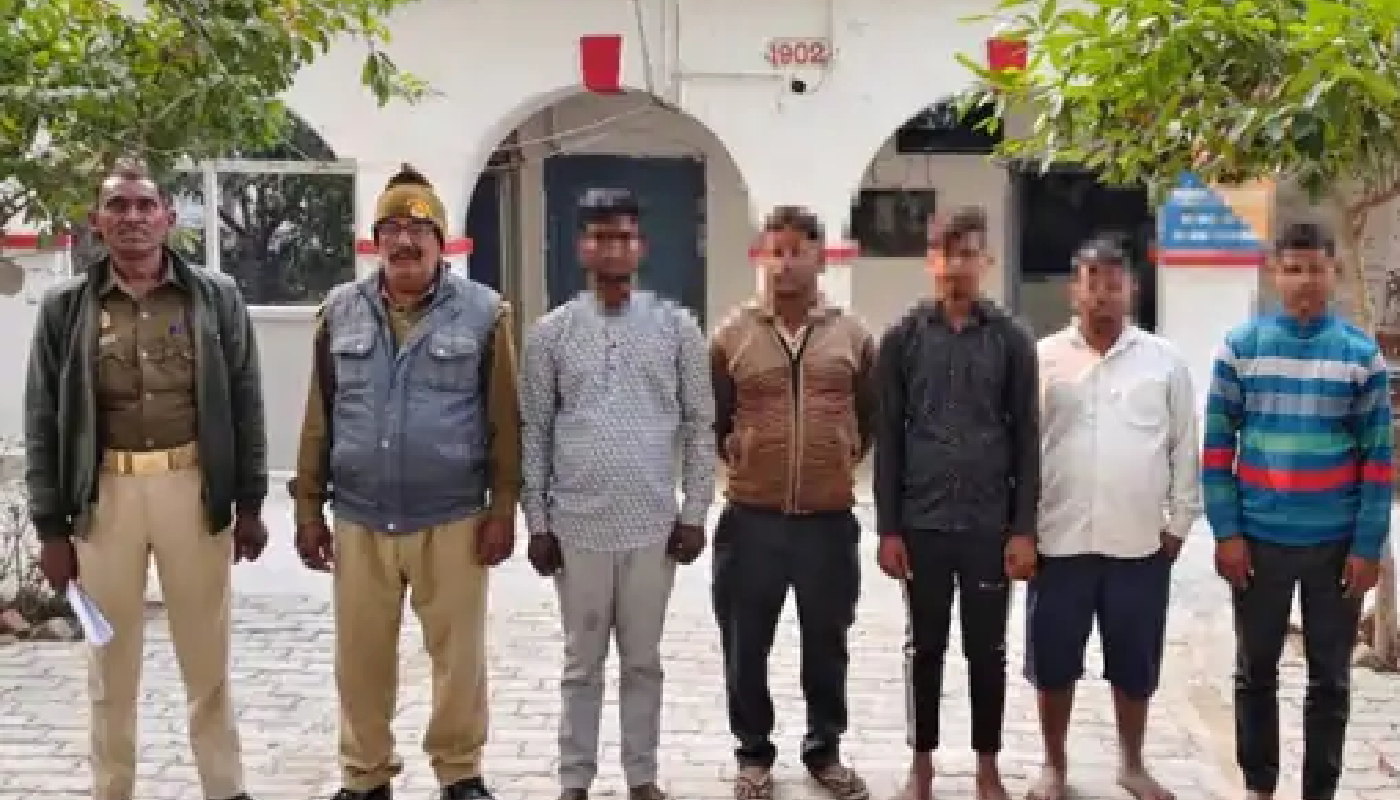
Case Summary
A conversion attempt under the garb of a Christian healing meeting was uncovered in the Baghrai area of Pratapgarh, Uttar Pradesh. Five men were arrested by the police for organising a Changai Sabha without permission. Police received confidential information that a gathering had been arranged in Attanagar Raipur village and that it could draw a crowd large enough to disturb public order. Officers reached the spot after receiving the alert and found the men involved in activities the police described as suspicious. The event, held without any official approval, raised concerns in locals as it was an attempt to influence vulnerable villagers under the guise of faith healing. The arrested men were identified as Shivalal Saroj, aged 27, Shiv Poojan Saroj, aged 19, Anoop Saroj, aged 21, and Mithlesh alias Amit Saroj, aged 22, all from Attanagar Raipur, and Narendra Gautam, aged 35, from Lodipur. According to the police, the unauthorised meeting and the circumstances surrounding it warranted immediate intervention to prevent any disruption. Legal action was initiated against all five under sections 170, 126 and 135 of the Bharatiya Nyaya Sanhita. The operation was carried out by a team comprising Sub Inspector Rahul, Sub Inspector Lalji Ram, Sub Inspector Jwala Prasad, Constable Ranjeet Kumar, Constable Atul Kumar and PRD member Meena Devi.
Why it is Hate Crime ?
The primary category in this case is: Predatory Proselytisation. The first subcategory under this is: Conversion/ attempts to convert by inducement. Predatory Proselytisation is not just limited to threat, harassment, force and violence, but it also has contours of stealth. In several cases, the Hindu victim is exploited to convert, with non-Hindus taking advantage of their poverty. In such cases, the Hindu victim who is suffering financially is offered monetary benefits, including lucrative offers for jobs, health treatment, education, etc, to induce the victim into changing his/her religion. In such cases, the religious identity of the victim and the aim to disenfranchise him from his faith form the heart of the crime. Also, taking advantage of and exploiting an individual’s economic vulnerabilities is widely acknowledged as exploitation, forms of which are often penalised by law. Such cases therefore are considered religiously motivated hate crimes since the victim’s religious identity forms the very heart of the crime itself. The second subcategory under this is: Proselytisation by grooming, brainwashing, manipulation or subtle indoctrination. Religious brainwashing essentially means the often subtle and forcible indoctrination to induce someone to give up their religious beliefs to accept contrasting regimented ideas. Religious grooming or brainwashing also involves propaganda and manipulation. It involves the systematic effort, driven by religious malice and indoctrination, to persuade “non-believers’ to accept allegiance, command, or doctrine to and of a contrasting faith. Cases of such grooming or brainwashing are far more nuanced than direct threats, coercion, inducement and violence. In such cases, it is often seen that there is repeated, subtle and continual manipulation of the victim to induce disaffection towards their own faith and acceptance of the contrasting faith of the perpetrator. While subtle indoctrination is widely acknowledged as predatory, an element which is often understated in such conversions or the attempts of such conversion is the role of loyalty and trust which might develop between the perpetrator and the victim. Fiduciary relationships are often abused to affect such religious conversion. For example, an educator transmitting religious doctrine of a competing faith to a Hindu student. The Hindu student is likely to accept what the teacher is transmitting owing to existence of the fiduciary relationship. The exploitation of the fiduciary relationship to religiously indoctrinate victims would also be included in this category. Since the underlying animosity towards the victim’s faith forms the basis of predatory proselytisation, such cases are considered religiously motivated hate crimes. This case has been added to the tracker because it shows a clear pattern of covert religious targeting carried out through methods designed to appear harmless on the surface. The Changai Sabha format, often described publicly as a faith healing gathering, is a well-recognised tool in organised Christian proselytisation networks. These meetings usually employ songs, testimonies and emotionally charged prayer sessions to influence and induce vulnerable individuals without openly declaring the underlying objective. The absence of transparency is itself central to the method. People attend believing they are seeking comfort, healing or spiritual support, only to be gradually drawn into teachings that undermine their own religious identity and introduce them to the Christian framework presented as the only path to relief. This case is especially significant because the meeting was conducted without permission and in a rural setting where economic vulnerability and limited access to healthcare make residents more susceptible to such approaches. In many such gatherings, healing claims are used as an entry point, promising relief from illness, misfortune or poverty. These promises are not presented as medical or practical solutions but as religious outcomes that require the acceptance of a different faith. This creates a situation where individuals are encouraged to believe that their suffering is linked to their Hindu identity and that improvement is possible only by adopting another creed. That psychological framing is a subtle but powerful form of pressure. The police found the individuals engaged in activities described as suspicious, which suggests that the meeting was not a devotional or cultural event but something designed to manipulate those who attended. When groups use such indirect methods to influence people, especially those who lack the resources or confidence to question the narrative being presented, the line between religious teaching and exploitation becomes clear. Exploiting someone’s vulnerability to weaken confidence in their faith and push them towards another belief system is not a neutral act. It strikes at the core of personal religious identity and targets individuals precisely because they are Hindu and therefore seen as potential subjects for conversion. For these reasons, the incident qualifies as a targeted attempt to influence Hindus through covert and manipulative means. The method used, the secrecy, the vulnerability of the attendees and the deliberate attempt to weaken Hindu belief systems together make this a case of religiously motivated harm. Disclaimer: It is important to clarify that none of the media sources covering this case have specified the exact date on which the incident happened. Therefore, for documentation purposes, we have recorded the date based on when the incident was reported in the media.


Case Status
Arrested


Perpetrators Details
Perpetrators
Christian Extremists
Perpetrators Range
From 2 To 5
Perpetrators Gender
male
 Sources




