Hindus targeted in USCIRF 2025 report; temple attacks, anti-Hindu riots and coercive conversions downplayed
 United States
  24 March, 2025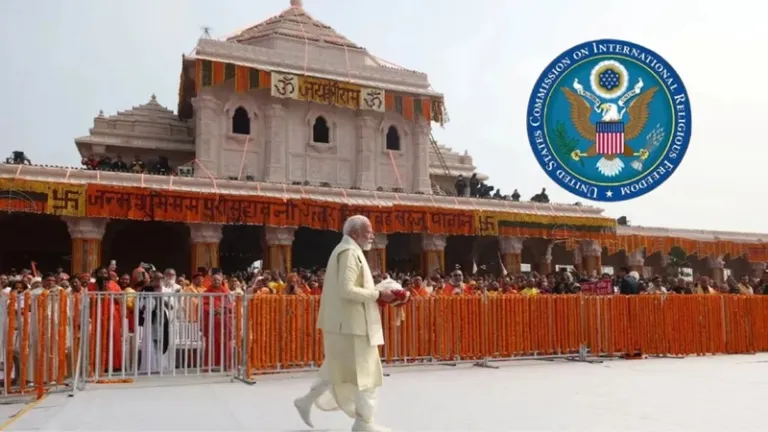
Case Summary
Hindus were targeted in the United States Commission on International Religious Freedom (USCIRF) report, released on 25 March 2025, which presented a series of claims that either ignored key facts or selectively framed events in a way that unfairly portrayed Hindus as aggressors and not as victims. The report described India as a “Country of Particular Concern” while overlooking the documented evidence of attacks on Hindu temples, the historical context of Hindu religious sites and the legal processes that have upheld Hindu claims in major disputes. One of the clearest examples is the way the report handled the Ram Mandir in Ayodhya. It suggested that the temple was simply built on the “ruins of Babri,” ignoring archaeological findings, archival records and the 2019 Supreme Court judgement that recognised the presence of an earlier Hindu temple at the site. By removing this context, the report undermined a legal decision that was based on decades of evidence. This dismissal directly affects Hindu claims to heritage and religious freedom. The report also attempted to reinterpret the 2020 anti-Hindu riots in Delhi by portraying Muslim individuals accused of planning the violence as “peaceful protesters.” Official charge sheets, call records, and witness statements show evidence of organised planning, yet USCIRF minimised the targeting of Hindu neighbourhoods and the deaths and injuries suffered by Hindu residents. This selective framing erased Hindu victims and reframed key Muslim accused as unjustly detained, which misrepresented the incidents entirely. The report repeated similar patterns when addressing demolition drives carried out in different states. These operations targeted illegal encroachments, but USCIRF portrayed them as actions taken specifically to harm one community. This framing ignored cases where Hindu structures were also removed and overlooked the admissions by some mosque committees acknowledging unauthorised construction. By doing so, the report created a narrative that excluded Hindu perspectives and reduced administrative enforcement to religious persecution narratives. The section on anti-conversion laws also presented Hindus negatively by suggesting these laws targeted minorities. In fact, these laws exist to prevent forced or deceptive conversions, and many complaints have come from Hindu communities who reported pressure, inducement or exploitation. By omitting these testimonies, the report disregarded Hindu victims of coercive conversion practices. The discussion on cow protection laws similarly disregarded the long-standing cultural and constitutional basis for protecting the cow in India. USCIRF portrayed these laws as tools of oppression, while ignoring the civilisational and legal context that shapes Hindu religious life. Overall, the USCIRF report targeted Hindus by removing or downplaying the harm faced by Hindu communities, ignoring evidence that supports Hindu claims, and presenting events in a way that consistently placed Hindus in a negative or distorted light.
Why it is Hate Crime ?
The primary category in this case is: Hate speech against Hindus. The subcategory under this is: Anti-Hindu subversion and prejudice. The tertiary category under this is: Anti-Hindu Fake News or Downplaying. Hate speech is defined as any speech, gesture, conduct, writing, or display that is prejudicial against a specific individual and/or group of people, which is leading to or may lead to violence, prejudicial action or hate against that individual and/or group. Media plays a specific and overarching reach in perpetuating prejudicial attitudes towards a community owing to unfair, untrue coverage and/or misrepresentation/misinterpretation, selective coverage and/or omission of facts of/pertaining to issues affecting a specific religious group. This type of bias can dehumanise the victim group, making it easier for others to justify harmful actions against them, which aligns with the objectives of hate speech laws aimed at preventing such harm. It is often observed that the media takes a prejudicial stand against the Hindu community driven by their need to shield the aggressor community which happens to be a numeric minority, however, is the one perpetrating violence against Hindus. For example, the media is often quick to contextualise religiously motivated crimes against Hindus, omit or misrepresent facts that point towards religiously motivated hate crimes, justify and/or downplay religiously motivated hate crimes or simply present fake news to stereotype Hindus. Such media bias leads to the denial of persecution and is often used to dehumanise Hindus, leading to justification for violence against them. For example, the media covered several fake allegations of Hindus targeting Muslims and forcing them to chant Jai Shree Ram. Most of these cases were proved false and fabricated after police investigation. These fake news reports were subsequently never retracted or clarified. Such fake news led to the justification of violence and dehumanisation of Hindus based on the argument that since Hindus targeted Muslims and forced them to chant Jai Shree Ram, the dehumanisation of Hindus and violence against them was par for the course and merely a retaliation. Such media bias leads to prejudicial portrayal of Hindus and offers a justification for violence against them and therefore, is considered hate speech under this category. This case has been added to the tracker because the USCIRF report does more than express an unfavourable opinion. It constructs a narrative that systematically disadvantages Hindus by misrepresenting events, erasing Hindu victimhood and reframing legitimate Hindu religious claims as politically motivated or illegitimate. When an influential organisation presents selective or distorted information, the consequences extend far beyond perception. Such narratives influence policymakers, shape global discourse and normalise prejudice against Hindus by encouraging audiences to view them as aggressors even in situations where evidence shows otherwise. The distortion surrounding the Ram Mandir reflects this deeper pattern. The struggle for the reclamation of the site spans centuries, with historical records, archaeological evidence and a long legal battle culminating in the 2019 Supreme Court judgement. Generations of Hindus fought to have the original temple acknowledged, documented and restored. By removing this entire context and depicting the temple simply as a structure “built on the ruins of Babri,” USCIRF constructs a narrative that denies Hindu heritage and delegitimises a civilisational claim that has been examined and affirmed through due process. The treatment of the 2020 Delhi riots reveals an even more striking example of narrative inversion. The anti Hindu violence was widely and incorrectly presented by sections of mainstream international media as an anti Muslim pogrom, obscuring the documented pattern of targeted attacks on Hindu neighbourhoods. Established facts regarding Hindu casualties and the extensive damage suffered by Hindu families were marginalised or ignored. Hindu victims, such as Intelligence Bureau officer Ankit Sharma, were brutally murdered. Another Hindu youth, Dilbar Negi, was burnt to death after his hands and legs were chopped off by Islamists, yet their experiences received limited acknowledgement in the global discourse. Significant law enforcement personnel were also killed, and incidents such as an armed rioter brandishing a weapon at police were critical developments that demonstrated the organised nature of the unrest. The riots erupted in the context of escalating tensions after the passage of the Citizenship Amendment Act, and what Delhi witnessed was the culmination of months of mobilisation by radical elements. By omitting all these aspects, the USCIRF report creates a version of the events in which Hindu suffering is sidelined, and those accused of orchestrating violence are recast as peaceful victims. This form of erasure contributes directly to long-term prejudice because it denies Hindus recognition as victims of communal violence. The misrepresentation of demolition drives, anti-conversion laws and cultural norms further contributes to this pattern. Routine administrative actions against illegal encroachments were selectively interpreted as communal targeting, despite evidence that such actions affected multiple communities. Testimonies from Hindus reporting coercion and inducement in conversion cases were excluded entirely, and long-established cultural and constitutional bases for practices such as cow protection were portrayed as oppressive rather than as expressions of religious life. Taken together, these omissions and distortions amount to a form of targeted misinformation that functions as hate speech. It removes Hindu experiences from the public record, strips Hindu perspectives of legitimacy and constructs a narrative in which Hindus are presumed to be aggressors even in contexts where they were victims. This systematic bias contributes to a climate of hostility and prejudice against Hindus, which is why this case qualifies as a hate crime against Hindus and has been included in the tracker.


Case Status
Unknown


Perpetrators Details
Perpetrators
Others
Perpetrators Range
N/A
Perpetrators Gender
unknown
 Sources




