Minor Hindu students forced to convert by Christian teachers at government school, forced to remove tilak and kalava
 Chhindwara, Madhya Pradesh, India
  17 November, 2025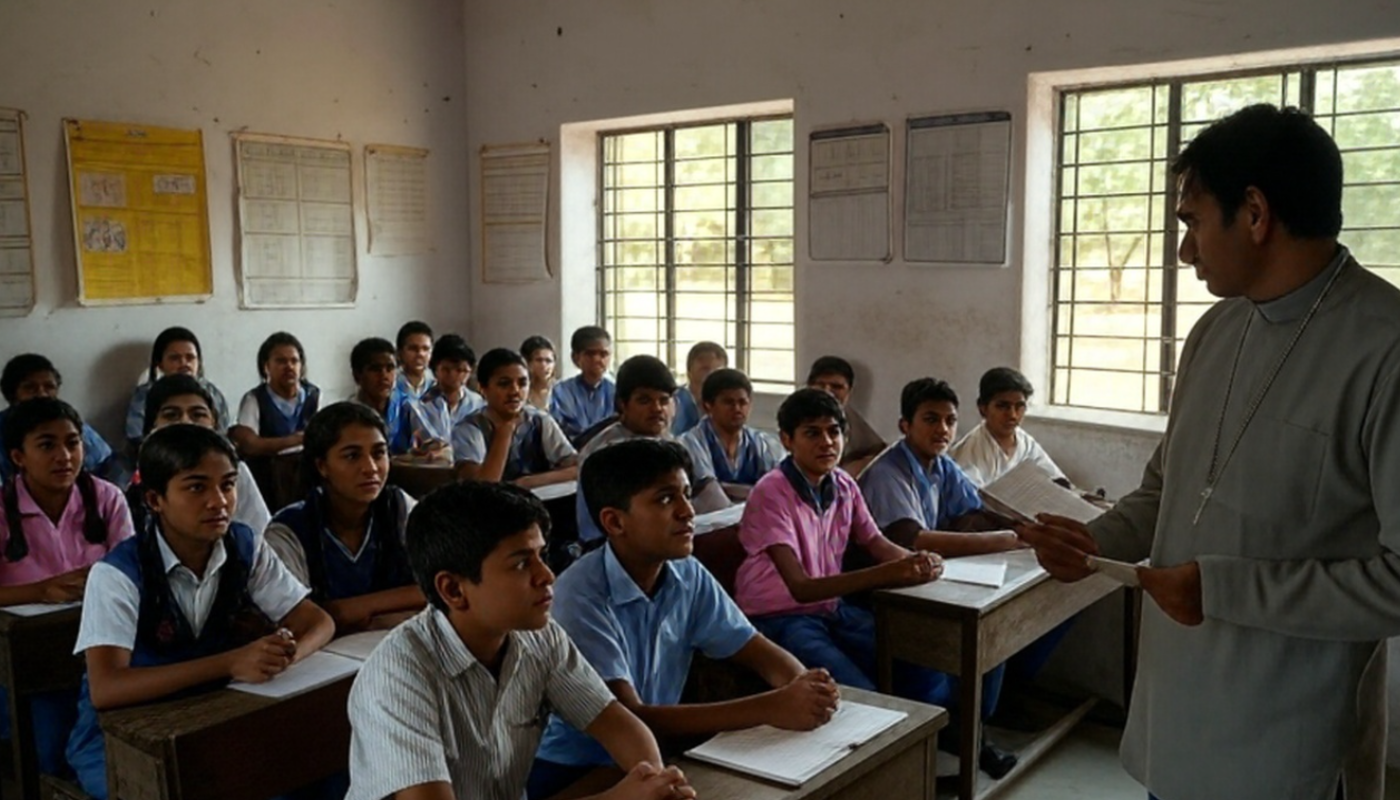
Case Summary
Hindu students were forced to convert at a government higher secondary school in Bilawar Kala, Junnardeo, Madhya Pradesh, where a teacher and the hostel superintendent pressured them to accept Christianity. They were forced to remove their tilak and kalava, with students stating that these sacred symbols were wiped off or taken away when they arrived at school. Pupils from classes ten and twelve reported that teacher Seema Mathews regularly promoted Christian teachings and urged tribal Hindu students to abandon their faith. They stated that this pressure was persistent and directly targeted their religious identity rather than any classroom activity. According to the students, refusal to comply invited threats. Children who resisted were warned that they would be issued a Transfer Certificate, a measure that would remove them from the school entirely. The combination of religious pressure, forced removal of Hindu symbols, and intimidation created an atmosphere in which the minors felt unable to object to the authority figures involved. Local representatives of the Vishva Hindu Parishad and the Kanhan Bachao Manch submitted a written complaint to the Tribal Welfare Department and the District Collector, urging immediate intervention. Police confirmed that an inquiry had begun based on the students’ statements.
Why it is Hate Crime ?
The primary category in this case is: Predatory Proselytisation. The first subcategory under this is: Harassment, threats, coercion for conversion. Harassment covers a wide range of behaviours of an offensive nature. It is commonly understood as behaviour that demeans, humiliates, and intimidates a person, including threats and coercion. Harassment and threats, in this case, find their root on discriminatory grounds which has the effect of nullifying a person’s rights or infringing upon his freedom to exercise his right specifically owing to the victim’s religious identity. Verbal and physical threats and psychological or physical harassment are often used against Hindu victims because they choose to practice their professed religion. Religious harassment also includes forced and involuntary conversions by harassment, threats or coercion. Coercion includes intimidatory tactics like force-feeding a Hindu victim beef to convert to another religion, forceful circumcision etc. In several cases documented, non-Hindu perpetrators or those who harbour specific animosity towards Hinduism, harass victims simply based on their religious identity. Such cases often also include harassment to ensure the Hindu victim abandons his/her professed religion and adopts the religion of the perpetrator. Such cases where Hindu victims are harassed to convert to the perpetrator’s religion are rooted in animosity towards the victim’s religious identity and are therefore documented as religiously motivated hate crimes. The second subcategory under this is: Proselytisation by grooming, brainwashing, manipulation or subtle indoctrination. The tertiary category under this is: Conversion of minor. Religious brainwashing essentially means the often subtle and forcible indoctrination to induce someone to give up their religious beliefs to accept contrasting regimented ideas. Religious grooming or brainwashing also involves propaganda and manipulation. It involves the systematic effort, driven by religious malice and indoctrination, to persuade “non-believers’ to accept allegiance, command, or doctrine to and of a contrasting faith. Cases of such grooming or brainwashing are far more nuanced than direct threats, coercion, inducement and violence. In such cases, it is often seen that there is repeated, subtle and continual manipulation of the victim to induce disaffection towards their own faith and acceptance of the contrasting faith of the perpetrator. While subtle indoctrination is widely acknowledged as predatory, an element which is often understated in such conversions or the attempts of such conversion is the role of loyalty and trust which might develop between the perpetrator and the victim. Fiduciary relationships are often abused to affect such religious conversion. For example, an educator transmitting religious doctrine of a competing faith to a Hindu student. The Hindu student is likely to accept what the teacher is transmitting owing to existence of the fiduciary relationship. The exploitation of the fiduciary relationship to religiously indoctrinate victims would also be included in this category. Since the underlying animosity towards the victim’s faith forms the basis of predatory proselytization, such cases are considered religiously motivated hate crimes. Another primary category in this case is: Attack on Hindu religious representations. The first subcategory under this is: Desecration of Hindu religious symbol. Icons and symbols or a religious representation of a spiritual ideal are widely revered in Hinduism. Iconography is of vital significance in the Hindu milieu. It helps connect people’s spiritual beliefs with the real world. Iconography within the Hindu faith takes several shapes and forms. Murtis are of most significance to Hindus, to which daily rituals, prayers and offerings are done. Besides the murtis, there are several other symbols which have deep significance in the Hindu faith – the Om and Swastika for example. Since these Hindu religious symbols hold paramount importance in Hinduism, any desecration of symbols, icons, murtis, religious representations and manifestations, is driven by animosity towards the faith itself which manifests itself through these murtis, icons and symbols. Therefore, any desecration of these Hindu religious symbols and representations is considered religiously motivated hate crimes under this category. Another primary category in this case is: Attack not resulting in death. The subcategory under this is: Attacked for Hindu identity. In several cases, Hindus are attacked merely for their Hindu identity without any perceived provocation. A classic example of this category of religiously motivated hate crime is a murder in 2016. 7 ISIS terrorists were convicted for shooting a school principal in Kanpur because they got ‘triggered’ seeing the Kalava on his wrist and tilak that he had put. In this, the Hindu victim had offered no provocation except for his Hindu religious identity. The motivation for the murder was purely religious, driven by religious supremacy. Such cases where Hindus are targeted merely for their religious identity would be documented as a hate crime under this category. This case has been added to the tracker because the conduct described by the students reveals a sustained attempt to influence, intimidate and reshape the religious identity of Hindu minors within a school environment. The victims are children, which means they occupy a position where consent, resistance and independent judgement are limited by age and by the authority of teachers. When adults responsible for their education use their position to pressure them into adopting another religion, the imbalance of power turns the situation into one of coercion rather than choice. Their expose points to a clear pattern in which religious pressure was accompanied by harassment. The students reported that they were repeatedly urged to accept a faith that was not their own and were discouraged from maintaining their Hindu identity. This pressure included attempts to persuade them that their inherited beliefs were inferior. When minors are subjected to such treatment, the underlying intention becomes an important factor, as the harm is directed at weakening their connection to their own tradition. The removal of visible symbols such as the tilak and kalava adds another dimension. These are not decorative items but markers of cultural belonging and daily religious observance. Forcing students to erase them signals contempt for the identity those symbols represent. When such actions are carried out by authority figures, they communicate that Hindu expression is unwelcome or punishable within the institution. This transforms the school from a neutral space into one where religious difference is manipulated to control behaviour. Threats directed at children who resisted further reinforce the coercive nature of the conduct. Warning minors that they may be expelled if they refuse to abandon their religious symbols or religious identity creates an atmosphere of fear. The threat of losing their place in the school becomes a tool to suppress their faith. This dynamic is critical to understanding why the case rises beyond misconduct and becomes a matter of identity-based hostility. The involvement of teachers and hostel staff also reflects the exploitation of trust. Students depend on educators for guidance, protection and academic support. When this trust is used to promote religious conversion or to engineer disaffection from their own belief system, the intent becomes central to understanding the harm. The manipulation of minors in this manner is recognised as predatory because it seeks to alter their faith before they are capable of recognising or resisting the influence. The case qualifies as a hate crime against Hindus because the pressure, coercion and intimidation were directed specifically at Hindu students due to their religious identity. The acts described were designed to weaken or erase their Hindu self-expression and to push them toward a different religious affiliation. The targeting was deliberate, repeated and rooted in hostility toward the beliefs they carried, making its inclusion in the tracker necessary and justified. Disclaimer: It is important to clarify that none of the media sources covering this case have specified the exact date on which the incident happened. Therefore, for documentation purposes, we have recorded the date based on when the incident was reported in the media.


Case Status
Complaint filed


Perpetrators Details
Perpetrators
Christian Extremists
Perpetrators Range
From 2 To 5
Perpetrators Gender
male
 Sources




