Hindu boys compelled to discard Janeu and Kalava by Muslim teacher at residential school in Udupi, Karnataka
 Udupi, Karnataka, India
  18 November, 2025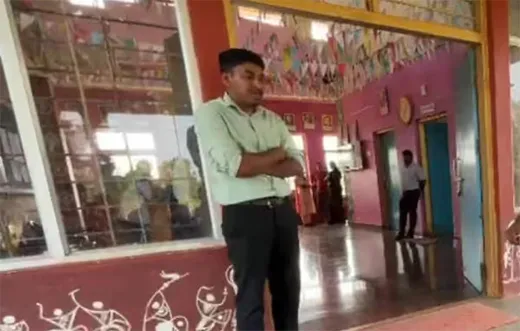
Case Summary
Hindu students were forced to remove their Janeu and sacred Kalava (wrist threads) at the Morarji Desai Residential School in Miyyar, Udupi, Karnataka, prompting a serious public outcry and the immediate dismissal of the teacher involved. The instructor, identified as Madarsa S. Makandar from Kalaburagi, had been serving as a guest physical education teacher since June 2025. Parents stated that the boys were singled out because they wore sacred symbols associated with Hindu duty and upbringing, and that this pressure was accompanied by harsh punishments, including demands for two hundred sit-ups. Families explained that the conduct did not arise suddenly. They had issued earlier complaints over similar behaviour, yet the pattern persisted unchanged. This created the impression that the pressure placed on the boys was intentional and directed at the visible markers of their Hindu identity rather than an issue of routine discipline. The principal responded to the renewed complaints by terminating the instructor’s appointment with immediate effect. Local residents gathered at the school and characterised the incident as a deliberate interference with the religious life of the children. They argued that the Janeu is a sacred symbol within Hindu practice and that compelling its removal is an affront to belief rather than a trivial act. They also dismissed the instructor’s defence that he did not understand the significance of the symbol, stating that such a claim reflected disregard for the cultural and religious identity of the students under his supervision. Community members noted that Miyyar has long been regarded as a place of coexistence, and they expressed concern that ideological bias within an educational setting could undermine that atmosphere. They emphasised that schools must remain spaces where the faith of students is respected and not subjected to intimidation or ridicule. The incident was therefore regarded as a serious breach of trust, prompting calls for vigilance to ensure that the religious dignity of Hindu students is safeguarded in the future.
Why it is Hate Crime ?
The primary category in this case is: Attack on Hindu religious representations. The subcategory under this is: Desecration of Hindu religious symbol. Icons and symbols or a religious representation of a spiritual ideal are widely revered in Hinduism. Iconography is of vital significance in the Hindu milieu. It helps connect people’s spiritual beliefs with the real world. Iconography within the Hindu faith takes several shapes and forms. Murtis are of most significance to Hindus, to which daily rituals, prayers and offerings are done. Besides the murtis, there are several other symbols which have deep significance in the Hindu faith – the Om and Swastika for example. Since these Hindu religious symbols hold paramount importance in Hinduism, any desecration of symbols, icons, murtis, religious representations and manifestations, is driven by animosity towards the faith itself which manifests itself through these murtis, icons and symbols. Therefore, any desecration of these Hindu religious symbols and representations is considered religiously motivated hate crimes under this category. The second primary category under this is: Attack not resulting in death. The subcategory under this is: Attacked for Hindu identity. In several cases, Hindus are attacked merely for their Hindu identity without any perceived provocation. A classic example of this category of religiously motivated hate crime is a murder in 2016. 7 ISIS terrorists were convicted for shooting a school principal in Kanpur because they got ‘triggered’ seeing the Kalava on his wrist and the tilak that he had put. In this, the Hindu victim had offered no provocation except for his Hindu religious identity. The motivation for the murder was purely religious, driven by religious supremacy. Such cases where Hindus are targeted merely for their religious identity would be documented as a hate crime under this category. The third subcategory under this is: Predatory Proselytisation. The subcategory under this is: Proselytisation by grooming, brainwashing, manipulation or subtle indoctrination. Religious brainwashing essentially means the often subtle and forcible indoctrination to induce someone to give up their religious beliefs to accept contrasting, regimented ideas. Religious grooming or brainwashing also involves propaganda and manipulation. It involves the systematic effort, driven by religious malice and indoctrination, to persuade “non-believers’ to accept allegiance, command, or doctrine to and of a contrasting faith. Cases of such grooming or brainwashing are far more nuanced than direct threats, coercion, inducement and violence. In such cases, it is often seen that there is repeated, subtle and continual manipulation of the victim to induce disaffection towards their own faith and acceptance of the contrasting faith of the perpetrator. While subtle indoctrination is widely acknowledged as predatory, an element which is often understated in such conversions or the attempts of such conversion is the role of loyalty and trust which might develop between the perpetrator and the victim. Fiduciary relationships are often abused to affect such religious conversion. For example, an educator transmitting religious doctrine of a competing faith to a Hindu student. The Hindu student is likely to accept what the teacher is transmitting owing to existence of the fiduciary relationship. The exploitation of the fiduciary relationship to religiously indoctrinate victims would also be included in this category. Since the underlying animosity towards the victim’s faith forms the basis of predatory proselytization, such cases are considered religiously motivated hate crimes. This case has been added to the tracker because the conduct directed at the Hindu boys reflects a deliberate intrusion into their religious self-expression, carried out within an environment where their capacity to refuse or negotiate was inherently limited. The victims were minors placed under the authority of a teacher, which means the ordinary safeguards of consent, autonomy and equal standing were absent from the outset. When children are compelled to remove sacred symbols that articulate their religious belonging, the action carries a weight far beyond routine discipline. It becomes an attempt to unsettle the markers through which they understand themselves, particularly when the instruction is accompanied by punitive exercise and repeated complaints that indicate a continuing pattern rather than a sudden lapse. The pressure exerted on them acquires a coercive character because minors depend on adults for safety and guidance, and any order issued by a teacher is shaped by an imbalance of power that they cannot meaningfully challenge. The nature of the symbols involved further strengthens the classification. The Janeu and sacred wrist threads are not casual accessories but the outward form of commitments that hold a particular place in Hindu tradition. Their removal strips away visible signs of religious duty, which is why the community interpreted the act as a calculated slight rather than an administrative correction. Hate crime analysis recognises that when symbols carrying deep meaning for a specific group are targeted, the injury is not merely personal but collective, for it signals contempt toward the identity represented by those objects. The insistence that the boys discard their sacred threads, therefore, aligns with the broader pattern of attacks on Hindu religious representations, where the symbolic dimension of the harm is central to its interpretation. The conduct also bears features of hostility directed at Hindu identity. The accounts suggest that the pressure was applied only to boys wearing Hindu ritual symbols, which points to a selection process based on visible religious markers rather than general behavioural concerns. The previous warnings issued to the instructor, alongside reports that the behaviour persisted despite admonition, indicate a degree of intention that exceeds ordinary misunderstanding. Community members understood this persistence as a sign of ideological bias, since no comparable interference with other faiths was reported. In hate crime evaluation, the repeated targeting of a specific religious sign within a setting where the victims are structurally unable to resist becomes a significant indicator of animus. The presence of a teacher in this sequence introduces an additional dimension that falls under the category of predatory proselytisation through subtle manipulation. While the case does not describe explicit doctrinal instruction, the exploitation of a fiduciary role to undermine a Hindu symbol mirrors the mechanisms through which belief can be gradually displaced in youthful minds. Children often associate authority with correctness, and when a teacher devalues a sacred object, the act can generate doubt or discomfort toward their own tradition. The attempt may be less overt than forced recitation or direct proselytising, yet it operates through the same principle of eroding confidence in inherited faith. This incident, therefore, qualifies as a hate crime against Hindus because it involves minors whose lack of agency magnifies the coercive impact, because it singles out a revered Hindu symbol for removal, and because it reflects a pattern of pressure rooted in disregard for Hindu identity rather than legitimate educational concerns. The episode demonstrates how hostility toward religious representation can manifest within institutional settings, and why such cases require careful documentation. Disclaimer: It is important to clarify that none of the media sources covering this case have specified the exact date on which the incident happened. Therefore, for documentation purposes, we have recorded the date based on when the incident was reported in the media.


Case Status
Unknown


Perpetrators Details
Perpetrators
Muslim Extremists
Perpetrators Range
One Person
Perpetrators Gender
male
 Sources




