Hindu man shot dead by Khalistani outfit for being associated with Hindu organisation in Punjab
 Firozpur, Punjab, India
  14 November, 2025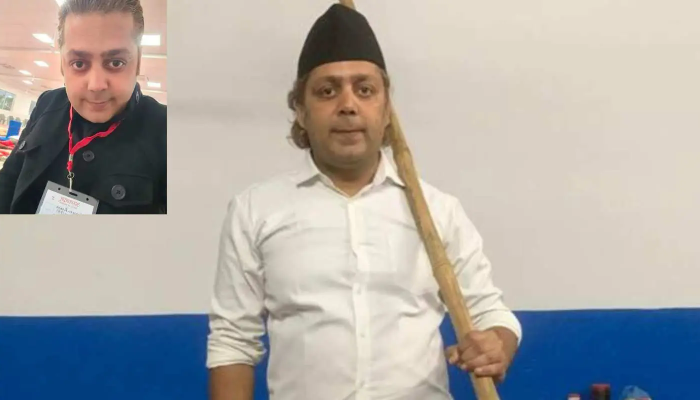
Case Summary
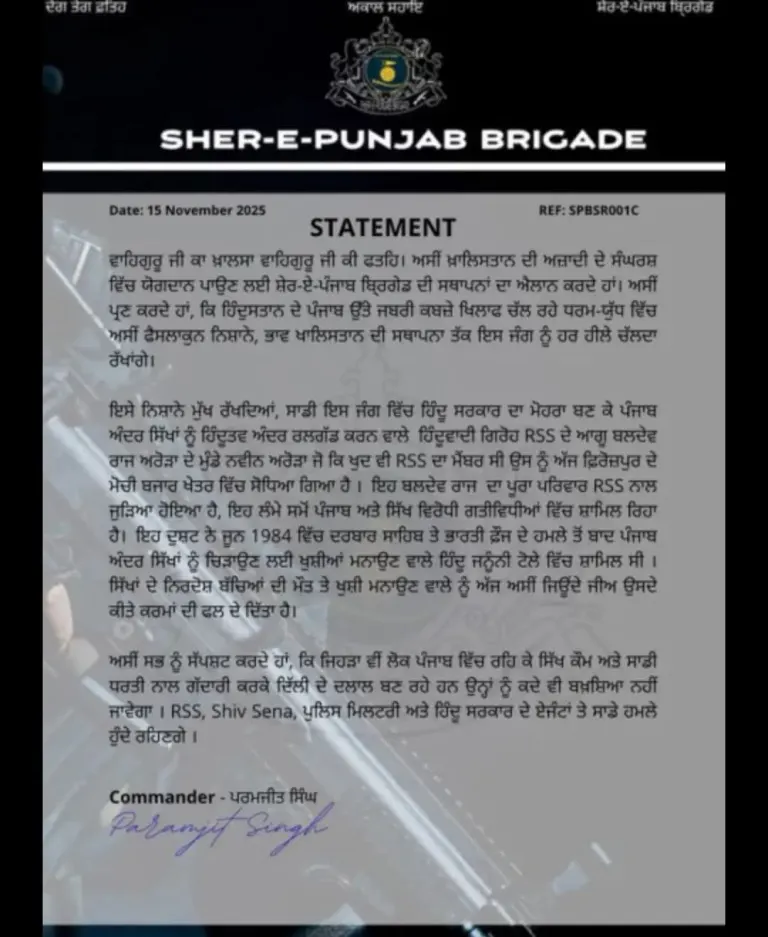
A Hindu man named Naveen Arora was murdered in Firozpur, Punjab, where two motorcycle-borne assailants shot him on 15 November 2025. Naveen, aged 32, was a third-generation Rashtriya Swayamsevak Sangh worker from a family long associated with social and community service in the region. Soon after the attack, a pro-Khalistan group calling itself the Sher-e-Punjab Brigade claimed responsibility through an online declaration. The group portrayed the killing as part of its separatist campaign and framed Naveen’s identity and affiliations as justification for the attack. Its statement accused his family of supporting national unity and described him as a target for resisting Khalistani narratives in Punjab. By openly naming him, linking him to Hindu institutions and asserting a religious-political motive, the outfit revealed that the attack was neither random nor personal, but a deliberate act rooted in hostility towards Hindu identity and organisations. Local traders responded by shutting their shops to stand with the family, while political leaders questioned the state administration over the deteriorating security climate. Calls for accountability intensified as officials acknowledged that they had little clarity about the attackers or their motive. A murder case was registered, and an investigation was underway, though the group’s public claim had already exposed the targeted nature of the crime and its ideological framing against Hindus.
Case Images
Why it is Hate Crime ?
The primary category in this case is: Attack resulting in death. The first subcategory under this is: Attacked for Hindu identity. In several cases, Hindus are attacked merely for their Hindu identity without any perceived provocation. A classic example of this category of religiously motivated hate crime is a murder in 2016. 7 ISIS terrorists were convicted for shooting a school principal in Kanpur because they got ‘triggered’ seeing the Kalava on his wrist and tilak that he had put. In this, the Hindu victim had offered no provocation except for his Hindu religious identity. The motivation for the murder was purely religious, driven by religious supremacy. Such cases where Hindus are targeted merely for their religious identity would be documented as a hate crime. Under this category, cases where the attack led to the death of the Hindu victim/s would be documented. The second subcategory under this is: Attacked for supporting/being part of perceived Hindu party/org or working for Hindu community. In several cases, Hindus are attacked specifically or tangentially for their association with parties or organizations perceived to be pro-Hindu and/or for working in favor of the Hindu community. One of the classic cases was the attack against a Bharatiya Janata Party Yuva Morcha (BJYM) worker Praveen Nettaru. Nettaru was attacked and hacked to death for his association with Hindu organizations and his work for the Hindu community. He was murdered by PFI, a terror organization that aimed to commit a genocide of Hindus, target Hindu leaders specifically, and turn India into an Islamic Nation. In such cases, it is possible that the immediate trigger for the violence is non-religious – either according to the perpetrator or the police. However, there are surrounding circumstances from which the conclusion can be reached that the victim was attacked for his association with a Hindu organization. In a similar case, Rinku Sharma was attacked by radicals. He was a member of Bajrang Dal and regularly worked for the Hindu community. While the police cited a different non-religious trigger for the attack, it is true that he was associated to a Hindu organization and the family of Rinku Sharma specifically attributed his gruesome murder to him working for Bajrang Dal and raising Jai Shree Ram slogans. Such cases are intrinsically driven by religious hate. Under this category, cases where the attack led to the death of the Hindu victim/s would be documented. This case has been entered into the tracker because it reflects a clear instance of targeted violence in which the victim’s Hindu identity and his association with a Hindu organisation were treated as grounds for lethal retribution. The killing of Naveen Arora did not arise from a personal dispute, an altercation, or a situational conflict. Instead, it was framed by the perpetrators themselves as part of a wider ideological campaign directed against Hindus, particularly those who work with or support organisations perceived as contributing to Hindu social consolidation. By publicly claiming responsibility, naming the victim, and declaring their motive in overtly religious and political terms, the group positioned the murder within a pattern of hostility directed at Hindu individuals for their identity, affiliation, and community engagement. The statements issued by the separatist outfit are central to the classification of this incident as a hate crime. In their own declaration, they asserted that they chose Naveen because he was an RSS volunteer and because his family had long served in roles aligned with Hindu institutions. The victim’s individual life or personal actions were not cited as reasons for the attack. Instead, his identity as a Hindu and his involvement in a Hindu organisation were cast as provocations sufficient to warrant violence. Such framing situates the murder within the subcategory of attacks carried out against individuals for their association with entities perceived as pro-Hindu or for their work in support of Hindu communities. This aligns with earlier documented cases where the targeting was explicitly linked to the victim’s role in organisations such as the RSS, Bajrang Dal, or other volunteer groups serving Hindu social and cultural interests. The rhetoric used by the group further underscores the religious hostility behind the attack. Their declaration described their act as part of a dharam yudh, invoked religious terminology to justify the killing, and depicted the victim’s affiliation as an existential threat to their separatist aims. By presenting themselves as engaged in a conflict against a Hindu presence in Punjab and using the killing as a symbolic demonstration of their intent, they transformed an individual act of murder into a wider statement of antagonism directed at the Hindu community. This dimension is critical in understanding why the case constitutes a hate crime. It reflects not only the targeting of a Hindu individual but also the use of violence to intimidate others who belong to or support Hindu organisations. The case, therefore, fits squarely within the framework of religiously motivated hostility that the tracker aims to document with precision.
Victim Details
Total Victim
1
Deceased
1
Gender
- Male 1
- Female 0
- Third Gender 0
- Unknown 0
Caste
- SC/ST 0
- OBC 0
- General 0
- Unknown 1
Age Group
- Minor 0
- Adult 1
- Senior Citizen 0
- Unknown 0


Case Status
Complaint registered


Perpetrators Details
Perpetrators
Sikh Extremists
Perpetrators Range
From 2 To 5
Perpetrators Gender
male
 Sources




