Tribal Hindus targeted for conversion through Christian prayer event in Sundargarh Odisha
 Sundargarh, Odisha, India
  12 November, 2025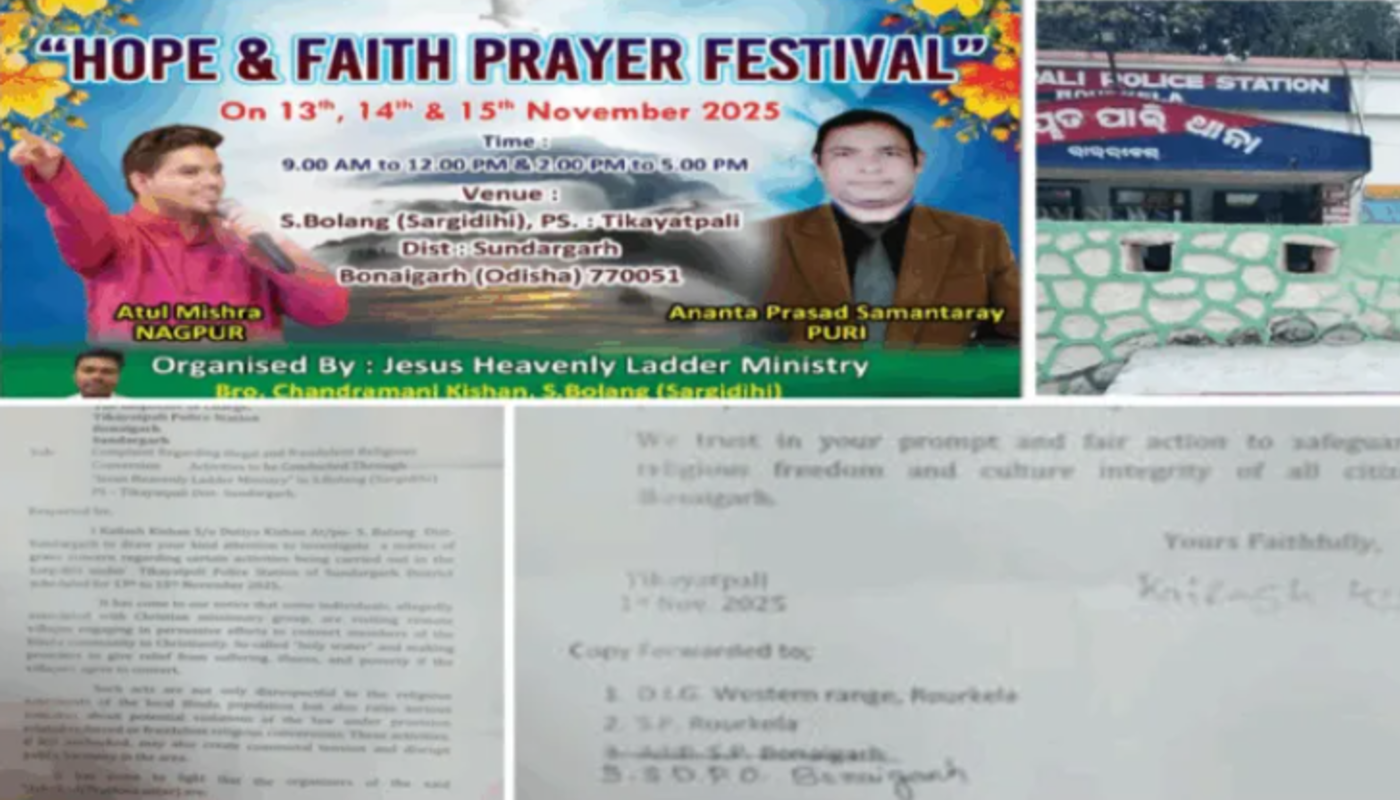
Case Summary
Hindus were targeted for religious conversion in Odisha’s tribal-dominated Sundargarh district, where a large-scale Christian “prayer meeting” organised by missionary groups in Sargidihi village, under Tikayatpali Police Station in Bonai block, was stopped by the administration following protests from local residents and Hindu organisations. The event, organised under the banner of the “Jesus Heavenly Ladder Ministry,” was scheduled to be held from 13 to 15 November 2025, and was exposed as a covert attempt to convert poor and illiterate Hindu tribals through inducement and deceit. When local villagers learned that the “prayer festival” (Ashirbad Sabha) was intended to facilitate mass conversions, they immediately objected and were joined by members of the Vishva Hindu Parishad (VHP) and Bajrang Dal, who submitted a formal memorandum to the police and senior district officials. The memorandum detailed how the organisers had been misleading villagers with false promises of miraculous healing, freedom from illness, and improved living conditions in exchange for embracing Christianity. It further stated that the missionaries used “holy water” and ritual displays to create the illusion of divine intervention, exploiting the simplicity and faith of poor tribal families. Following the complaint, police and administrative teams conducted an on-site inspection and found sufficient evidence suggesting violations of the Odisha Freedom of Religion Act, 1967, which prohibits conversion through fraud or inducement. The authorities then cancelled the event to prevent communal unrest and safeguard public order. Local leaders, including Ugresen Kishan, President of the Sundargarh Sarpanch Association, strongly condemned the incident, calling it an “insult to the faith of indigenous communities” and a “systematic attempt to exploit the poverty of tribals in the name of religion.” Residents of Sargidihi and neighbouring villages expressed relief after the event was halted, stating that they had been “saved from deception and forced conversion.” Leaders of Hindu organisations such as the VHP and Bajrang Dal praised the administration for its decisive intervention and urged the state government to remain vigilant against similar activities across Odisha.
Why it is Hate Crime ?
The primary category in this case is: Predatory Proselytisation. The first subcategory under this is: Conversion/ attempts to convert by inducement. Predatory Proselytisation is not just limited to threat, harassment, force and violence, but it also has contours of stealth. In several cases, the Hindu victim is exploited to convert, with non-Hindus taking advantage of their poverty. In such cases, the Hindu victim who is suffering financially is offered monetary benefits, including lucrative offers for jobs, health treatment, education, etc, to induce the victim into changing his/her religion. In such cases, the religious identity of the victim and the aim to disenfranchise him from his faith form the heart of the crime. Also, taking advantage of and exploiting an individual’s economic vulnerabilities is widely acknowledged as exploitation, forms of which are often penalised by law. Such cases therefore are considered religiously motivated hate crimes since the victim’s religious identity forms the very heart of the crime itself. The second subcategory under this is: Proselytisation by grooming, brainwashing, manipulation or subtle indoctrination. Religious brainwashing essentially means the often subtle and forcible indoctrination to induce someone to give up their religious beliefs to accept contrasting, regimented ideas. Religious grooming or brainwashing also involves propaganda and manipulation. It involves the systematic effort, driven by religious malice and indoctrination, to persuade “non-believers’ to accept allegiance, command, or doctrine to and of a contrasting faith. Cases of such grooming or brainwashing are far more nuanced than direct threats, coercion, inducement and violence. In such cases, it is often seen that there is repeated, subtle and continual manipulation of the victim to induce disaffection towards their own faith and acceptance of the contrasting faith of the perpetrator. While subtle indoctrination is widely acknowledged as predatory, an element which is often understated in such conversions or the attempts of such conversion is the role of loyalty and trust which might develop between the perpetrator and the victim. Fiduciary relationships are often abused to affect such religious conversion. For example, an educator transmitting religious doctrine of a competing faith to a Hindu student. The Hindu student is likely to accept what the teacher is transmitting owing to existence of the fiduciary relationship. The exploitation of the fiduciary relationship to religiously indoctrinate victims would also be included in this category. Since the underlying animosity towards the victim’s faith forms the basis of predatory proselytization, such cases are considered religiously motivated hate crimes. This case has been added to the Hinduphobia Tracker because it represents a clear instance of predatory proselytisation aimed at vulnerable Hindu tribal communities in Odisha’s Sundargarh district. The attempted “prayer meeting” in Sargidihi village, organised by the group known as Jesus Heavenly Ladder Ministry, was not a benign religious assembly but a calculated effort to induce conversion through deception, manipulation, and exploitation of economic hardship. The choice of venue, timing, and target group, poor, illiterate tribal Hindus, underscores the deliberate nature of the act, which sought to replace traditional faith through emotional coercion and false promises. Such events follow a recurring pattern observed in several parts of India, particularly in regions with economically marginalised populations. The conversion strategy typically begins under the façade of “spiritual healing” or “prayer sessions,” where participants are gradually exposed to messages that discredit Hindu beliefs and glorify Christianity as the sole path to salvation. In Sargidihi, the use of so-called “holy water” and promises of miraculous cures served as tools to weaken faith in indigenous practices and to present conversion as a pathway to relief from suffering. These tactics are not spiritual acts but psychological conditioning, designed to create dependency and alienation from native identity. What distinguishes this case is its organised structure and the systemic targeting of an entire community rather than isolated individuals. The language used by the organisers, linking faith with material improvement and divine favour, was an exploitation of poverty and lack of education. This intersection of religious manipulation and economic vulnerability transforms the act into an instrument of coercion. It is therefore recorded as a religiously motivated act of hostility toward Hindu identity, operating under the guise of charity and compassion. The cancellation of the event following strong local resistance reflects the growing awareness among tribal Hindus about such covert missionary operations. Yet, it also highlights the continued need for vigilance, as these patterns of inducement-based conversion persist across several tribal regions in India, threatening both cultural heritage and religious autonomy.


Case Status
Unknown


Perpetrators Details
Perpetrators
Christian Extremists
Perpetrators Range
Unknown
Perpetrators Gender
unknown
 Sources




