Hindus targeted as Muslim youth demands violent retaliation for Babri masjid and insults Ram Mandir
 Etawah, Uttar Pradesh, India
  13 November, 2025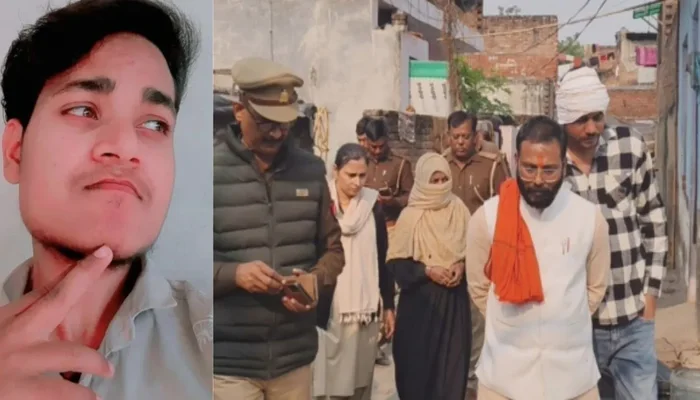
Case Summary
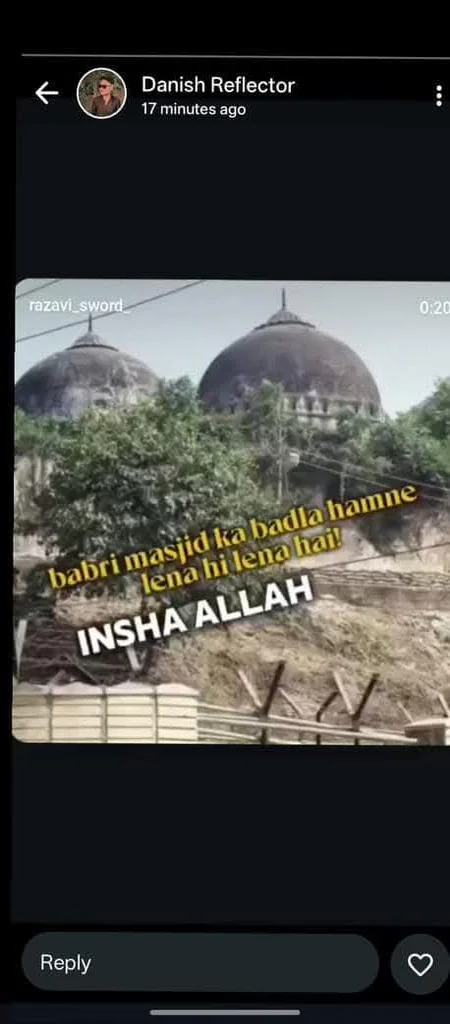
In Etawah, Uttar Pradesh, Hindu religious sentiments were insulted after a Muslim youth named Danish Khan made objectionable comments on social media targeting the Hindu community and Ram Mandir in Ayodhya. According to reports, the Muslim accused posted a photograph of the disputed structure of Babri Masjid at Ram Janmabhoomi in Ayodhya (dispute continued until the Supreme Court, in a historic decision on 9th November 2019, ruled in favour of Ram Lalla Virajmaan and ordered the government of India to provide support for the construction of the Ram Mandir) on Facebook and WhatsApp, with the caption "Babri masjid ka badla humne lena hi lena hai … Insha Allah" (we must take revenge for the Babri masjid at all costs… Insha Allah). The post was circulated widely on social media and quickly went viral, triggering strong outrage among Hindu organisations and residents. Members of the Hindu Seva Samiti, a Hindu organisation, escalated the issue by sending the screenshot to the Chief Minister and senior police officials, urging them to take immediate action against the accused. Police and intelligence agencies were already on alert due to the Red Fort bombing on 10 November 2025; thus, the nature of the post intensified concerns about radical activity within the district. Acting on the complaint, police traced and arrested the accused, Danish Khan, a resident of the ARTO Colony near Civil Lines, on 15 November 2025. A case was registered against him under Section 197 of the CrPC for disturbing communal harmony and Section 296 of the CrPC for inciting violence through online content, and the authorities continued examining his digital activity for wider connections.
Case Images
Why it is Hate Crime ?
This case has been added to the tracker under the primary category of - Hate Speech against Hindus. Within it, the subcategory selected is- Anti-Hindu slurs, mocking faith. Anti-Hindu slurs and the deliberate mocking of the Hindu faith owing to religious animosity involve the usage of derogatory terms, stereotypes, or offensive references to religious practices, symbols, or figures. One of the common anti-Hindu slurs used against Hindus is “cow-worshipper” and “cow piss drinker”. The intention of using this term is to demean and mock Hindus as a group and their religious beliefs since Hindus consider the cow holy. Additionally, some symbols and the slurs attached to them have a historical context that exacerbates the insult, hate, stereotyping, dehumanisation and oppression against Hindus. Cow worship has been used for centuries to denigrate Hindus, insult their faith and oppress Hindus specifically as a religious group. There has been overwhelming documentation about how cow slaughter has been used to persecute Hindus with cow meat being thrown in temples and places of worship. There has also been overwhelming documentation where cow meat (beef) has been force-fed to Hindus to either forcefully convert them to Islam or denigrate their faith. Apart from cow worship, the Swastika – which holds deep religious significance for the Hindus – has also been misinterpreted and distorted to use as a slur against Hindus. Similarly, the worship of the Shivling has been used by supremacist ideologies and religions to denigrate Hindus owing to religious animosity. Such slurs and denigration stem out of inherent animosity and hate towards Hindus and their faith, therefore, it is categorised as hate speech targeted at Hindus specifically owing to their religious identity. The other sub-category selected is - Violent threats. Violent threats, explicit, implicit or implied, is the most dangerous form of hate speech since it goes beyond discriminatory and prejudicial language to express the intent of causing harm to an individual or a group of people based on their religious identity and faith. There could be several different kinds of threats that are issued to Hindus based on religious animosity. An explicit threat would mean the direct threat of violence towards an individual Hindu, a group of Hindus or Hindus at large. Physical violence, death threats, threats of destruction of property belonging to Hindus and threats of genocide would mean explicit threats against Hindus for their religious identity. Implicit threats may not be a direct threat but implied through the use of symbols of actions – for example – in the Nupur Sharma case, other than explicit threats, there were also implicit threats when Islamists took to the streets to burn and beat her effigies. It implies that they want to do the same to Nupur Sharma – thereby is considered an implicit threat. Violent threats can be delivered in person, through letters, phone calls, graffiti, or increasingly through social media and other online platforms. It would be important to understand that a threat – explicit or implicit, online or offline – to an individual who happens to be a Hindu does not qualify as a religiously motivated threat. Such a threat, while vile and dangerous, could be owing to non-religious reasons and/or personal animosity. To qualify as a religiously motivated threat, it would need to exhibit an indication that the individual is being targeted for religious reasons and/or owing to his/her religious identity as a Hindu. This case has been added to the tracker because Hindu religious sentiments were insulted after Danish Khan issued a direct violent threat and an explicit call for revenge against the Hindu community through his post targeting the Ram Mandir in Ayodhya. His actions were not random, impulsive, or merely provocative; they were deliberate, targeted, and rooted in hostility towards Hindu identity, Hindu sacred spaces, and the Ayodhya Ram Mandir. The accused intentionally posted an old photograph of the disputed Babri Masjid at Ram Janmabhoomi in Ayodhya, with the caption "Babri masjid ka badla humne lena hi lena hai… Insha Allah" (“We must take revenge for the Babri Masjid at all costs…Insha Allah”). It is important to note here that he did not use a recent picture of the site; he specifically chose the old photograph of the pre-1992 structure, even though the dispute was conclusively settled by the Supreme Court in 2019. The Court recognised the site as the birthplace of Lord Ram and awarded it for the construction of the Ram Mandir, thereby resolving the decades-long dispute. The dispute no longer exists. neither legally, nor politically, socially, nor historically. Yet the accused revived that imagery intentionally. Furthermore, the caption itself, “badla lenge hi lenge” (“we will definitely take revenge”), was a direct call for revenge and violence. This was not a personal opinion; it was a public threat and a call to the wider Muslim community to act by invoking religious imagery. Such language conveys a clear message of violence: that Hindus, and specifically those associated with the Ram Mandir movement, should be punished. It was an explicit attempt to stoke communal tensions and rally Muslims by portraying Hindus as aggressors who must now be avenged. The use of religious phrases such as “Insha Allah” in the context of violent revenge added a communal and ideological tone, reinforcing the intent to frame the issue not as an individual dispute but as a sort of religious war. The accused was invoking religion to justify hostility and violence towards Hindus. Babri was just an excuse; the real motive was religious animosity. By deliberately posting the old image, the accused intended to create the false impression that the conflict was still alive, thereby provoking anger, resentment, and a sense of religious grievance within the Muslim community, with the intention of channelling it towards violence against Hindus. It was not an innocent post; it was a calculated attempt to distort reality and generate hostility against the wider Hindu community. It is pertinent to note that Muslim extremists harbour specific animosity towards Hindus and their faith and also view India as a Hindu collectivity. The very basis of the partition of India was that the Muslims believed that Islam was a nation unto itself, which could not survive with a Hindu collectivity like India. Thus, when Islamists weaponise religious imagery to generate hostility, it is not mere provocation but a promotion of the idea that sees Hindus and the Indian nation as outsiders or enemies. In recent times, social media has increasingly become a platform for anti-Hindu hate, with derogatory memes, videos, and messages targeting Hindu religious symbols, practices, and deities. Such content is recognised as part of a broader pattern of Hinduphobia and religious hate crimes online. Since the accused's actions were rooted in religious animosity, this case has been added to the tracker. Disclaimer: The Hinduphobia Tracker records incidents based on when an event occurred or when the victim's ordeal began. It is important to clarify that none of the media sources covering this case has specified the exact date when the accused made such comments. Therefore, for documentation purposes, we have recorded the date based on when the case was reported in the media, 14 November 2025.


Case Status
Arrested


Perpetrators Details
Perpetrators
Muslim Extremists
Perpetrators Range
One Person
Perpetrators Gender
male
 Sources




