Hindu man targeted for religious conversion by Christian man through inducements and denigration of Hinduism
 Chhindwara, Madhya Pradesh, India
  2 November, 2025
Case Summary
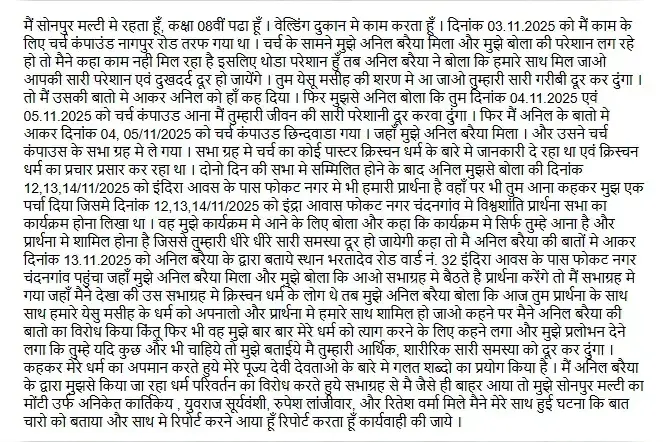
In Chhindwara, Madhya Pradesh, a Hindu man named Rakesh Dhurve, a resident of Sonpur Multi, was lured, brainwashed and offered inducements for religious conversion by a Christian man named Anil Baraiya. The accused also insulted Hinduism and abused Hindu deities to push Rakesh towards conversion. The Hinduphobia Tracker accessed the FIR filed by the victim, who was working at a welding shop. On 3 November 2025, he went to a Church Compound on Nagpur Road for some work. During this time, he met the Christian accused, Anil Baraiya, who approached him after noticing that he appeared distressed. The victim explained that he was worried because he could not find steady employment, on which the accused attempted to brainwash him, saying that all his troubles would disappear if he joined them and took refuge in Jesus Christ, assuring him that this would alleviate all his problems and his poverty. Influenced by these promises, the victim agreed, and the accused instructed him to return to the Church Compound on 4 and 5 November 2025. Rakesh went on both days, met Anil again, and was taken into a meeting hall to a prayer meeting where a church pastor was actively promoting Christianity. After these meetings, Anil invited him to attend a three-day Vishwa Shanti prayer programme, essentially a prayer meeting scheduled for 12–14 November in Fokat Nagar near Indira Awas, assuring him that participation in the prayers would gradually remove all his problems. Influenced by Anil's words, the victim went to the location on 13 November 2025, where the accused again met him and took him to the prayer meeting. During the prayer meeting, the accused told him to accept Christianity and formally join them. The victim objected to it, but the accused repeatedly pressured him to abandon his religion. The accused also offered financial inducements, asking the victim if he needed anything, and claiming that he would resolve any financial or physical difficulties of the victim. When the victim did not budge, the accused went even further and began insulting Hinduism and abusing Hindu deities. Distressed by the coercion and the derogatory remarks, the victim left the meeting in protest. Subsequently, he reported the matter to the police and filed a complaint. Based on the complaint, the police registered a case against the accused, Anil Baraiya, under Section 49 of the Indian Penal Code (IPC) and the Madhya Pradesh Freedom of Religion Act and took him into custody. Station in-charge Ashish Dhurve said that statements of those present at the gathering are being recorded, and the investigation was ongoing.
Case Images
Why it is Hate Crime ?
This case has been added to the tracker under the primary category of - Predatory Proselytisation. Within it, the sub-category selected here is - Proselytisation by grooming, brainwashing, manipulation or subtle indoctrination. Religious brainwashing essentially means the often subtle and forcible indoctrination to induce someone to give up their religious beliefs to accept contrasting regimented ideas. Religious grooming or brainwashing also involves propaganda and manipulation. It involves the systematic effort, driven by religious malice and indoctrination, to persuade “non-believers’ to accept allegiance, command, or doctrine to and of a contrasting faith. Cases of such grooming or brainwashing are far more nuanced than direct threats, coercion, inducement and violence. In such cases, it is often seen that there is repeated, subtle and continual manipulation of the victim to induce disaffection towards their own faith and acceptance of the contrasting faith of the perpetrator. While subtle indoctrination is widely acknowledged as predatory, an element which is often understated in such conversions or the attempts of such conversion is the role of loyalty and trust which might develop between the perpetrator and the victim. Fiduciary relationships are often abused to affect such religious conversion. For example, an educator transmitting religious doctrine of a competing faith to a Hindu student. The Hindu student is likely to accept what the teacher is transmitting owing to existence of the fiduciary relationship. The exploitation of the fiduciary relationship to religiously indoctrinate victims would also be included in this category. Since the underlying animosity towards the victim’s faith forms the basis of predatory proselytization, such cases are considered religiously motivated hate crimes. The other sub-category selected here is - Conversion/ attempts to convert by inducement. Predatory Proselytisation is not just limited to threat, harassment, force and violence, but it also has contours of stealth. In several cases, the Hindu victim is exploited to convert, with non-Hindus taking advantage of their poverty. In such cases, the Hindu victim who is suffering financially is offered monetary benefits, including lucrative offers for jobs, health treatment, education, etc, to induce the victim into changing his/her religion. In such cases, the religious identity of the victim and the aim to disenfranchise him from his faith form the heart of the crime. Also, taking advantage of and exploiting an individual’s economic vulnerabilities is widely acknowledged as exploitation, forms of which are often penalised by law. Such cases therefore are considered religiously motivated hate crimes since the victim’s religious identity forms the very heart of the crime itself. The other sub-category selected here is - Attempting to convert/converting by denigrating Hinduism. In several cases, Hindus are converted or an attempt is made to convert Hindus by denigrating their faith, Hinduism. In such cases, the Hindus associate with the non-Hindu perpetrators often by choice and then, the attempt to convert them by insulting their faith, showing the faith down etc begins. An example of this would be a non-Hindu gathering where the Hindus are attending the gathering of their own free will. However, once they attend the gathering, there is an explicit attempt to convert them by abusing their faith and hailing the faith of the perpetrator. The denigration of the Hindu faith is often based on misrepresentation of the Hindu faith, its doctrine and scriptures and insult to espoused traditions if not blatant lies about Hindu beliefs and ways. Such conversions or attempts at conversions are driven by animosity towards the Hindu faith and are therefore documented as religiously motivated hate crimes. The other sub-category selected here is - Harassment, threats, coercion for conversion. Harassment covers a wide range of behaviours of an offensive nature. It is commonly understood as behaviour that demeans, humiliates, and intimidates a person, including threats and coercion. Harassment and threats, in this case, find their root on discriminatory grounds which has the effect of nullifying a person’s rights or infringing upon his freedom to exercise his right specifically owing to the victim’s religious identity. Verbal and physical threats and psychological or physical harassment are often used against Hindu victims because they choose to practice their professed religion. Religious harassment also includes forced and involuntary conversions by harassment, threats or coercion. Coercion includes intimidatory tactics like force-feeding a Hindu victim beef to convert to another religion, forceful circumcision etc. In several cases documented, non-Hindu perpetrators or those who harbour specific animosity towards Hinduism, harass victims simply based on their religious identity. Such cases often also include harassment to ensure the Hindu victim abandons his/her professed religion and adopts the religion of the perpetrator. Such cases where Hindu victims are harassed to convert to the perpetrator’s religion are rooted in animosity towards the victim’s religious identity and are therefore documented as religiously motivated hate crimes. This case has been added to the tracker because the Hindu man was lured, brainwashed, and offered inducements for religious conversion by the Christian accused. The accused initially approached the victim by pretending to show concern for his personal problems, using sympathy as an entry point for indoctrination. This tactic created a false sense of trust, allowing the accused to slowly draw the victim into a prayer meeting where he was deliberately exposed to Christian teachings. Firstly, the act of inviting Hindus to a prayer gathering, with the intention of religious conversion, demonstrates that these meetings were not genuine religious sessions or community prayers. Instead, they were calculated efforts to exploit the trust and social cohesion within the Hindu community by disguising conversion attempts as routine gatherings. These events often begin as innocuous community or social gatherings but gradually evolve into platforms for indoctrination, where faith-based manipulation and emotional grooming are employed to influence vulnerable individuals for conversion. Secondly, when the victim refused to convert, the accused attempted to lure the victim by offering inducements, claiming that he would resolve any financial or physical difficulties. Offering incentives or making false promises, especially when directed at vulnerable individuals in need, shows that these incentives are not acts of kindness or charity. Instead, they are calculated moves to exploit vulnerable Hindus because of their religion. By providing inducements in exchange for conversion, the accused was effectively blackmailing the victim, who was in desperate need of assistance. Thirdly, the accused also insulted Hinduism and abused revered Hindu deities. This goes beyond religious debate or proselytisation; it constitutes an act of incitement and insult directed at the core beliefs of the Hindu community. Such remarks are designed to demean and undermine the faith of Hindus and intend to create an inferiority complex in the minds of the victims against their own faith. This fosters an environment of hostility and disrespect towards the Hindu community and Hindu deities. These acts of insulting Hinduism stem from Christian theology, which harbours disdain and hatred for polytheistic faiths, and which categorises Hindus as ‘polytheists’, thereby fostering hatred against them. Such actions make the religiously motivated nature of the crime even more evident. Fourth, when the victim objected to conversion, the accused repeatedly pressured him and harassed him to abandon his religion and convert to Christianity. Pressuring a Hindu individual to discard his religious faith and embrace another is a direct attack on his religious identity and dignity. It is not a matter of personal choice; it is coercion rooted in hostility towards the victim's Hindu identity. Such an attempt reflects religious animosity because the act is not simply about personal differences but about erasing the victim’s Hindu faith, making it a religiously motivated crime. The Christian faith, by its very theological foundations, places a strong emphasis on proselytisation. In pursuit of conversion objectives, Christian evangelists often employ unethical means, ranging from psychological pressure and misinformation to inducements such as money or jobs. Such instances are seen in many cases where members of Christian missionary groups target socially and economically vulnerable Hindus to further their agenda of religious conversions. This form of coercion strips people of their agency and dignity and results in coerced conversions. These are not random or isolated incidents, but rather cases deeply rooted in religious animosity towards Hindu victims. Therefore, this case has been added to the tracker. Disclaimer: The Hinduphobia Tracker records incidents based on when an event occurred or when the victim's ordeal began. Since the victim came into contact with the accused on 3 November 2025, the date of the incident has been selected as such.
Victim Details
Total Victim
1
Deceased
0
Gender
- Male 1
- Female 0
- Third Gender 0
- Unknown 0
Caste
- SC/ST 0
- OBC 0
- General 0
- Unknown 1
Age Group
- Minor 0
- Adult 1
- Senior Citizen 0
- Unknown 0


Case Status
Arrested


Perpetrators Details
Perpetrators
Christian Extremists
Perpetrators Range
One Person
Perpetrators Gender
male
 Sources




