Hindu devotees attacked, revered deities abused inside sacred temple premises by armed Muslim mob
 Chamba, Himachal Pradesh, India
  11 November, 2025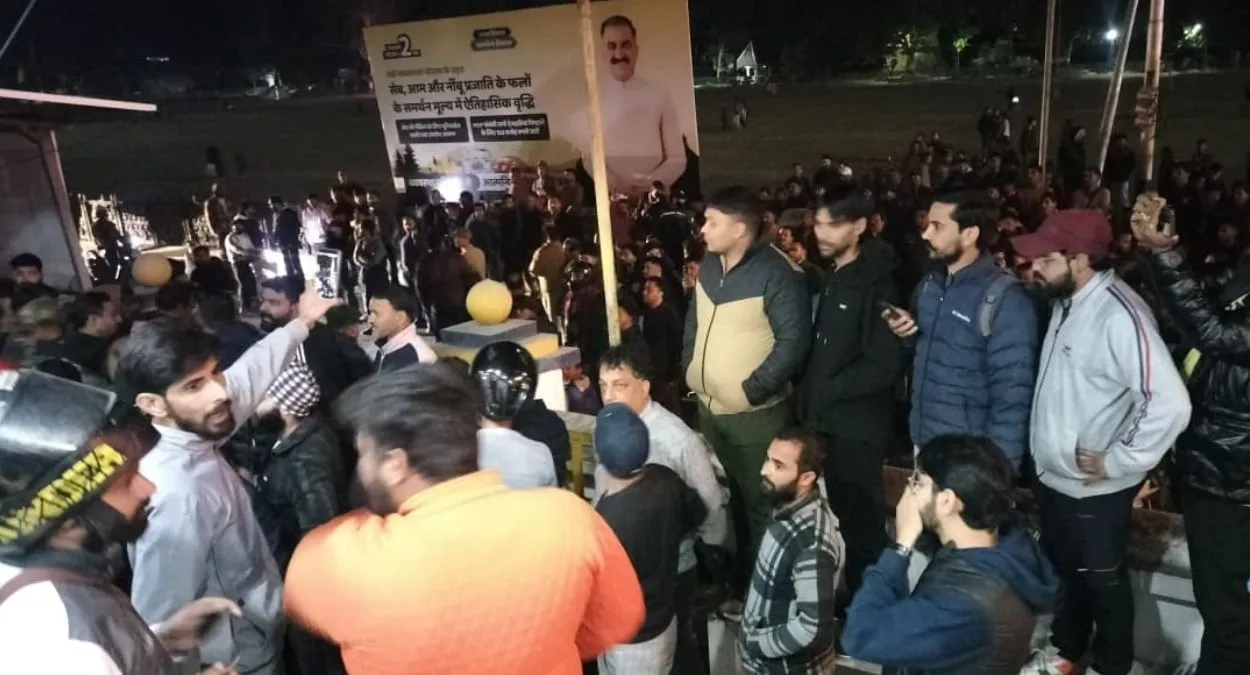
Case Summary
In Chamba town, Himachal Pradesh, Hindu youths were brutally assaulted by a group of 20-25 Muslims inside the premises of the historic Chamunda Mata Temple, a sacred Hindu temple dedicated to the Goddess Chamunda. According to media reports, this incident occurred on the night of 12 November 2025. The attackers entered the temple complex armed with sticks and other weapons, hurled abusive language at Hindu deities, and violently beat three Hindu youths present at the site. As per the eyewitnesses, the incident occurred when several Muslim men arrived at the temple and began arguing with three Hindu youths who were already seated there. The confrontation soon escalated into violence, and the assailants physically attacked the Hindu men, inflicting serious injuries. Local residents rushed to the scene upon hearing the commotion and helped transport the injured to the Chamba Medical College and Hospital for treatment. Eyewitnesses further stated that the assailants openly threatened devotees, insulted Hindu gods and goddesses, and tried to create panic within the temple complex. During the chaos, local youths managed to catch one of the attackers and handed him over to the police, while the rest fled from the spot. The attack triggered widespread anger among Hindu organisations and local residents, who gathered outside the City Police Post in Chamba to protest what they described as police inaction and negligence. The protesters accused the police of delaying the arrest of the culprits and staged a road blockade (chakka jam), chanting slogans demanding immediate justice. As the situation grew tense, the Quick Response Team (QRT) was deployed to control the crowd and restore order. Senior police officers, including Superintendent of Police Vijay Kumar Saklani, arrived at the spot and urged the public to maintain peace. Additional police personnel were stationed across the area to prevent further escalation. By late night, the protest was still continuing. The police confirmed that an FIR had been registered and that search operations were underway to locate and arrest the remaining accused.
Why it is Hate Crime ?
The primary category selected in this case is: Attack not resulting in death. The subcategory selected under this is: Attack against Hindu devotees. Hindu devotees are a few of the easiest targets of religiously motivated hate crimes because during the festival/procession/puja etc, for non-Hindus it is easy to profile their victims on the basis of religion. Hindu devotees come under attack on several occasions by individual non-Hindus or mobs of non-Hindus owing to their animosity against Hinduism, its symbols and tradition/practices. There are several instances of Hindu devotees being attacked while they worship in temples or temporary religious structures, during religious processions, doing bhajan/kirtan/puja in their own homes, in the residential society etc. These attacks are perpetrated by non-Hindus primarily because of their animosity towards Hindus and their faith. In some cases, the trigger for the violence may be non-religious, however, there are two elements that make these hate crimes. First, the Hindus who come under attack are attacked violently while indulging in religious activity. Whether they are in a place of worship or not is immaterial to the crime. When individuals are attacked while indulging in religious practices, the attack in itself is a hindrance to their freedom to practice religion and therefore constitutes a hate crime. Secondly, religious supremacist doctrines and ideologies deem religious practices of Hindus to be offensive ab initio since they are considered “sinful” by these ideologies, worthy to be annihilated by force or coercion. Driven by these religious supremacist ideologies and doctrines, the attacks against Hindu devotees stem from intrinsic animosity towards Hinduism. In some cases, the trigger for the violence may be non-religious, however, it develops into a religiously motivated crime during the course of the violence. Since these attacks stem from animosity towards Hindus and Hinduism, they are considered religiously motivated hate crimes under this category. The other subcategory under this is: Communal Clash/ Attack. Communal clash is a form of collective violence that involves clashes between groups belonging to different religious identities. For a communal clash between Hindus and non-Hindus to qualify as a religiously motivated hate crime, the trigger of the violence itself would have to be anti-Hindu in essence. For example, if there is a Hindu religious procession that comes under attack from a non-Hindu mob and after the initial attack, Hindus retaliate in self-defence, leading to a communal clash between the two religious communities. While at a later stage, both communities are involved in the clash/violence, the initial trigger of the violence was by the non-Hindu mob against the Hindus and therefore, it could safely be termed as an anti-Hindu violence. Further, the trigger would also have to be religiously motivated. In the cited example, the attack by the non-Hindu mob was against religious processions and therefore, can be concluded to be religiously motivated. In some cases, the trigger may be non-religious, however, it develops into religious violence against Hindus at a later stage. In such cases too, the foundational animosity towards Hindus becomes the motivating factor of the crime and therefore, it would be classified as a religiously motivated hate crime against Hindus under this category. Another primary category under this is: Attack on Hindu religious representations. The subcategory under this is: Attack on Temples. In Hinduism, a temple is the abode of the Deity. The Deity in the Temple is consecrated, thereby, making it a real, breathing entity. Hindus believe that not just the Deity but the temple premises itself are sacred to Hindus since Hindus hold the faith that the entire Temple space is an amalgamation of the divine energy of the deity. Given the central significance of Temples in Hindu Dharma, any attack against a Hindu Temple or its peripheral premises is an attack on the faith itself and is born out of animosity towards the faith, of which, the Temple is a central tenet. Any manner of attack against a Temple and/or its premises would therefore be considered a religiously motivated hate crime. The other subcategory under this is: Defiling religious customs. Sanatan Dharma is not a religion of one book, which is to say that while it has religious scriptures that form the central tenets of the faith, there are several traditions followed through thousands of years, mostly passed from generation to generation orally. There are several such customs and traditions that are followed by various Hindus and Hindu sects. Defiling of these traditions and customs is a breach of an individual or group’s religious practices. Such practices can range from dietary restrictions like not eating non-vegetarian food for a certain period of the year, not eating non-vegetarian food at all, not eating beef since the cow is considered holy in Hinduism, the sanctity of religious customs followed in the house (like many ISCKON devotees), etc. Any malicious action leading to the breach of such traditions or defilement of these traditions owing to animosity towards the faith or for the sake of activism stems not only from the lack of faith in the religion itself but also from disregard for the faith of the devotees who follow the customs/traditions and implicit bias against the faith, the tradition itself. Since these specific traditions are central to the faith of the devotees of that specific sect of Hindus, any non-compliance with these traditional rules would be considered a religiously motivated hate crime. Another primary category in this case is: Hate speech against Hindus. The subcategory under this is: Anti-Hindu slurs, mocking faith. Anti-Hindu slurs and the deliberate mocking of the Hindu faith owing to religious animosity involve the usage of derogatory terms, stereotypes, or offensive references to religious practices, symbols, or figures. One of the common anti-Hindu slurs used against Hindus is “cow-worshipper” and “cow piss drinker”. The intention of using this term is to demean and mock Hindus as a group and their religious beliefs since Hindus consider the cow holy. Additionally, some symbols and the slurs attached to them have a historical context that exacerbates the insult, hate, stereotyping, dehumanisation and oppression against Hindus. Cow worship has been used for centuries to denigrate Hindus, insult their faith and oppress Hindus specifically as a religious group. There has been overwhelming documentation about how cow slaughter has been used to persecute Hindus with cow meat being thrown in temples and places of worship. There has also been overwhelming documentation where cow meat (beef) has been force-fed to Hindus to either forcefully convert them to Islam or denigrate their faith. Apart from cow worship, the Swastika – which holds deep religious significance for the Hindus – has also been misinterpreted and distorted to use as a slur against Hindus. Similarly, the worship of the Shivling has been used by supremacist ideologies and religions to denigrate Hindus owing to religious animosity. Such slurs and denigration stem out of inherent animosity and hate towards Hindus and their faith, therefore, it is categorised as hate speech targeted at Hindus specifically owing to their religious identity. This incident represents a clear act of religiously motivated hostility, in which Hindu devotees were deliberately attacked, humiliated, and intimidated within a temple — a space sacred to their faith. The assault on Hindus inside the Chamunda Mata Temple in Chamba cannot be dismissed as a spontaneous clash or a personal altercation; it bears the unmistakable imprint of anti-Hindu violence driven by deep contempt for the Hindu religion and its followers. The incident encompassed multiple layers of hate — physical aggression, verbal desecration, and deliberate intrusion into a sacred space — making it one of the more complex and distressing examples of anti-Hindu communal violence. The attack on Hindu devotees while they were offering prayers within the sanctity of a temple — one of the holiest spaces in Hinduism — reflects calculated targeting based solely on religious identity. The Muslim assailants were armed and prepared, demonstrating that the act was not an impulsive outburst but a premeditated and organised assault. By selecting Hindu devotees and launching the attack inside a temple, the perpetrators revealed their intentions clearly: to harm individuals for openly practising and expressing their Hindu faith. This targeted violence against people engaged in worship leaves no ambiguity — the act was motivated by religious hatred. This incident also constitutes a communal attack. The perpetrators specifically targeted Hindus for being Hindus, inside a space that symbolises the very identity and devotion of the Hindu community — the temple. Such violence is not only directed at individual victims but also at the collective religious identity they embody. By assaulting Hindu devotees as a group, the attackers sought to instil fear among Hindus, transforming the act into one of deliberate communal aggression. The motive was not personal but collective — to intimidate and humiliate Hindus as a religious community. It therefore stands as a clear instance of communal violence driven by religious hostility. It is also crucial to emphasise that this attack occurred within a temple. Temples are sacred institutions that hold profound reverence in the Hindu faith; they serve as places where devotees connect with the divine through prayer, ritual, and shared spiritual experience. An act of violence within temple premises is thus not only an assault on the devotees alone but an attack on the temple itself. By bringing weapons and aggression into a space of peace and sanctity, the perpetrators desecrated a holy site that carries immense spiritual and cultural significance for millions of Hindus. This reflects a complete disregard for the sanctity of the temple and reinforces the religiously motivated nature of the crime. When Hindu devotees are attacked within a temple, the sacred environment of that temple is defiled. Temples are regarded as living ecosystems of divinity, purity, and devotion, sustained through prayers, rituals, and the collective faith of the worshippers. Any act of violence within such a space contaminates its sanctity, disrupting the spiritual harmony that defines temple life. The attack not only inflicted physical harm but also caused deep spiritual injury, transforming a place of worship into a site of fear. This desecration further underscores the deeply religious motivation behind the crime. Furthermore, the perpetrators also insulted and abused Hindu deities within the temple premises, rendering the act even more grievous. In Hinduism, deities are revered embodiments of divine presence and occupy a central place in the spiritual lives of Hindu devotees. To insult these deities within their own sanctum is an act of deliberate humiliation and religious violation, intended to wound the faith of Hindu worshippers. This conscious desecration of what is most sacred to Hindus exposes the perpetrators’ deep-seated animosity and hostility towards the Hindu religion and its followers. By targeting both the devotees and their deities, the attackers made their intent unmistakable — this was a religiously motivated hate crime. Given that this case meets all recognised criteria of a religiously motivated hate crime — including premeditation, selective targeting based on faith, desecration of a sacred site, and abuse of revered deities — it has been added to the Hate Crime Database of the Hinduphobia Tracker. Disclaimer: In this case, media reports state that nearly 20–25 Muslim youths attacked the temple, but the exact number of perpetrators has not been recorded or specified. Therefore, for documentation purposes, the Hinduphobia tracker is recording the perpetrator count as 25.
Victim Details
Total Victim
3
Deceased
0
Gender
- Male 3
- Female 0
- Third Gender 0
- Unknown 0
Caste
- SC/ST 0
- OBC 0
- General 0
- Unknown 3
Age Group
- Minor 0
- Adult 0
- Senior Citizen 0
- Unknown 3


Case Status
Case sub-judice


Perpetrators Details
Perpetrators
Muslim Extremists
Perpetrators Range
From 10 to 100
Perpetrators Gender
male
 Sources




