Married Hindu woman raped twice by Muslim neighbours in Bangladesh, forced to flee village
 Barguna District, Bangladesh
  22 October, 2025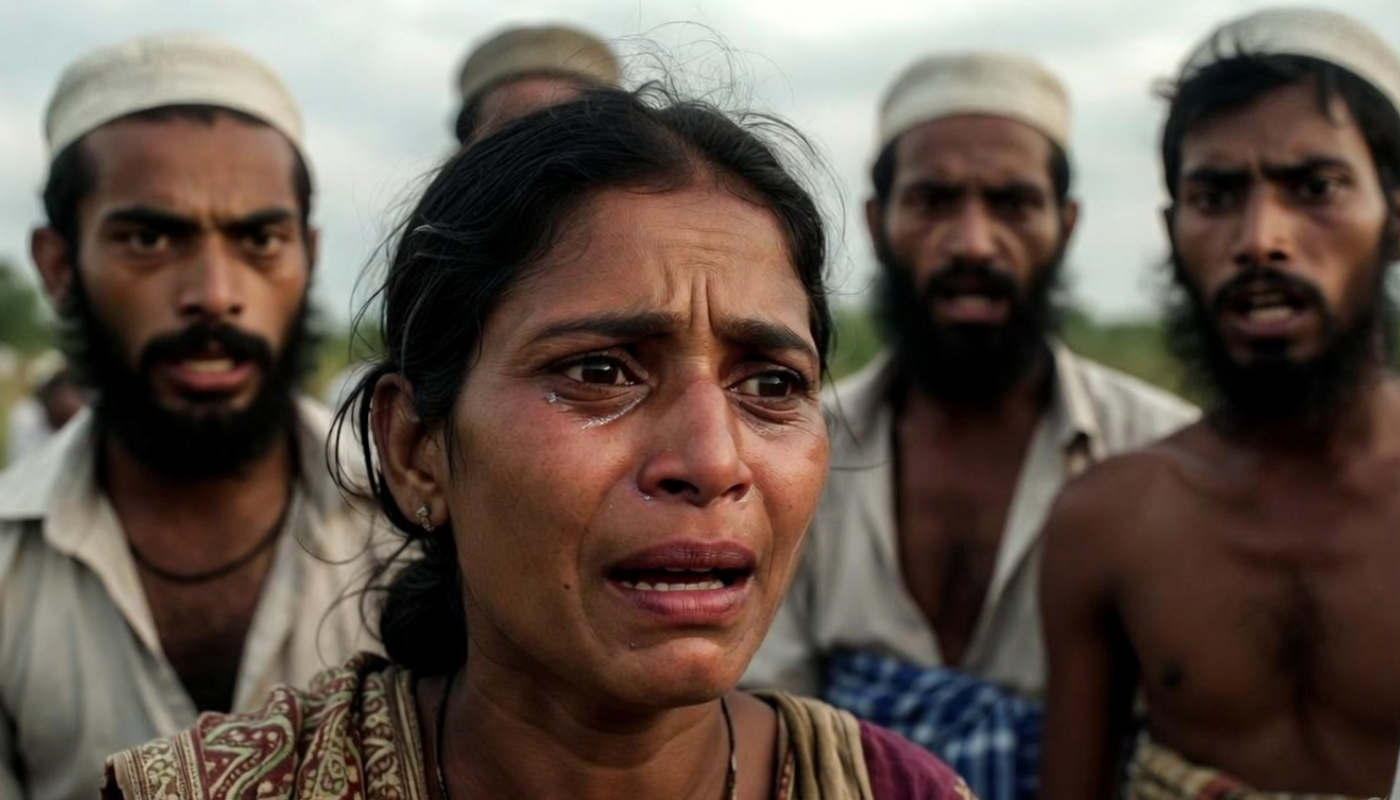
Case Summary
A 38-year-old Hindu woman in Sonauta village under Haldia Union, Amtali, Barguna, Bangladesh, was twice raped in her own home by two men from the same locality. The first assault took place on 23 October 2025 when her husband and sons were at the market. The accused, Saiful Islam Howlader (25), son of Nazrul Islam Howlader, and Md Imran Howlader (30), son of Shahid Howlader, entered her house, tied her hands and feet, raped her, and threatened to kill her if she spoke. The second attack occurred on 29 October 2025 when her husband and sons were working in the fields. The same men broke into the house again and raped her. This time, Imran’s younger brother, Imraz Howlader (22), recorded the act on a mobile phone and threatened to release the video on Facebook if she reported the incident. Out of fear, the survivor fled with her husband and two young sons and took refuge at a relative’s home. On 1 November 2025, she filed a formal complaint at Amtali Police Station. Police arrested Imran that night and sent the survivor to Barguna General Hospital for medical examination. Two days later, on 4 November 2025, police arrested Imraz from Chattogram and sent him to jail. However, on 5 November 2025, Imran was released on bail, while Saiful, the main accused, remained at large. The release of the accused and ongoing threats forced the family to continue hiding. The survivor’s husband said Saiful’s mother, Piyara Begum, his wife, Hamida Begum, and Imran’s mother, Beauty Begum, threatened them to leave the village, saying, “You Hindus cannot live here.” Their 16-year-old son said, “We are living in fear now. Those who did this to my mother must be hanged.” After national outrage over reports that the survivor had been forced to flee her home, the Barguna district administration and police ensured her return. On 8 November 2025, officials, including Amtali Upazila Nirbahi Officer Md Roknuzzaman Khan, Amtali Police Station Officer-in-Charge Dewan Jaglul Hasan, and leaders from the Barguna District and Amtali Upazila Puja Udjapon Parishad visited the family’s home. They met the survivor, spoke to villagers, and confirmed that round-the-clock police protection had been arranged. Inspector (Investigation) Md Saidul Islam stated that two of the accused were in custody, efforts were underway to arrest the remaining suspect, and the family was under constant police watch for safety. This incident occurred amidst a surge in communal violence against Hindus following the ouster of Sheikh Hasina’s Awami League government on August 5, 2024, after a student-led uprising. The Yunus-led interim government, intended to stabilise the country, faced allegations of failing to curb retaliatory attacks against Hindus, who made up roughly 8% of Bangladesh’s population and were often associated with Hasina’s secular policies. Islamist factions and mobs capitalised on the political upheaval, fueling anti-Hindu sentiment often linked to anti-India narratives and vengeance against perceived Awami League supporters. Human rights groups provided alarming statistics on the scale of the violence. The Bangladesh Hindu Buddhist Christian Unity Council recorded over 2,010 communal attacks between August 4 and 20, 2024, including assaults on 69 temples, the looting and burning of 157 Hindu properties, and the deaths of at least five Hindus, two of whom were tied to the Awami League. By mid-2025, the number of reported attacks had risen to 2,442, with Transparency International Bangladesh noting a lack of accountability in the interim government’s first 100 days, as investigations into anti-minority violence remained inadequate. A UN fact-finding mission, invited by the Yunus administration, confirmed widespread mob violence, arson, and attacks on Hindu places of worship, contradicting Yunus’s claims that such reports were exaggerated for political gain. The violence persisted beyond the initial post-uprising chaos. In December 2024, over 100 Hindu homes and businesses in Sunamganj’s Mangalgaon and Monigaon areas were vandalised and looted after unverified blasphemy allegations against a Hindu youth. The arrest of ISKCON leader Chinmoy Krishna Das on sedition charges in late 2024 further escalated tensions, with his supporters clashing with police, drawing condemnation from India and the United States. In April 2025, the abduction of Hindu leader Bhabesh Chandra Roy in Dinajpur highlighted the ongoing threat of targeted kidnappings. During Durga Puja preparations, temples faced vandalism and idol destruction, prompting the Awami League to denounce the interim government’s apparent complicity in fostering impunity. In September 2025, former Prime Minister Sheikh Hasina, exiled in India, expressed deep concern over the “multidimensional violence” against Hindus since August 2024, calling it a “horrific period of persecution” that had shocked the global community. The Awami League echoed her sentiments, alleging that the Yunus regime had made Bangladesh unsafe for all faiths, with minorities facing killings and assaults under its watch. The interim government’s response was inconsistent. While Yunus visited Dhaka’s Dhakeshwari Temple on August 13, 2024, promising equal rights for minorities, his later dismissal of the violence as overstated undermined public confidence. By December 2024, authorities acknowledged 88 cases of communal violence and made 70 arrests, but organisations like Amnesty International criticised the lack of prompt and impartial investigations. Protests by Hindu groups demanding protection erupted in Dhaka and other cities, while international figures, including US and UK lawmakers, called for stronger measures to safeguard minorities.
Why it is Hate Crime ?
The primary category in this case is: Attack not resulting in death. The first subcategory under this is: Attacked for Hindu identity. In several cases, Hindus are attacked merely for their Hindu identity without any perceived provocation. A classic example of this category of religiously motivated hate crime is a murder in 2016. 7 ISIS terrorists were convicted for shooting a school principal in Kanpur because they got ‘triggered’ seeing the Kalava on his wrist and tilak that he had put. In this, the Hindu victim had offered no provocation except for his Hindu religious identity. The motivation for the murder was purely religious, driven by religious supremacy. Such cases where Hindus are targeted merely for their religious identity would be documented as a hate crime under this category. Another subcategory under this is: Attacked to induce migration from non-Hindu dominated area. There have been cases where the Hindus living in an area, often with a majority dwelling belonging to non-Hindus or those harbouring animosity towards the Hindu faith, the Hindu residents experience threats and violence. The violence is employed with the aim of making the Hindus leave the area and relocate, so the area could be turned into an exclusive ghetto for adherents of the non-Hindu faith or those who harbor animosity towards the Hindu faith. In several cases, the aim of exodus is explicit. However, in several cases, the demand for exodus of Hindu residents is not explicit, however, violence by non-Hindu residents leaves the Hindu residents no option but to leave the area, thereby, turning the area into an exclusive ghetto of non-Hindu residents. In such cases, there are instances violence against the Hindu residents explicitly. For example, in the Hauz Qazi case of 2019, the Muslim residents claimed that mob violence against the Hindu residents had been triggered by a parking dispute. However, the violence did turn religious with a temple being desecrated and was directed specifically against the Hindu residents. The Hindu residents of the area were clear that the violence was religiously motivated and one of the motives was to affect an exodus of the Hindu residents. In such cases, even though the perpetrators have not explicitly expressed the aim of affecting exodus, the given circumstances and violence and precedent point to the intention of exodus and therefore would be categorized under this sub-category. Such crimes are religiously motivated and therefore are hate crimes. This case has been included in the Hinduphobia Tracker because it reflects the continued and systematic pattern of violence directed against Hindus in Bangladesh in the aftermath of the 2024 political upheaval. The brutality inflicted on a 38-year-old Hindu woman in Amtali, Barguna, where she was twice raped, threatened with death, and later told by the Muslim perpetrators’ families that “Hindus cannot live here,” embodies the intersection of gendered and religious violence that has become increasingly common during the post-Awami League period. The attack, while framed as a crime of sexual violence, cannot be detached from the socio-political climate in which Hindu identity itself became a target of dehumanisation. The assault took place in October 2025, a year after Sheikh Hasina’s ouster, when attacks on Hindus had not only continued but expanded beyond major cities into smaller towns and villages. Reports by human rights organisations and international missions documented more than two thousand incidents of violence against Hindus between August 2024 and mid-2025, including arson, mob lynching, desecration of temples, and mass displacement. The scale of violence indicated not random criminality but a structural pattern of intimidation, designed to coerce migration and to erase Hindu presence from local geographies. Within that environment, the rape of a Hindu woman by Muslim perpetrators in Barguna acquires an explicitly communal dimension. The victim and her family were directly threatened with expulsion from the village for being Hindu, a statement that transforms the act from individual sexual violence into a mechanism of collective humiliation. The phrase “You Hindus cannot live here” signals intent not merely to dominate or violate one woman but to reinforce a climate of religious terror and supremacy of Islam over any other religion. Muslims target Hindus owing to this supremacy and, through all means of violence, reiterate that Hindus should either adopt Islam or leave the place. That phrase exemplifies the operational logic of intimidation, where sexual assault functions as a weapon of displacement and subjugation. The incident also underscores the persistent failure of state mechanisms under the Yunus-led interim government to protect minorities. Despite police arrests, the rapid release of one of the accused on bail and the continued freedom of the principal perpetrator reflect a judicial and administrative breakdown that emboldens offenders. The family’s forced displacement, followed by their return under official escort and continuous police watch, reveals both the fragility of minority safety and the token nature of state protection in such contexts. The broader national backdrop adds weight to the interpretation of religious motivation. Since August 2024, Islamist factions have targeted Hindu households, temples, and community leaders with calculated precision. The Barguna case aligns with this pattern, where Hindu women, in particular, face the compounded vulnerability of being both a religious minority and female — categories often exploited to enforce communal subjugation. Sexual violence in such contexts operates as a psychological weapon: it seeks to destroy dignity, enforce fear, and signal dominance over the religious “other.” Therefore, even though the immediate police documents may not include explicit religious invocations by the accused, the pattern, timing, and accompanying threats leave little doubt about the underlying hostility towards the victim’s Hindu identity. For the purpose of documenting the 2024 ethnic cleansing of Hindus in Bangladesh, the Hinduphobia Tracker is assuming religious motivation ab initio. If a case is specifically and beyond a reasonable doubt proven to be driven by motivations other than religious hostility, it will post-facto be removed from the hate crime database. Disclaimer: The number of perpetrators in this case has been recorded as three, based on the names and details available in the official complaint and media reports — Saiful Islam Howlader, Md Imran Howlader, and Imraz Howlader. This figure represents the conservative and verifiable count at present. Should further evidence emerge identifying additional participants or facilitators, the record will be updated accordingly in the Hinduphobia Tracker.
Victim Details
Total Victim
1
Deceased
0
Gender
- Male 0
- Female 1
- Third Gender 0
- Unknown 0
Caste
- SC/ST 0
- OBC 0
- General 0
- Unknown 1
Age Group
- Minor 0
- Adult 1
- Senior Citizen 0
- Unknown 0


Case Status
Case sub-judice


Perpetrators Details
Perpetrators
Muslim Extremists
Perpetrators Range
From 2 To 5
Perpetrators Gender
male
 Sources




