Hindu woman verbally abused, threatened and brutally assaulted by Muslim neighbours for living in Muslim locality
 Bareilly, Uttar Pradesh, India
  1 November, 2025
Case Summary
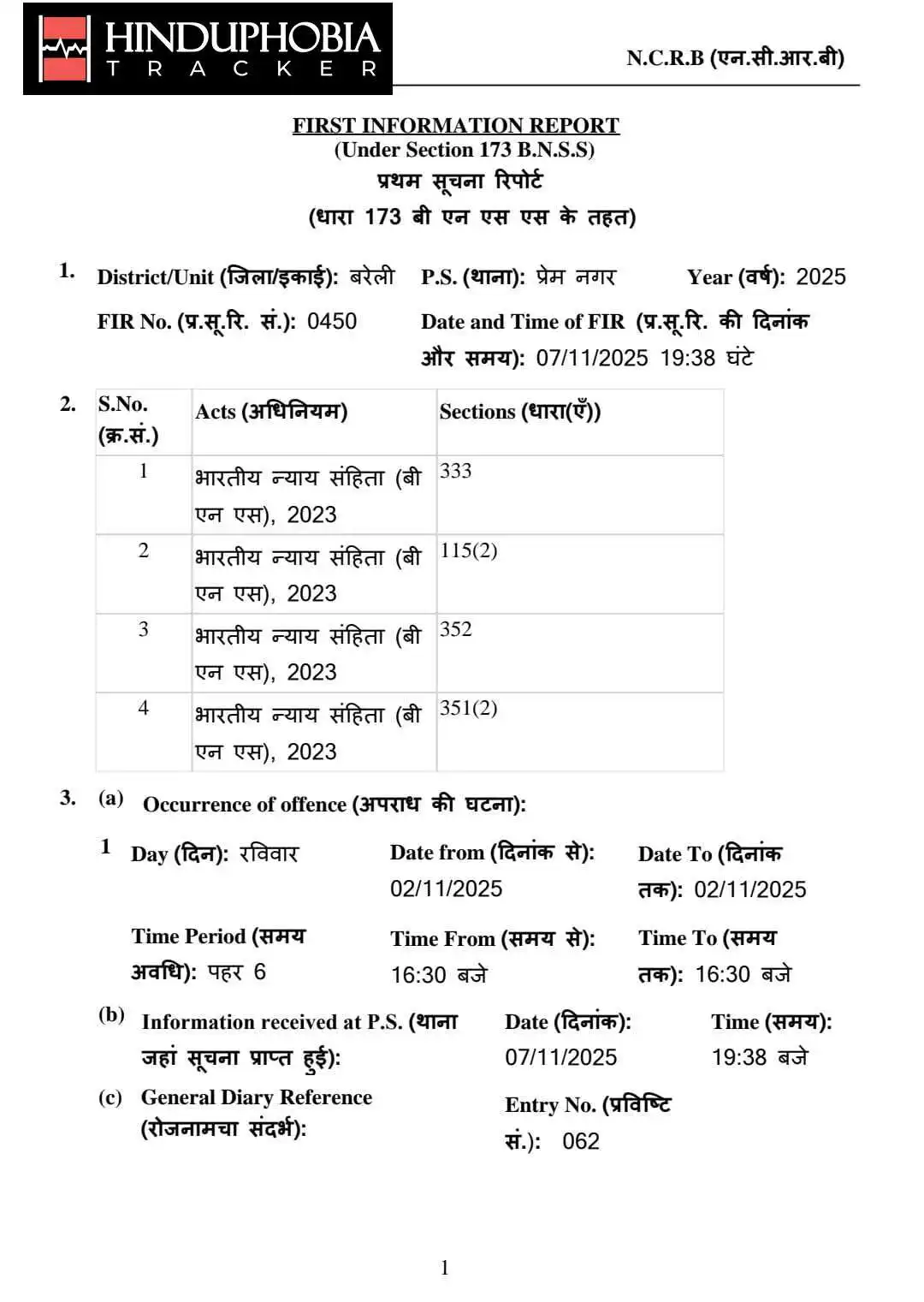
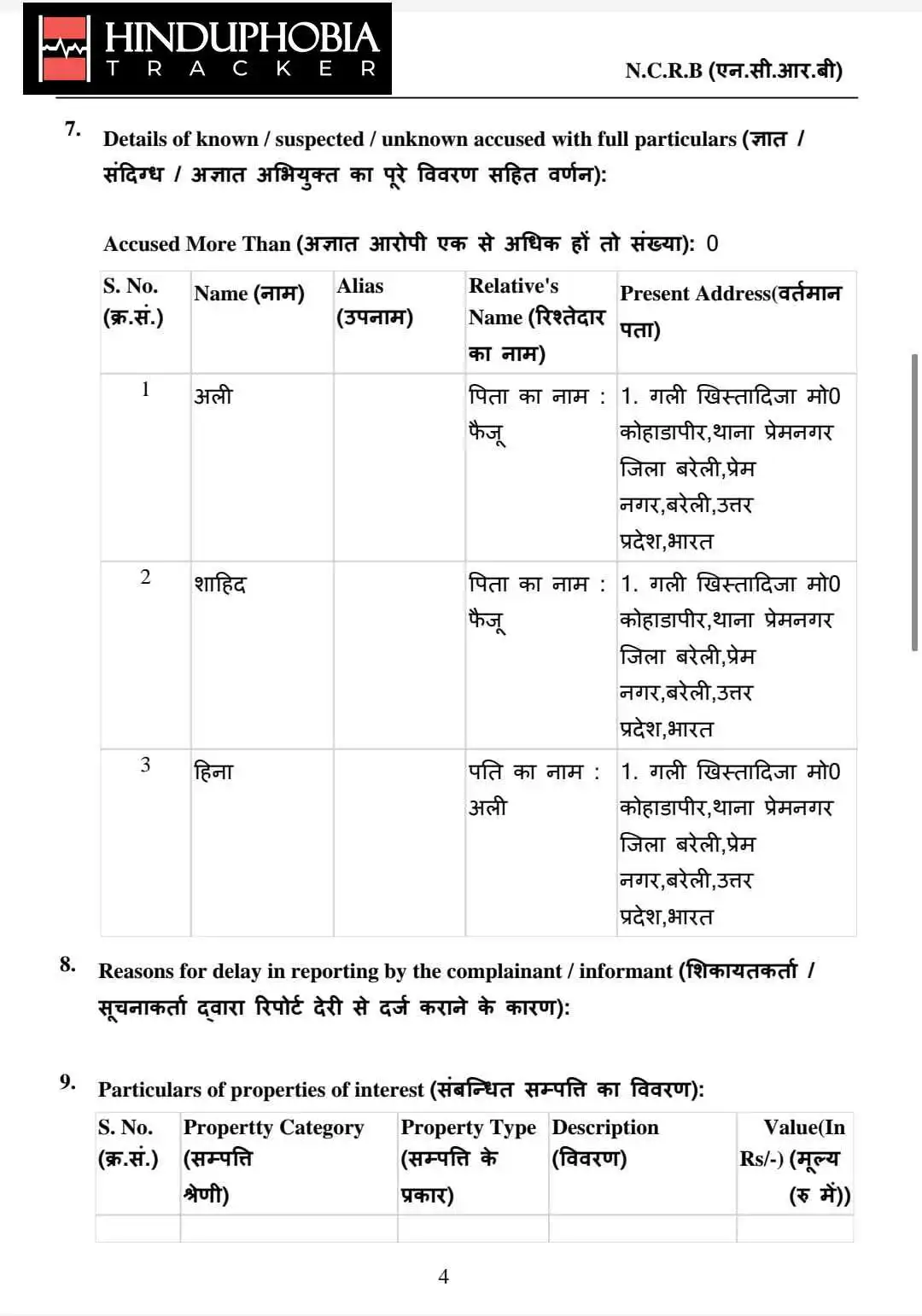
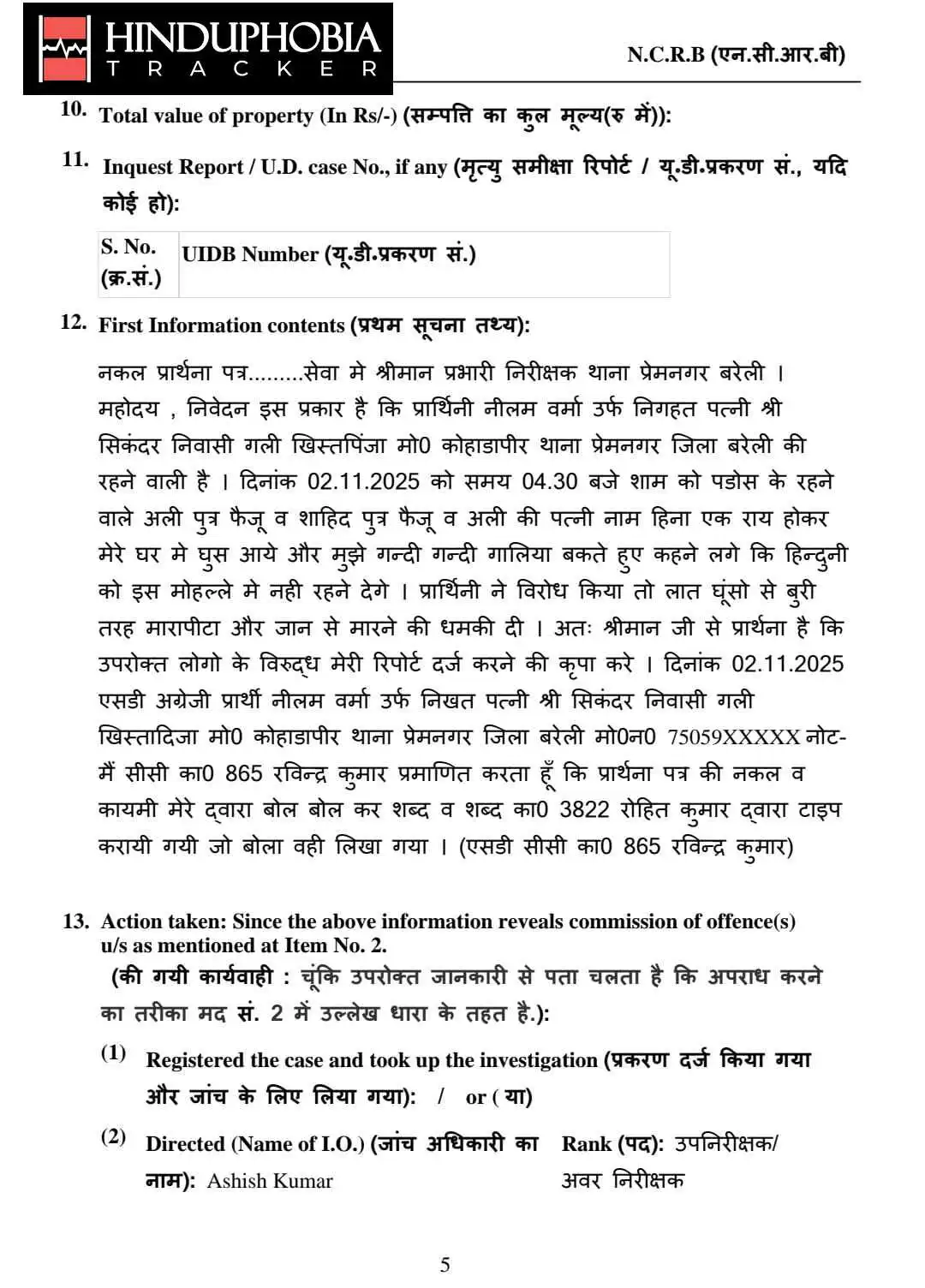
In Bareilly, Uttar Pradesh, a Hindu woman named Neelam Verma, also known as Nikhat, was verbally abused and brutally assaulted by her Muslim neighbours just for being a Hindu. The Hinduphobia Tracker accessed the FIR filed by the victim, Neelam Verma. She stated that she had an interfaith marriage to a Muslim man named Sikandar, a resident of Kohadapir under the Premnagar police station. On 2 November 2025, at around 4:30 pm, three Muslim individuals from her neighbourhood, Ali, his brother Shahid, and Ali’s wife Hina, forcibly entered her home. They verbally abused her using filthy language and declared that a Hindu woman would not be allowed to live in their (Muslim) locality. When Neelam protested against their abuse, the Muslim perpetrators brutally assaulted her with kicks and punches and threatened to kill her if she continued to stay there. Following the attack, Neelam approached the Premnagar police station and submitted a written complaint seeking legal action against Ali, Shahid, and Hina. As of the date of writing this report, the investigation was ongoing.
Case Images
Why it is Hate Crime ?
This case is being added to the tracker under the primary category- Attack not resulting in death. The subcategory selected is- Attacked to induce migration from non-Hindu dominated area. There have been cases where the Hindus living in an area, often with a majority dwelling belonging to non-Hindus or those harbouring animosity towards the Hindu faith, the Hindu residents experience threats and violence. The violence is employed with the aim of making the Hindus leave the area and relocate, so the area could be turned into an exclusive ghetto for adherents of the non-Hindu faith or those who harbor animosity towards the Hindu faith. In several cases, the aim of exodus is explicit. However, in several cases, the demand for exodus of Hindu residents is not explicit, however, violence by non-Hindu residents leaves the Hindu residents no option but to leave the area, thereby, turning the area into an exclusive ghetto of non-Hindu residents. In such cases, there are instances violence against the Hindu residents explicitly. For example, in the Hauz Qazi case of 2019, the Muslim residents claimed that mob violence against the Hindu residents had been triggered by a parking dispute. However, the violence did turn religious with a temple being desecrated and was directed specifically against the Hindu residents. The Hindu residents of the area were clear that the violence was religiously motivated and one of the motives was to affect an exodus of the Hindu residents. In such cases, even though the perpetrators have not explicitly expressed the aim of affecting exodus, the given circumstances and violence and precedent point to the intention of exodus and therefore would be categorized under this sub-category. Such crimes are religiously motivated and therefore are hate crimes. The other subcategory selected is- Attacked for Hindu identity. In several cases, Hindus are attacked merely for their Hindu identity without any perceived provocation. A classic example of this category of religiously motivated hate crime is a murder in 2016. 7 ISIS terrorists were convicted for shooting a school principal in Kanpur because they got ‘triggered’ seeing the Kalava on his wrist and tilak that he had put. In this, the Hindu victim had offered no provocation except for his Hindu religious identity. The motivation for the murder was purely religious, driven by religious supremacy. Such cases where Hindus are targeted merely for their religious identity would be documented as a hate crime under this category. The other sub-category selected here is - Attacked for opposing radicals or trying to save victim. In several cases, Hindus are attacked for opposing religiously motivated crimes being committed against a fellow Hindu or simply for voicing an opinion opposing radical elements, who either have in the past or continue to persecute Hindus. In such cases, the initial attack against the victim, against which the Hindu was trying to defend the victim, would also need to be classified as a religiously motivated hate crime. Since the initial crime itself was religiously motivated and the subsequent crime of attempting to save the victim or speaking against the radical elements ends up inviting a violent attack, it would also be classified as a religiously motivated hate crime under this category. This case has been added to the tracker because the Hindu woman, Neelam Verma, was targeted and attacked explicitly for her Hindu identity, exposing the deep-seated religious hostility harboured by her Muslim neighbours. The violence began when Neelam, who had married a Muslim man named Sikandar and was residing in the Muslim-majority locality of Kohadapir. She was singled out, verbally abused and brutally assaulted inside her house, with the accused declaring that a Hindu woman would not be allowed to live in their neighbourhood. Their words and actions revealed a clear motive of religious discrimination and hatred towards her identity as a Hindu woman living among Muslims. The attack was clearly communal in nature with the intention of driving away the Hindu woman out of a Muslim neighbour through violence. The violence and intimidation were rooted in collective religious hostility, with the identity of the victims as Hindus being the central cause of the attack. The perpetrators’ animosity was directed not at individuals but at the entire Hindu community, reflecting a pattern of hatred and intolerance aimed specifically at Hindus and their faith. This case follows the familiar pattern where Muslims, in Muslim majority areas, tend to force non-Muslims, especially Hindus, to migrate. This is achieved through various means such as physical intimidation, threats, harassment, torture, and constant discrimination. This reveals a disturbing sense of Islamic supremacy harboured by the attackers. In this case, the perpetrators viewed the predominantly Muslim-occupied region as an exclusive zone where non-Muslims, particularly Hindus, were unwelcome. This sense of entitlement and superiority not only reflects deep-seated prejudice but also highlights an attempt to assert religious dominance over public spaces. The sustained torture and intimidation meted out to the Hindus was motivated by this supremacist ideology, where Islamists in the area looked down upon Hindus, believing that they had the right to dictate who could move freely through their community. By explicitly invoking her Hindu identity and threatening to bar her from the neighbourhood, the accused displayed a conscious intent to humiliate and terrorise her because of her religion. The attack thus stands as a clear instance of targeted communal violence, motivated by hatred towards a Hindu individual living in a Muslim locality, reflecting the broader pattern of religious intolerance and hostility against Hindus. Notably, this was not the first instance where Hindus were selectively targeted, attacked, and forced to abandon their homes by members of the Muslim community. The Hinduphobia Tracker has previously documented several such cases that reflect a recurring pattern of hostility and violence against Hindus. One such case emerged in June 2025 from the Muslim-majority locality of Chhota Pura in Azamgarh district, Uttar Pradesh, where nearly forty Hindu families were compelled to flee their village after enduring continuous harassment on the basis of their religious identity. The Hindu victims reported persistent episodes of molestation, physical assaults, violent death threats, restrictions on their religious and cultural practices, and even pressure from Muslim villagers to renounce Hinduism. Overwhelmed by this sustained abuse, the families decided to leave their ancestral homes. Many put up posters reading, "This house is for sale," symbolising their anguish and helplessness in the face of religious persecution. Similarly, in May 2025, news emerged that in the Shanichari and Shukrawari localities of Sagar city, Madhya Pradesh, Hindu families had been gradually migrating for more than a decade. Their mass departure was driven by systematic intimidation, social isolation, and relentless harassment at the hands of the local Muslim population, which made their continued survival in the area unbearable. Like those previous cases, the current attack fulfils several parameters of a religiously motivated hate crime—selective targeting based on faith, organised violence, threats to life and forced displacement. It has therefore been added to the hate crime database of the Hinduphobia Tracker as another documented instance of violence rooted in religious hatred against Hindus.
Victim Details
Total Victim
1
Deceased
0
Gender
- Male 0
- Female 1
- Third Gender 0
- Unknown 0
Caste
- SC/ST 0
- OBC 0
- General 1
- Unknown 0
Age Group
- Minor 0
- Adult 1
- Senior Citizen 0
- Unknown 0


Case Status
Complaint registered


Perpetrators Details
Perpetrators
Muslim Extremists
Perpetrators Range
From 5 to 10
Perpetrators Gender
both
 Sources




