Hindu families targeted with cash inducements for covert Christian conversion inside a mall in Surat, Gujarat
 Surat, Gujarat, India
  8 November, 2025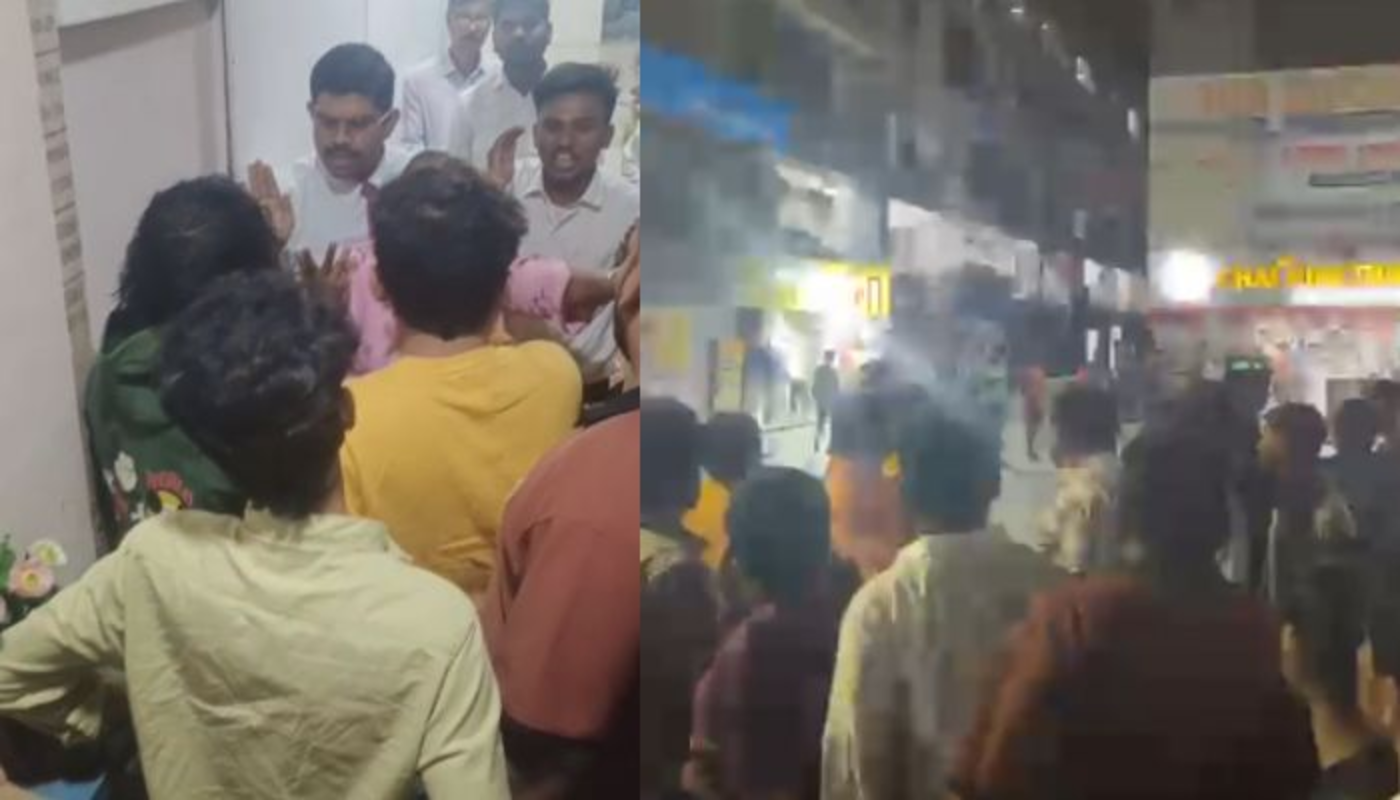
Case Summary
A religious conversion racket was uncovered in Dindoli, Surat, Gujarat, after a Hindu organisation found that Christian missionaries had been covertly converting people inside Rajmahal Mall for the past two to three months. Members of the organisation said they detected systematic efforts to target middle-class Hindu families and lure them with monetary benefits. As the news spread, a large crowd gathered at the mall, and slogans of Jai Shri Ram were raised. According to the Hindu group, those who converted were paid between Rs 20,000 and Rs 25,000, and agents were offered around Rs 5,000 per person. Acting on this information, members of the organisation reached the location late at night and caught several individuals in the act. Dindoli police soon arrived and detained seven people. After the accused apologised, tensions eased on the spot, although the police said the inquiry would continue. Udhna MLA Manu Patel visited the location and spoke with officials. He warned that if such incidents occurred again, the Hindu community would take a firm stand to protect its culture and faith. Patel stated that larger networks might be operating behind such activities and described it as an anti-national threat. He said several of the young individuals who had converted belonged to Rathod, Marathi and North Indian families. According to him, members of the Hindu organisation spent nearly two hours counselling them on Hindu scriptures and philosophy, after which the youths expressed willingness to return to Hinduism. Police confirmed that an inquiry had been initiated and that those detained were being questioned. Inspector K.A. Chauhan stated that police had been called by a Christian couple and that they were taken in for questioning. He denied that any confirmed conversion event took place and said that at least seven people were brought to the police station to record statements and clarify the situation.
Why it is Hate Crime ?
The primary category under this is: Predatory Proselytisation. The first subcategory under this is: Conversion/ attempts to convert by inducement. Predatory Proselytisation is not just limited to threat, harassment, force and violence, but it also has contours of stealth. In several cases, the Hindu victim is exploited to convert, with non-Hindus taking advantage of their poverty. In such cases, the Hindu victim who is suffering financially is offered monetary benefits, including lucrative offers for jobs, health treatment, education, etc, to induce the victim into changing his/her religion. In such cases, the religious identity of the victim and the aim to disenfranchise him from his faith form the heart of the crime. Also, taking advantage of and exploiting an individual’s economic vulnerabilities is widely acknowledged as exploitation, forms of which are often penalised by law. Such cases therefore are considered religiously motivated hate crimes since the victim’s religious identity forms the very heart of the crime itself. The second subcategory under this is: Proselytisation by grooming, brainwashing, manipulation or subtle indoctrination. Religious brainwashing essentially means the often subtle and forcible indoctrination to induce someone to give up their religious beliefs to accept contrasting regimented ideas. Religious grooming or brainwashing also involves propaganda and manipulation. It involves the systematic effort, driven by religious malice and indoctrination, to persuade “non-believers’ to accept allegiance, command, or doctrine to and of a contrasting faith. Cases of such grooming or brainwashing are far more nuanced than direct threats, coercion, inducement and violence. In such cases, it is often seen that there is repeated, subtle and continual manipulation of the victim to induce disaffection towards their own faith and acceptance of the contrasting faith of the perpetrator. While subtle indoctrination is widely acknowledged as predatory, an element which is often understated in such conversions or the attempts of such conversion is the role of loyalty and trust which might develop between the perpetrator and the victim. Fiduciary relationships are often abused to affect such religious conversion. For example, an educator transmitting religious doctrine of a competing faith to a Hindu student. The Hindu student is likely to accept what the teacher is transmitting owing to existence of the fiduciary relationship. The exploitation of the fiduciary relationship to religiously indoctrinate victims would also be included in this category. Since the underlying animosity towards the victim’s faith forms the basis of predatory proselytization, such cases are considered religiously motivated hate crimes. This case has been included in the tracker because it demonstrates the systematic targeting of Hindus for religious conversion through covert inducement rather than open persuasion or spiritual discourse. The operation in Dindoli was not driven by the free movement of personal belief, but by the calculated deployment of cash incentives designed to exploit economic vulnerability. When the prospect of monetary reward becomes the instrument through which individuals are encouraged to abandon their inherited religious identity, the behaviour crosses the threshold of legitimate propagation and enters the realm of inducement. Then, the victim’s material insecurity and social pressures are engineered to produce a religious outcome that does not originate from conscience or conviction. What the Hindu organisation uncovered here was not the presence of religious debate, but the presence of a structured mechanism which attempted to harvest Hindu identity by treating conversion as a commodity transaction. The secrecy of the location and the duration for which these activities continued indicate that this was not informal evangelism, but a covert system intended to remain undetected for as long as possible. Malls are neutral commercial environments; they are not religious spaces. The choice of venue alone demonstrates that the actors responsible believed their activity required concealment. When inducement and concealment operate together, the intention is unmistakable: to weaken resistance, bypass scrutiny, and convert individuals who would not have changed their faith voluntarily. The fact that the affected individuals came from middle-class Hindu families is significant because these are precisely the strata where financial pressures and aspiration intersect to create a vulnerability that can be exploited with offers of cash, job promises, or personal relief. It is also relevant that when these individuals were counselled about the philosophy and foundational values of their own religion, they immediately affirmed that they wished to return to Hinduism. Their reversal was not gradual, nor was it a matter of theological argument. It was instantaneous once emotional grounding and community validation were restored. This proves that the earlier shift in their religious position had not arisen from a genuine inner transformation but had been formed externally, through inducement, pressure, or opportunistic manipulation. In such a situation, the Hindu identity is not being changed through informed consent; it is being overwritten through exploitation. This is why this incident is not classified merely as a misunderstanding or a clash of views, but as a deliberate act of predatory religious targeting. This case has therefore been included because it shows an attempt to detach Hindus from their faith, not by respecting their agency, but by bypassing it altogether. The religious identity of the Hindu here was not engaged respectfully, but treated as a negotiable attribute that could be stripped away if the correct price was offered. This erosion of religious belonging through inducement is an assault not only on the individual Hindu victim, but also on the Hindu community’s collective continuity, because it treats Hindu identity not as a living inheritance of culture, memory and philosophy, but as an item which could be purchased like a commodity. This is a harm that is targeted, directional, and rooted in intent, and that is why this incident has been documented as a hate crime against Hindus. Disclaimer: It is important to clarify that none of the media sources covering this case have specified the exact date on which the conversion racket was unearthed. Therefore, for documentation purposes, we have recorded the date based on when the incident was reported in the media. Disclaimer: The number of perpetrators in this case has been provisionally recorded as seven because police stated that seven individuals were taken for questioning. Should further details or formal charge details emerge from the ongoing investigation, the number will be updated accordingly to reflect the official record.


Case Status
Complaint filed


Perpetrators Details
Perpetrators
Christian Extremists
Perpetrators Range
From 5 to 10
Perpetrators Gender
both
 Sources




