Hindu temple land in Gaumat village targeted for encroachment by the Muslim community; meat and egg shops opened near temple
 Khair, Uttar Pradesh, India
  6 November, 2025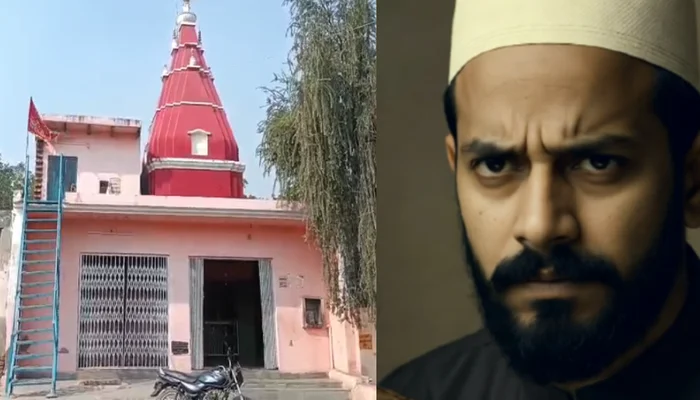
Case Summary
In the Gaumat village of Khair town in Aligarh, Uttar Pradesh, a Hindu temple was facing threats of encroachment by members of the Muslim community. According to a Hindu man named Mukesh Kumar Sharma, the land was part of his ancestral property. His ancestors built the Pathwari Temple here and deliberately left some adjoining land vacant for the purpose of expanding the temple in future. Mukesh Sharma stated that members of the Muslim community were trying to take control of this land by opening meat and egg shops on it, an act seen as provocative and disrespectful in the vicinity of a Hindu place of worship. Mukesh Sharma submitted written complaints to the Khair Police Station, the Khair Circle Officer, and the Sub-Divisional Magistrate, but no action followed. He then escalated the matter to the Senior Superintendent of Police (SSP) in Aligarh, demanding legal intervention. Following this, a joint revenue and police team visited the site to investigate the illegal occupation. Both sides were called to present their documents and arguments during the on-site inspection. After the inquiry, the police detained one person from each community and took them to the Khair police station. This move sparked resentment among the Hindu villagers, who felt misled, as they were assured their statements would be recorded, but instead faced detention. Inspector Khair Dushyant Tiwari stated that appropriate legal action was being taken based on the application received. He also stated that peace was currently established in the village. It is important to note here that the Gaumat village, located in the Khair Kotwali area, falls under the highly sensitive category, where people from both communities reside. Tensions had erupted between the two communities in this village on several occasions in the past due to caste and religious issues.
Why it is Hate Crime ?
This case has been added to the tracker under the primary category of - Attack on Hindu religious representations. Within it, the sub-category selected is - Encroachment or illicit takeover of temple land/land near temple. In Hinduism, a temple is the abode of the Deity. The Deity in the Temple is consecrated, thereby, making it a real, breathing entity. Hindus believe that not just the Deity but the temple premises itself are sacred to Hindus since Hindus hold the faith that the entire Temple space is an amalgamation of the divine energy of the deity. Not only the Temple but the Temple premises in its entirety are considered sacred by Hindus. In several cases, the premises of the Temple and/or religious centre are illicitly taken over by institutions belonging to other faiths – like the Waqf board or the Church. Other times, the temple property, land or the property of religious centres are illicitly encroached by non-Hindu groups. Any illicit take over or encroachment is a crime an initio, however, when non-Hindu groups illicitly take over or encroach the sacred land of Hindus, it is an affront to the Hindu community and is therefore classified as a religiously motivated hate crime under this category. The other sub-category relevant here is - Defiling religious customs. Sanatan Dharma is not a religion of one book, which is to say that while it has religious scriptures that form the central tenets of the faith, there are several traditions followed through thousands of years, mostly passed from generation to generation orally. There are several such customs and traditions that are followed by various Hindus and Hindu sects. Defiling of these traditions and customs is a breach of an individual or group’s religious practices. Such practices can range from dietary restrictions like not eating non-vegetarian food for a certain period of the year, not eating non-vegetarian food at all, not eating beef since the cow is considered holy in Hinduism, the sanctity of religious customs followed in the house (like many ISCKON devotees), etc. Any malicious action leading to the breach of such traditions or defilement of these traditions owing to animosity towards the faith or for the sake of activism stems not only from the lack of faith in the religion itself but also from disregard for the faith of the devotees who follow the customs/traditions and implicit bias against the faith, the tradition itself. Since these specific traditions are central to the faith of the devotees of that specific sect of Hindus, any non-compliance with these traditional rules would be considered a religiously motivated hate crime. This case has been added to the tracker because of the attempted encroachment and illegal occupation of the Pathwari Hindu temple land in Gaumat village by members of the Muslim community. The land surrounding the temple was not merely a piece of property but held deep religious and cultural significance for the local Hindu community. For Hindus, both the temple and its land are considered the abode of the deity, embodying divine energy. Any form of encroachment or seizure of temple land was an attack on the religious rights and sentiments of Hindus, disrupting their ability to worship and maintain their sacred spaces. Any unauthorised occupation of this space, especially one that halts worship and religious observance, is a violation of that sanctity. Such actions are not only an encroachment in legal terms but a direct affront to the religious beliefs and collective identity of Hindus. The case also highlights the deliberate disregard for the sanctity of Hindu temples. The attempt to open meat and egg shops on the temple land was seen as a provocative act intended to offend Hindu religious sentiments. Such actions are a deliberate violation of the sanctity of Hindu temples, which are revered as sacred spaces of worship. Establishing such businesses near a Hindu place of worship, especially one dedicated to a deity, amounts to an act of desecration and disrespect, aimed at provoking Hindus and mocking their deeply held beliefs. Such an act reflects a profound disregard for the faith and its practices, stemming from underlying animosity toward Hinduism. This was clearly done with the intent to mock the Hindu faith, underscoring the deep-rooted hatred towards Hinduism in the minds of the perpetrators. The temple encroachment in Gaumat village thus goes beyond a land dispute, reflecting hostility towards Hindu religious spaces. Since the perpetrators’ actions were motivated by religious animosity, this case has been added to the tracker. Disclaimer: The Hinduphobia Tracker records incidents based on when an event occurred or when the victim's ordeal began. It is important to clarify that none of the media sources covering this case has specified the exact date when the temple encroachment began. Therefore, for documentation purposes, we have recorded the date based on when the incident was reported in the media - 7 November 2025.


Case Status
Complaint filed


Perpetrators Details
Perpetrators
Muslim Extremists
Perpetrators Range
Unknown
Perpetrators Gender
unknown
 Sources




