Hindu student denied classroom entry for wearing Ayyappa Deeksha attire and Mala in Andhra Pradesh
 Vijayawada, Andhra Pradesh, India
  30 October, 2025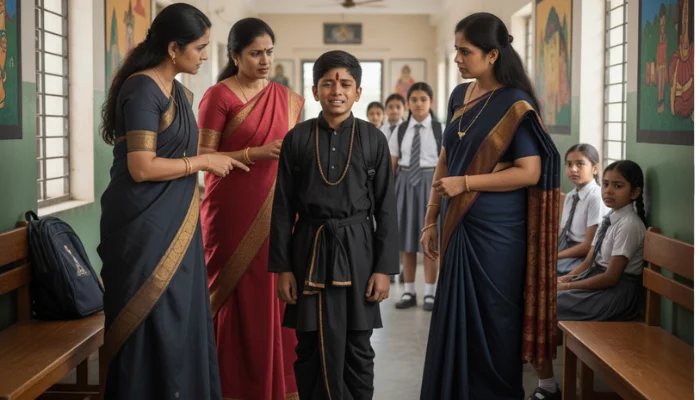
Case Summary
In Vijayawada, Andhra Pradesh, a Hindu student wearing an Ayyappa Mala and Ayyappa Deeksha attire, traditional garments and a necklace worn by Ayyappa devotees before visiting the Sabarimala temple, was denied entry into the classroom for not complying with the school’s uniform dress code rules. According to media reports, the incident occurred at a private school where the student, upon arriving in the morning wearing the mala and the attire, was sent back home by the school authorities. Following this, news of the incident attracted a group of Hindu devotees and activists, including members of the Akhil Bharatiya Vidyarthi Parishad (ABVP) and Rashtriya Swayamsevak Sangh (RSS), two Hindu organisations, who gathered at the school to protest and demand that the student be allowed to attend class wearing the Ayyappa Mala and Deeksha attire. Subsequently, the Bhavanipuram Police arrived at the scene and attempted to pacify the aggrieved parties while maintaining law and order. Following this, the matter was taken up with the District Educational Officer (DEO), U V Subba Rao. Following discussions between the DEO and the school management, the school issued an apology and agreed to allow the student to attend class wearing the mala and deeksha attire, effectively resolving the immediate conflict. The DEO issued notices to the school management and directed that a settlement be reached within two days. He instructed that students attending private, aided, or other schools who wear religious symbols such as the Ayyappa mala must not be prevented from entering classrooms and warned of stringent action against schools that fail to comply. Officials cautioned that school managers who persistently objected to students displaying religious symbols could face disciplinary measures, including possible cancellation of school recognition.
Why it is Hate Crime ?
In this case, the school refused to grant entry into the classroom to a Hindu student for wearing the Ayyappa Mala and Ayyappa Deeksha attire—the black religious clothes worn by Ayyappa devotees. This decision sparked outrage among Hindus, who said that the action of the school administration was driven by prejudice against their faith. This is not the first time such controversy has erupted. In 2022, in Karnataka, a heated debate erupted when Muslim girls insisted on wearing burqas and hijabs in schools and classrooms. At that time, politicians, social commentators, Hindu activists, and even the judiciary argued that schools have the right to enforce uniform rules. Uniformity was seen as a means to promote harmony and equality within classrooms. Therefore, disallowing hijabs was deemed enforcement of uniform policy rather than religious discrimination. Similar logic can apply here. The school's restriction on wearing the black Ayyappa Deeksha attire may well have been an enforcement of uniform regulations rather than an act motivated by religious bias. However, if the school allowed Muslim students to wear hijabs but barred Hindu students from wearing their religious symbols, it would certainly amount to a hate crime, exposing blatant discrimination and double standards. At present, based on available information, such differential treatment does not appear evident in this case. Therefore, this case is being added to the 'Undecided' database of the Hinduphobia Tracker. If any further information emerges indicating religious bias, it will be reclassified and added to the Hate Crime database.
Victim Details
Total Victim
1
Deceased
0
Gender
- Male 1
- Female 0
- Third Gender 0
- Unknown 0
Caste
- SC/ST 0
- OBC 0
- General 0
- Unknown 1
Age Group
- Minor 1
- Adult 0
- Senior Citizen 0
- Unknown 0


Case Status
Case adjudicated


Perpetrators Details
Perpetrators
Others
Perpetrators Range
Unknown
Perpetrators Gender
unknown
 Sources




