Hindu family subjected to insults against Hindu faith and deities by visiting Christian pastor in Maharashtra
 Palghar, Maharashtra, India
  1 November, 2005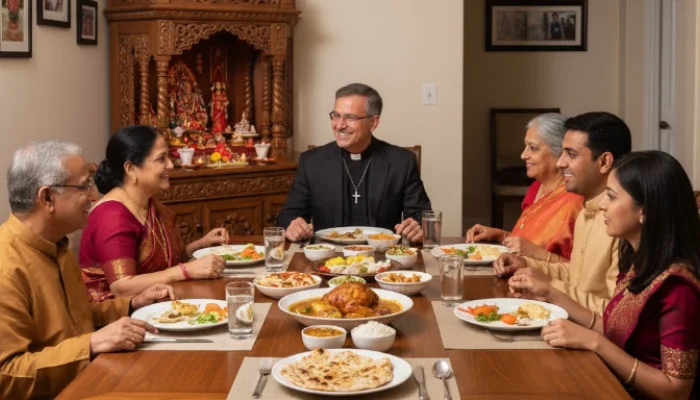
Case Summary
In Palghar, Maharashtra, a Hindu family was subjected to insults directed at Hinduism and its deities by a Christian pastor who had been a guest at their home. This incident came to public attention after one of the family members shared the ordeal on the social media platform X. The victim, a Hindu man named Rahul Srinivas, who uses the username “@whizzkid”, described how he and his family endured the denigration of their faith and deities about twenty years ago (2005), when a visiting pastor came to their home. In a detailed post, he recounted how what began as a casual lunch gradually turned into an uncomfortable and distressing exchange about faith—an experience that had stayed with him for decades. Rahul wrote that around twenty years earlier, at their home in Palghar, they had hosted a visiting pastor from Kerala for lunch. His father, who was active in the local Malayalee association, had invited the pastor as a guest. Initially, the meeting appeared cordial, but the atmosphere shifted when the pastor noticed the family’s pooja corner—a small shelf with a murti of Lord Krishna and framed photographs of Lord Shiva and Lakshmi Devi. According to Rahul, the pastor smiled derisively before asking why the family “needed so many gods.” Rahul recalled that this was not a genuine question but a deliberate provocation. The pastor also began denigrating Hindu traditions and deities as misguided and illusions. The victim, Rahul, on his X wrote: “About twenty years ago, at our home in Palghar, we had a visiting pastor from Kerala join us for lunch. My dad, who was active in the local Malayalee association, had invited him as a guest. The meal went well enough. Soon, the conversation drifted towards religion. Our modest pooja corner—a small shelf with a murti of Krishna Ji and framed photos of Shiv Ji and Lakshmi Devi—caught his attention. He smiled (almost with ridicule), and then asked why we ‘needed so many gods.’ It wasn’t really a question; it was an opening. What began as curiosity quickly turned into a sermon—a calm, confident dismissal of everything we believed in. In a matter of minutes, he explained how our faith was misguided, our rituals unnecessary, and our gods mere illusions.” Rahul further wrote: “What stayed with me wasn’t the disagreement itself, but the ease with which he spoke. He had just eaten our food, which my mom served with love. He was inside our home, in our living room, feeling perfectly comfortable ridiculing the very faith of his hosts. That was the day I learnt that fanaticism doesn’t always look fierce. Sometimes it just smiles at you from across the table.” While Rahul’s account resonated deeply online, it emerged within the broader context of a discussion surrounding statements made by Usha Vance, the wife of United States Vice President JD Vance. During a conservative event, Vice President Vance had remarked that he “hoped” his Hindu wife would one day embrace Christianity. This comment sparked a wider debate about religious sensitivity and the predatory nature of conversion tactics employed by Christian missionaries. Within that discussion, Rahul’s story stood as a personal testimony reflecting how subtle forms of religious denigration and missionary pressure have long affected ordinary Hindu families.
Why it is Hate Crime ?
This case has been added to the tracker under the primary category- Hate Speech against Hindus. The subcategory selected is- Anti-Hindu slurs, mocking faith. Anti-Hindu slurs and the deliberate mocking of the Hindu faith owing to religious animosity involve the usage of derogatory terms, stereotypes, or offensive references to religious practices, symbols, or figures. One of the common anti-Hindu slurs used against Hindus is “cow-worshipper” and “cow piss drinker”. The intention of using this term is to demean and mock Hindus as a group and their religious beliefs since Hindus consider the cow holy. Additionally, some symbols and the slurs attached to them have a historical context that exacerbates the insult, hate, stereotyping, dehumanisation and oppression against Hindus. Cow worship has been used for centuries to denigrate Hindus, insult their faith and oppress Hindus specifically as a religious group. There has been overwhelming documentation about how cow slaughter has been used to persecute Hindus with cow meat being thrown in temples and places of worship. There has also been overwhelming documentation where cow meat (beef) has been force-fed to Hindus to either forcefully convert them to Islam or denigrate their faith. Apart from cow worship, the Swastika – which holds deep religious significance for the Hindus – has also been misinterpreted and distorted to use as a slur against Hindus. Similarly, the worship of the Shivling has been used by supremacist ideologies and religions to denigrate Hindus owing to religious animosity. Such slurs and denigration stem out of inherent animosity and hate towards Hindus and their faith, therefore, it is categorised as hate speech targeted at Hindus specifically owing to their religious identity. In this case, the pastor’s remarks towards the Hindu family in Palghar represented a deliberate attempt to denigrate their faith and humiliate their beliefs, constituting a clear case of anti-Hindu hate speech. His first comment—asking why the family “needed so many gods”—was not rooted in genuine curiosity but in derision. This statement directly mocked the plural and inclusive nature of Hinduism, which venerates multiple deities as manifestations of the same divine truth. By questioning the legitimacy of this deeply philosophical and cultural aspect of the Hindu religion, the pastor belittled the family’s faith and dismissed centuries of spiritual tradition. Such words carried not only offence but also a message of religious superiority that sought to undermine Hindu identity itself. He further escalated his contempt by calling the family’s faith “misguided.” By labelling Hindu beliefs as misguided, the pastor implied ignorance or deception on the part of the Hindus who followed their faith with devotion and sincerity. Hinduism, a philosophy that has nurtured countless spiritual systems and schools of thought, was reduced to ignorance in his words. This portrayal mirrored a historical colonial narrative that missionaries have often used to depict Hindus as people in need of “correction” or “salvation.” His words invalidated a religion that teaches tolerance, universality, and coexistence, converting a peaceful conversation into a subtle display of religious intolerance and contempt. In the next instance, the pastor mocked Hindu rituals by calling them “unnecessary.” This statement was not just dismissive but deeply offensive. Rituals in Hinduism—be it pooja, lighting a diya, reciting mantras, or observing fasts—hold emotional and spiritual meaning, connecting individuals to the divine and their ancestral heritage. By calling them unnecessary, the pastor struck at the emotional and cultural core of Hindu life, implying that these practices were meaningless. Such derision not only insulted personal conviction but also constituted a wider assault on the cultural and spiritual identity of Hindus as a community. The pastor then went a step further by calling Hindu gods and goddesses “illusions.” This was the most severe form of insult, as it invalidated the sacred itself. To call Lord Krishna, Lord Shiva, and Goddess Lakshmi illusions amounted to desecrating the divine figures worshipped by millions. It was not an opinion—it was an act of verbal desecration. To dismiss the deities of another faith within their own home, after sharing their food and hospitality, demonstrated an alarming level of disregard and hatred. This remark, made in the context of religious proselytisation, bore all the marks of anti-Hindu hate speech, as it sought to humiliate and morally degrade followers of the Hindu faith. Beyond the personal experience of the victim, this incident reflected a broader pattern of religious hostility often seen in missionary contexts in India. While the accused in this case was a Christian pastor, it is important to recognise that similar acts of denigration have repeatedly been used as conversion tools by missionary actors. Across various regions, Hindu families have been targeted and emotionally manipulated through the systematic ridicule of their beliefs. Questioning why Hindus “need so many gods” or why they practise rituals is a typical tactic employed to erode faith and sever individuals from their religious roots. When Hindus are told their gods are false and their traditions meaningless, it becomes more than a debate—it transforms into an act of cultural and spiritual denigration intended to excommunicate them from their own identity and pressure them into adopting the Christian faith. However, in this particular case, it is important to note that the pastor, while clearly engaging in anti-Hindu derision, did not attempt to proselytise or forcibly convert the Hindu family. The victim, in his post on X, nowhere indicated that the pastor tried to convert them to Christianity. Therefore, this case does not document an attempt at conversion but reflects verbal and psychological hostility directed purely against the Hindu faith and its deities. Viewed through the prism of anti-Hindu hatred, it remains a clear instance of hate speech motivated by religious bias and contempt for Hinduism. Therefore, this case is being added to the hate crime database of the Hinduphobia Tracker. Disclaimer: The Hinduphobia Tracker records the date of an incident based on when the event occurred rather than when it was reported by the media. However, in this particular case, neither the media reports nor the victim’s social media post specified the exact date of the incident. The victim mentioned only that the incident took place about twenty years ago and shared his experience publicly on 2nd November 2025. Based on these two details, an indicative date of 2nd November 2005 has been used as the date of the incident. This is for documentation purposes only and serves to record the timeline of the family’s ordeal.
Victim Details
Total Victim
3
Deceased
0
Gender
- Male 2
- Female 1
- Third Gender 0
- Unknown 0
Caste
- SC/ST 0
- OBC 0
- General 0
- Unknown 3
Age Group
- Minor 0
- Adult 3
- Senior Citizen 0
- Unknown 0


Case Status
Unknown


Perpetrators Details
Perpetrators
Christian Extremists
Perpetrators Range
One Person
Perpetrators Gender
male
 Sources




