Hindu wedding procession attacked as it passes Muslim locality, multiple Hindu youths injured
 Saharanpur, Uttar Pradesh, India
  31 October, 2025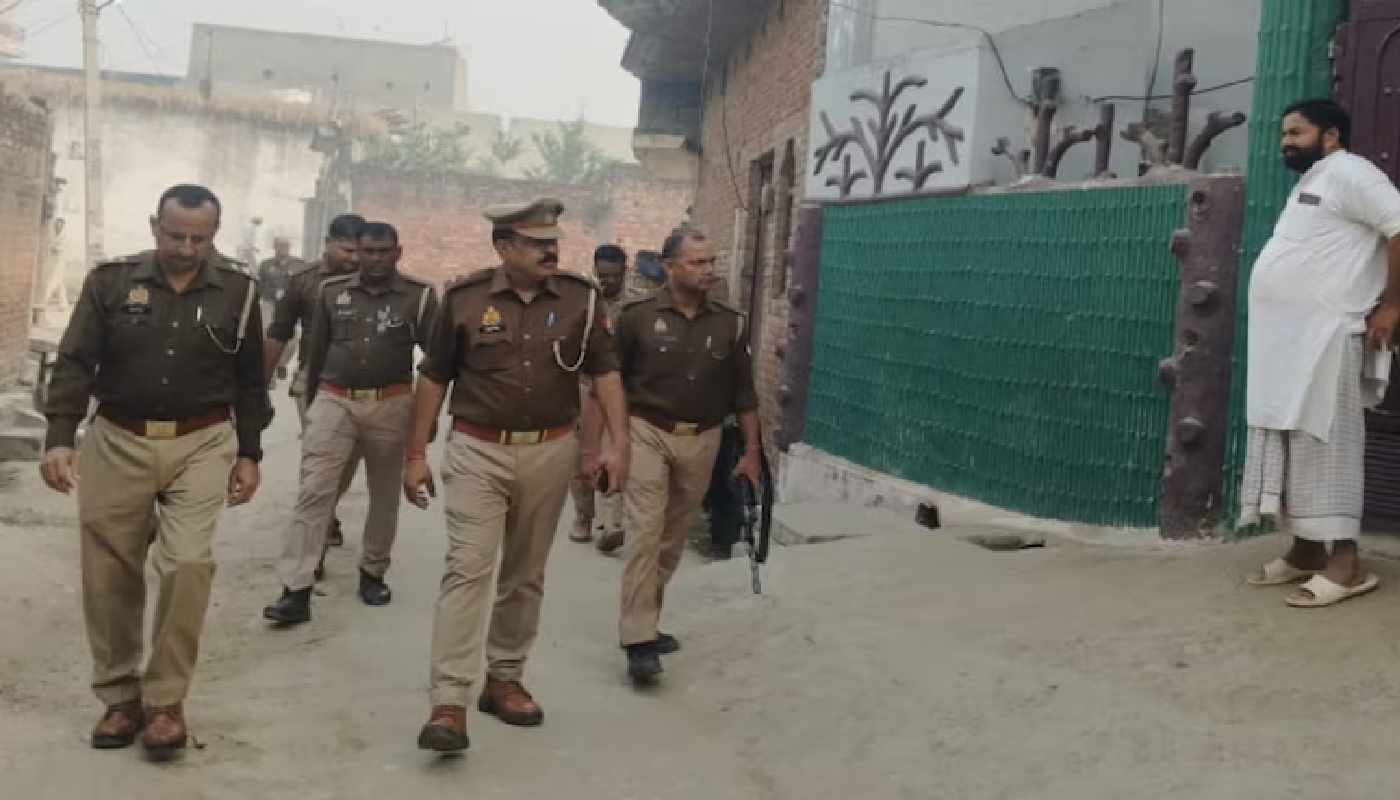
Case Summary
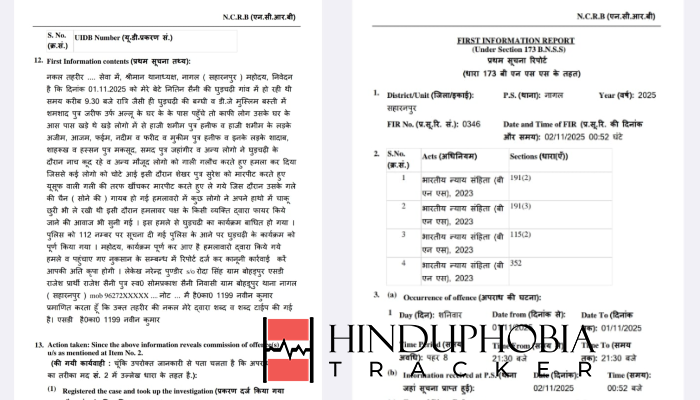
Hindus were attacked in Bohdhoopur village in Nagal area of Saharanpur district, Uttar Pradesh, during a traditional pre-wedding Ghudchadi ritual for Nitin Saini, son of Rajesh Saini. The Hindu wedding procession was moving through the village at around 9.30 pm on November 1, 2025, and reached near the house of a Muslim resident named Shamshad. At that point, Muslim youths stopped the procession, and when the Hindu youths objected, they were assaulted. Over a dozen Muslim attackers physically attacked the Hindu boys dancing in the procession. Many were injured in the violence. Witnesses said the attackers were armed with sharp weapons and also fired shots in the air. Panic broke out, and Hindu youths started running to escape. The police control room received information, and Station House Officer Rajkumar Chauhan reached the spot with a police team and informed senior officers. Late at night, the Deoband Circle Officer and a heavy force from multiple police stations arrived and brought the situation under control. Hindu complainant Rajesh Saini submitted a written complaint naming ten Muslim attackers and one unknown person. Police registered a case and started the search for attackers. One Hindu youth named Nikhil was seriously injured and referred to the district hospital. Other injured Hindus received medical attention and were discharged after primary treatment. Considering the continued tension between Hindus and Muslims in the village, the police force was deployed overnight to prevent further violence. The Muslim side later claimed that they had only asked to lower the DJ volume, but the documented events show that Hindus were attacked during a sacred wedding ritual. Some media reports also state that the procession was attacked when it passed from a nearby mosque.
Case Images
Why it is Hate Crime ?
The primary category in this case is: Attack not resulting in death. The first subcategory under this is: Attacked for Hindu identity. In several cases, Hindus are attacked merely for their Hindu identity without any perceived provocation. A classic example of this category of religiously motivated hate crime is a murder in 2016. 7 ISIS terrorists were convicted for shooting a school principal in Kanpur because they got ‘triggered’ seeing the Kalava on his wrist and tilak that he had put. In this, the Hindu victim had offered no provocation except for his Hindu religious identity. The motivation for the murder was purely religious, driven by religious supremacy. Such cases where Hindus are targeted merely for their religious identity would be documented as a hate crime under this category. The second subcategory is: Attacked for crossing Muslim area. One of the reasons that Hindus get attacked unprovoked specifically by Islamists is for crossing ‘Muslim areas’. Essentially, Muslim mobs often attack Hindus crossing or present in certain areas which have a majority Muslim population. It has often been cited as one of the reasons to blame Hindus for attacks against themselves, signalling that Hindus displaying religious symbols, taking our religious processions or crossing any area which is dominated by Muslim residents is a provocation in and of itself. These areas are mostly ghettoized areas where mobs mobilize quickly to attack Hindus for a variety of reasons like playing music during a religious procession, crossing a mosque, wearing a tilak or any other religious symbol in a Muslim-dominated area, praying at a local temple in that area etc. There have been cases where the few local Hindus of that area have been attacked on their way to the Temple for prayers as well, simply because the area is considered a Muslim-dominated area. Several times, it is entirely possible that the immediate trigger for the violence against Hindus was non-religious in nature, however, the violence became religiously motivated in nature because the area was Muslim dominated and the residents on the whole harboured animosity towards Hindus, evidenced from the actions of the mob, the slogans, and the nature of the attack. Such crimes are motivated by the religious identity of the victims and are therefore classified as hate crimes under this category. The third subcategory under this is: Attacked for opposing radicals or trying to save victim. In several cases, Hindus are attacked for opposing religiously motivated crimes being committed against a fellow Hindu or simply for voicing an opinion opposing radical elements, who either have in the past or continue to persecute Hindus. In such cases, the initial attack against the victim, against which the Hindu was trying to defend the victim, would also need to be classified as a religiously motivated hate crime. Since the initial crime itself was religiously motivated and the subsequent crime of attempting to save the victim or speaking against the radical elements ends up inviting a violent attack, it would also be classified as a religiously motivated hate crime under this category. This case is included in the Hinduphobia Tracker because the violence directed at Hindus during the Hindu pre-wedding horse procession in Bohdhoopur village fits directly within the category of Hindus being attacked for their identity and for crossing a Muslim dominated area. The Ghudchadi procession is itself a Hindu ritual which marks the formal journey of the groom towards his marriage. It is not incidental background noise. It is a core cultural and religious component of the Hindu wedding tradition. When such a Hindu ritual is stopped by a Muslim group and the Hindu boys participating in that ritual are physically attacked, the incident becomes an unambiguous demonstration of religious hostility. It is not reasonable to reduce this case to a neighbourhood scuffle or a misunderstanding about volume. This was targeted violence against Hindus while they were performing a sacred Hindu ritual. There is a structural pattern here which is now well-documented in the Tracker across multiple cases. Hindu processions are treated as provocation merely because they pass through or near Muslim localities. Instead of accepting the normal coexistence of religious communities in public spaces, there is the construction of territorial ownership, where Hindus are punished for passing through or for celebrating religiously significant moments. The claim of the attackers that the procession was near a mosque and that the DJ needed to be lowered is, in itself, part of the mechanism by which Hindus are delegitimised and made unwelcome in areas where Muslims have demographic dominance. Hindu religious activities are treated as a violation, and any resistance from Hindu youth becomes the excuse for a violent collective assault. This case demonstrates a second core Hinduphobia feature. The attackers were not content with blocking the procession. They escalated immediately to armed violence, including the use of sharp weapons and aerial firing. That escalation is a signal of religious supremacy. It communicates that Hindus must not exist as free religious subjects inside those spaces, and that even the presence of Hindu cultural expression in those streets can be punished. The Hindu procession offered no provocation except the presence of a Hindu ritual. The Muslim attackers chose to read that presence as an act that deserved violence. Such cases have a deeper impact. They generate fear among Hindu families who must conduct rituals in public and create an atmosphere where Hindus are forced to self-censor and self-restrict their religious culture in mixed areas to avoid violence. The demand that Hindus must suppress rituals because they pass near Muslim homes or mosques has become a recurring justification for attacks. This is the precise kind of conditionality that Hinduphobia normalises. This is why this case is documented. It is not about sound pollution. It is about power assertion through violence and about the denial of Hindu public religious expression. Disclaimer: The number of perpetrators in this case has been set to 11, based on the complaint naming ten Muslim attackers and one unknown person. Disclaimer: The victim count has been set to 1 as a conservative figure for documentation purposes because only one Hindu youth was seriously injured, although multiple Hindu youths were injured in the attack.
Victim Details
Total Victim
1
Deceased
0
Gender
- Male 1
- Female 0
- Third Gender 0
- Unknown 0
Caste
- SC/ST 0
- OBC 0
- General 0
- Unknown 1
Age Group
- Minor 0
- Adult 0
- Senior Citizen 0
- Unknown 1


Case Status
Complaint registered


Perpetrators Details
Perpetrators
Muslim Extremists
Perpetrators Range
From 10 to 100
Perpetrators Gender
male
 Sources




