Tribal Hindu families, including children, lured with inducements and misled to convert to Christianity in Odisha
 Mayurbhanj, Odisha, India
  1 November, 2025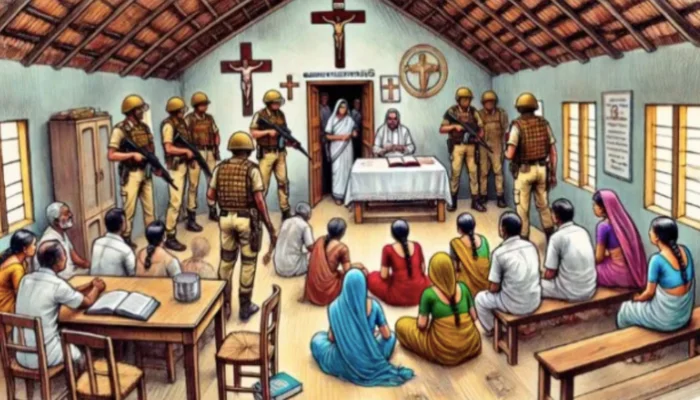
Case Summary
In Mahalibasa village, located in the Khunta block of Mayurbhanj district, Odisha, nearly 110 Hindus, including men, women, and children from 21 Hindu families, were forcibly converted to Christianity. The victims were lured with various inducements and were misled into adopting Christianity. All 110 individuals later returned to Hinduism during a Ghar Wapsi ceremony, a Hindu reversion event where those who had been coerced into conversion came back to their original faith. According to reports, the Ghar Wapsi ceremony, organised on 2nd November 2025, saw the participation of the victim families belonging to five major tribal communities — Santhal, Mankadia, Lodha, Barang, and Bhumij. The event was attended by tribal chiefs from 18 nearby villages, who performed traditional rituals to welcome the families back to their ancestral faith. The homecoming ceremony began with customary prayers and purification rituals conducted by local tribal leaders. The participants, dressed in traditional attire, symbolically reaffirmed their connection to their ancestral beliefs and cultural heritage. The Hindu victims shared that they had converted to Christianity a few years earlier after being misled by Christian missionaries. The missionaries, they said, had used false promises and inducements such as assurances of improved living conditions and medical aid to convince them to abandon their Hindu faith and its traditional practices. One of the Hindu victims stated, “After conversion, we gradually became disconnected from our festivals, customs, and the ways of worship passed down by our forefathers. That created a deep void in our lives. We realised that leaving our ancestral path had been a big mistake, and we wanted to return to our roots.” The Ghar Wapsi programme was organised with the support of the Janajati Suraksha Manch and the Vanvasi Kalyan Ashram, two organisations dedicated to preserving the identity and culture of tribal communities. Local Hindu and tribal activists stated that foreign-funded Christian missionaries had been targeting the tribal population of Mayurbhanj, enticing them into conversion through various incentives disguised as social and medical assistance. An activist from the Janajati Suraksha Manch stated that Mayurbhanj, being a tribal-dominated district, had long remained a target for missionary groups. The activist added that such conversions had persisted despite the Odisha Freedom of Religion Act, which prohibits religious conversion through coercion or inducement. The local activists also urged the state government to strictly enforce laws to prevent further exploitation of poor and uneducated tribal communities.
Why it is Hate Crime ?
This case has been added to the tracker under the primary category- Predatory Proselytisation. Within this, the subcategory selected is- Conversion/attempts to convert by inducement. Predatory Proselytisation is not just limited to threat, harassment, force and violence, but it also has contours of stealth. In several cases, the Hindu victim is exploited to convert, with non-Hindus taking advantage of their poverty. In such cases, the Hindu victim who is suffering financially is offered monetary benefits, including lucrative offers for jobs, health treatment, education, etc, to induce the victim into changing his/her religion. In such cases, the religious identity of the victim and the aim to disenfranchise him from his faith form the heart of the crime. Also, taking advantage of and exploiting an individual’s economic vulnerabilities is widely acknowledged as exploitation, forms of which are often penalised by law. Such cases therefore are considered religiously motivated hate crimes since the victim’s religious identity forms the very heart of the crime itself. The other subcategory selected is- Proselytisation by grooming, brainwashing, manipulation or subtle indoctrination. The tertiary categories selected are- 'Conversion of Minor', 'Pattern of targeting Hindus', and 'Victim says was brainwashed/groomed'. Religious brainwashing essentially means the often subtle and forcible indoctrination to induce someone to give up their religious beliefs to accept contrasting regimented ideas. Religious grooming or brainwashing also involves propaganda and manipulation. It involves the systematic effort, driven by religious malice and indoctrination, to persuade “non-believers’ to accept allegiance, command, or doctrine to and of a contrasting faith. Cases of such grooming or brainwashing are far more nuanced than direct threats, coercion, inducement and violence. In such cases, it is often seen that there is repeated, subtle and continual manipulation of the victim to induce disaffection towards their own faith and acceptance of the contrasting faith of the perpetrator. While subtle indoctrination is widely acknowledged as predatory, an element which is often understated in such conversions or the attempts of such conversion is the role of loyalty and trust which might develop between the perpetrator and the victim. Fiduciary relationships are often abused to affect such religious conversion. For example, an educator transmitting religious doctrine of a competing faith to a Hindu student. The Hindu student is likely to accept what the teacher is transmitting owing to existence of the fiduciary relationship. The exploitation of the fiduciary relationship to religiously indoctrinate victims would also be included in this category. Since the underlying animosity towards the victim’s faith forms the basis of predatory proselytization, such cases are considered religiously motivated hate crimes. This case is a clear instance of a religiously motivated hate crime targeting Hindus. A total of 110 tribal Hindus, including men, women, and children from 21 families, were forcibly converted to Christianity by Christian missionaries. The perpetrators used inducements such as promises of better living conditions, access to medical facilities, and other socio-economic benefits to manipulate the victims. These inducements were not expressions of kindness or goodwill but calculated tools to exploit the victims’ financial hardship and social vulnerability. By exploiting their poverty and trust, the missionaries used these material incentives to pressure the victims into abandoning their faith, turning acts of aid into instruments of religious coercion. This deliberate use of deception and manipulation clearly makes the incident a religiously motivated crime. The Hindu victims said they had been misled into converting through false assurances and deceptive narratives. The perpetrators played on their vulnerabilities to distance them from their ancestral Hindu faith and practices. Such misrepresentation not only demonstrates religious prejudice but also exposes deep-rooted hostility toward Hindus and their spiritual beliefs. The act of intentionally stripping the victims of their Hindu identity and heritage constitutes a direct assault on their religion, revealing the perpetrators’ clear intent and religious animosity. Importantly, 110 Hindus, encompassing 21 families, were targeted together. The scale of the operation shows this was neither an isolated incident nor a spontaneous occurrence. It was a systematic and pre-planned effort to change the region’s religious composition by converting Hindu families en masse. The scale, coordination, and deliberate targeting reveal a consistent pattern of hostility against Hindus based solely on their religious identity, marking it as a deliberate act of religious hate. Another grave aspect of this case is that it involved Hindu children. The inclusion of minors in these forced conversions means the essential element of consent was absent from the outset. Children, lacking the maturity and understanding to comprehend the consequences of conversion, were deliberately preyed upon and manipulated. The Christian perpetrators exploited the innocence and dependence of these minors to further their conversion agenda. Such exploitation of children’s vulnerability amplifies the gravity of this crime, making it an unequivocal example of religiously motivated offence. After conversion, several victims shared that they experienced a deep sense of emptiness and cultural loss. They felt cut off from their traditions, festivals, and customs—the essence of the life that their forefathers had lived with devotion. This sense of spiritual void and grief eventually compelled them to return to their faith. Their decision to reclaim their identity through the Ghar Wapsi ceremony reflects the profound psychological and cultural damage caused by coercive conversion and underscores the resilience of those who endured it. Given that this case meets multiple parameters of a religiously motivated hate crime, it is being added to the hate crime database of the Hinduphobia Tracker. Disclaimer: The Hinduphobia Tracker records the date of an incident based on when the crime occurred rather than when it was reported by the media. In this case, the media reported the incident on 3rd November 2025; however, the report did not specify the exact date when the victims’ ordeal began. It only mentioned that the Ghar Wapsi event took place on 2nd November 2025 and that the Hindu families had been coerced into conversion several years earlier without a recorded timeline. Based on this information, for documentation purposes, the date of 2nd November 2025—the day of the Ghar Wapsi event—is being used as the indicative date of the incident. Media reports stated that around 110 Hindu villagers, including men and women, were targeted for conversion in Mahalibasa village of Mayurbhanj district, Odisha, but no gender-wise breakdown was provided. For documentation clarity, the Hinduphobia Tracker has applied a proportional demographic estimate based on India’s Census 2011 and NFHS-5 (2019–21) rural population data. Accordingly, the 110 participants are estimated as 55 men (50%) and 55 women (50%), reflecting an equal gender distribution consistent with typical rural family demographics. As the age-wise segregation was also not specified in the media report, the Hinduphobia Tracker has used a proportional demographic estimate derived from the same data sources. Accordingly, the 110 participants are estimated as 77 adults (70%) and 33 children (30%).
Victim Details
Total Victim
110
Deceased
0
Gender
- Male 55
- Female 55
- Third Gender 0
- Unknown 0
Caste
- SC/ST 110
- OBC 0
- General 0
- Unknown 0
Age Group
- Minor 33
- Adult 77
- Senior Citizen 0
- Unknown 0


Case Status
Unknown


Perpetrators Details
Perpetrators
Christian Extremists
Perpetrators Range
Unknown
Perpetrators Gender
unknown
 Sources




