Shivling and idols smashed by Muslim man inside Shiva temple in Sagar, Madhya Pradesh
 Sagar, Madhya Pradesh, India
  2 November, 2025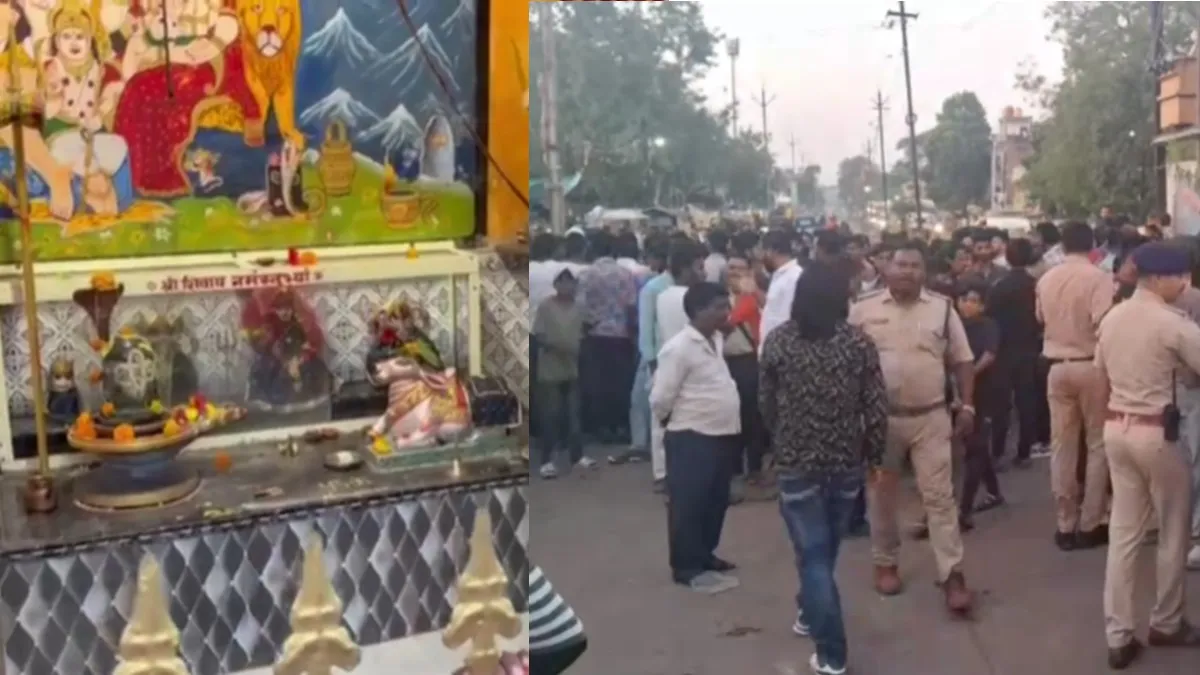
Case Summary
A Muslim youth vandalised idols at a Shiva temple in the Man Jabot area of Sagar district in Madhya Pradesh. Early in the morning on 03 November 2025, devotees found that the Shivling and several other idols had been broken. The youth reportedly used a heavy stone to damage the idols. As word spread, hundreds of Hindus gathered at the temple and raised slogans, demanding immediate police action. Hindu advocacy groups led the protest and insisted that the attacker be arrested and punished. Hindu leader Kapil Soni said that there are meat shops on both sides of the temple and that Muslims frequently disturb communal peace in Sagar. A report of Dainik Jagran also stated that cow slaughter was also prevalent in that locality. Police arrived at the site and brought the crowd under control. A case was registered against unknown persons, and officers began investigating to identify those responsible. A Muslim man named Wasid Mukeri was later arrested by the police. Wasid used to sell eggs with his friend at a stall near the temple. Senior police officials promised strict action. The incident caused widespread anger across the city, and residents demanded stronger security arrangements at all Hindu religious places.
Why it is Hate Crime ?
The primary category in this case is: Attack on Hindu religious representations. The first subcategory under this is: Attack on Temples. In Hinduism, a temple is the abode of the Deity. The Deity in the Temple is consecrated, thereby, making it a real, breathing entity. Hindus believe that not just the Deity but the temple premises itself are sacred to Hindus since Hindus hold the faith that the entire Temple space is an amalgamation of the divine energy of the deity. Given the central significance of Temples in Hindu Dharma, any attack against a Hindu Temple or its peripheral premises is an attack on the faith itself and is born out of animosity towards the faith, of which, the Temple is a central tenet. Any manner of attack against a Temple and/or its premises would therefore be considered a religiously motivated hate crime. Second subcategory under this is: Desecration of Hindu religious symbol. Icons and symbols or a religious representation of a spiritual ideal are widely revered in Hinduism. Iconography is of vital significance in the Hindu milieu. It helps connect people’s spiritual beliefs with the real world. Iconography within the Hindu faith takes several shapes and forms. Murtis are of most significance to Hindus, to which daily rituals, prayers and offerings are done. Besides the murtis, there are several other symbols which have deep significance in the Hindu faith – the Om and Swastika for example. Since these Hindu religious symbols hold paramount importance in Hinduism, any desecration of symbols, icons, murtis, religious representations and manifestations, is driven by animosity towards the faith itself which manifests itself through these murtis, icons and symbols. Therefore, any desecration of these Hindu religious symbols and representations is considered religiously motivated hate crimes under this category. The third subcategory under this is: Defiling religious customs. Sanatan Dharma is not a religion of one book, which is to say that while it has religious scriptures that form the central tenets of the faith, there are several traditions followed through thousands of years, mostly passed from generation to generation orally. There are several such customs and traditions that are followed by various Hindus and Hindu sects. Defiling of these traditions and customs is a breach of an individual or group’s religious practices. Such practices can range from dietary restrictions like not eating non-vegetarian food for a certain period of the year, not eating non-vegetarian food at all, not eating beef since the cow is considered holy in Hinduism, the sanctity of religious customs followed in the house (like many ISCKON devotees), etc. Any malicious action leading to the breach of such traditions or defilement of these traditions owing to animosity towards the faith or for the sake of activism stems not only from the lack of faith in the religion itself but also from disregard for the faith of the devotees who follow the customs/traditions and implicit bias against the faith, the tradition itself. Since these specific traditions are central to the faith of the devotees of that specific sect of Hindus, any non-compliance with these traditional rules would be considered a religiously motivated hate crime. This incident has been placed on the Hinduphobia Tracker because it illustrated a direct, intentional and wilful violation of the core civilisational spaces which Hindus consider sacred. A temple in the Hindu imagination is not an ordinary cultural institution or a community hall. It is a consecrated place believed to house a living divine presence. For that reason, the destruction of a Shivling and other temple idols is not an act of random hooliganism. It is a targeted desecration of a Hindu spiritual nucleus. One must call this conduct by its correct character. This was an attack on a Hindu religious representation, an attack upon an institution which the Hindu community holds as the literal residence of the deity, and by extension, an attack upon the Hindu faith itself. The removal of the Shivling’s physical integrity was in itself a deliberate assault on a central religious symbol. It also carried an implied declaration that Hindu spaces are permissible sites for violation. Such conduct is not comparable to petty crime. This is an unambiguous act aimed at humiliating the Hindu community by harming the iconography which sits at the centre of its worship traditions. That the police later arrested a Muslim man for this crime confirms that this was not an abstract or theoretical scenario. The Muslim man carried out a targeted act of destruction directed at the religious property of Hindus. The social response which followed, with hundreds of Hindus congregating in protest, only corroborated the fact that the community recognised this as a religiously directed attack. Further, the context provided by locals about the environment surrounding the temple must also be acknowledged. Statements referencing regular communal disturbances, meat shops on either side of the temple, and reports concerning cow slaughter in the same locality, present a wider pattern of disregard towards Hindu religious sensitivities. When repetitively, Hindu places of worship are forced to share space with activities antithetical to their sanctity, one sees a continuing pattern of psychological attrition. This case has therefore been added to the tracker because it fulfils the fundamental criteria of a hate crime against Hindus. The event demonstrates how hostility towards Hindu symbols and sacred traditions continues to manifest in physical acts of destruction. Documenting such incidents is necessary to establish a factual record of intolerance directed towards Hindus and to underscore the need for accountability and protection of their religious spaces.


Case Status
Arrested


Perpetrators Details
Perpetrators
Muslim Extremists
Perpetrators Range
One Person
Perpetrators Gender
male
 Sources




