Hindu woman journalist and husband threatened and assaulted by Islamists for reporting on anti-Hindu atrocities in Bangladesh
 Bangladesh
  2 November, 2025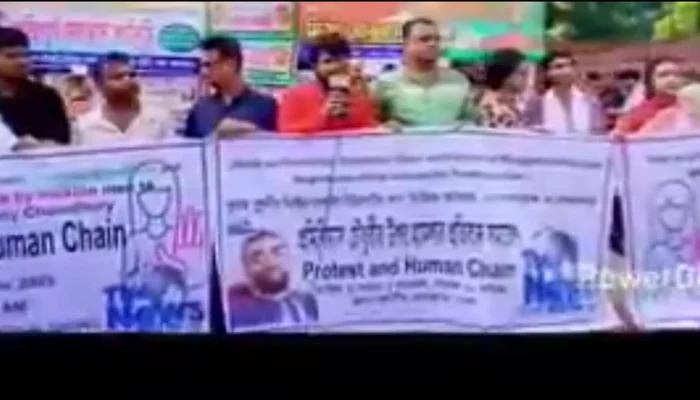
Case Summary
Hindu journalist Trina Roy Chowdhury, news editor of TheNewse.com, and her husband Promithias Chowdhury, the portal’s editor and publisher, were threatened and attacked by Islamist extremists in Barisal district on October 29, 2025. The couple, who also ran an ashram called Anand Lok to support local Hindus, had long been under threat for their fearless reporting on anti-Hindu atrocities in Bangladesh. According to Trina, her husband was lured to a shop by acquaintances Nazim Mulla and Shaheen, who accused him of belonging to ISKCON and demanded money. When he refused, they assaulted him, slapped, and beat him, calling him a “Kafir Hindu” and shouting, “Bangladesh is ours; we are letting you stay out of kindness. Get out of Bangladesh.” He was then forced to sign a stamp paper and hand over a cheque under duress, under the supervision of Fakhrul Islam, who gave instructions on how to torture him. Following the assault, the perpetrators issued explicit rape threats against Trina, saying: “Your wife is dangerous; get her gangraped by Muslims so she’ll start liking us.” These statements revealed not only extreme religious hatred but also a deliberate attempt to degrade and silence Hindu women who spoke out against Islamic extremism. The threats stemmed from the couple’s journalistic exposure of Islamist violence against Hindus, as well as their community support through Anand Lok Ashram. Their consistent reporting on anti-Hindu atrocities and refusal to submit to Islamist intimidation had made them prime targets of persecution. Earlier, during Navratri, they had clashed with local Muslims who disrupted temple rituals by smoking near the shrine and turned violent when confronted. Despite filing a police complaint on October 29, no action was taken. Instead, the Muslim station in-charge allegedly pressured them to withdraw references to ISKCON, warning that it could “incite riots.” The police then threatened to register false cases against Promithias, accusing him of “provoking people to demolish a mosque.” This intimidation by law enforcement demonstrated a systemic bias and institutional complicity in suppressing Hindu voices. The couple lived under constant fear as fundamentalists reportedly monitored their home, and visitors were threatened and turned away. Other journalists who visited them on October 31 were also warned that their houses would be vandalized. Following the attack, journalists across Bangladesh protested, demanding action against the perpetrators. However, the police remained unresponsive. This reflected a broader environment where Hindu journalists, women, and activists faced escalating violence, rape threats, and censorship, particularly after the fall of Sheikh Hasina’s government.
Why it is Hate Crime ?
This case has been added to the tracker under the first primary category of- Hate speech against Hindus. Within this, the sub-category selected is- Violent threats. Violent threats, explicit, implicit or implied, are the most dangerous form of hate speech since they go beyond discriminatory and prejudicial language to express the intent of causing harm to an individual or a group of people based on their religious identity and faith. There could be several different kinds of threats that are issued to Hindus based on religious animosity. An explicit threat would mean the direct threat of violence towards an individual Hindu, a group of Hindus or Hindus at large. Physical violence, death threats, threats of destruction of property belonging to Hindus and threats of genocide would mean explicit threats against Hindus for their religious identity. Implicit threats may not be a direct threat but implied through the use of symbols of actions – for example, in the Nupur Sharma case, other than explicit threats, there were also implicit threats when Islamists took to the streets to burn and beat her effigies. It implies that they want to do the same to Nupur Sharma, thereby is considered an implicit threat. Violent threats can be delivered in person, through letters, phone calls, graffiti, or increasingly through social media and other online platforms. It would be important to understand that a threat – explicit or implicit, online or offline – to an individual who happens to be a Hindu does not qualify as a religiously motivated threat. Such a threat, while vile and dangerous, could be owing to non-religious reasons and/or personal animosity. To qualify as a religiously motivated threat, it would need to exhibit an indication that the individual is being targeted for religious reasons and/or owing to his/her religious identity as a Hindu. The second primary category selected is: Attack not resulting in death. Within this, the sub-category selected is: Attacked for opposing radicals/or trying to save victim from radicals. In several cases, Hindus are attacked for opposing religiously motivated crimes being committed against a fellow Hindu or simply for voicing an opinion opposing radical elements, who either have in the past or continue to persecute Hindus. In such cases, the initial attack against the victim, against which the Hindu was trying to defend the victim, would also need to be classified as a religiously motivated hate crime. Since the initial crime itself was religiously motivated and the subsequent crime of attempting to save the victim or speaking against the radical elements ends up inviting a violent attack, it would also be classified as a religiously motivated hate crime under this category. The other subcategory relevant here is- Attacked for Hindu identity. In several cases, Hindus are attacked merely for their Hindu identity without any perceived provocation. A classic example of this category of religiously motivated hate crime is a murder in 2016. 7 ISIS terrorists were convicted for shooting a school principal in Kanpur because they got ‘triggered’ seeing the Kalava on his wrist and tilak that he had put. In this, the Hindu victim had offered no provocation except for his Hindu religious identity. The motivation for the murder was purely religious, driven by religious supremacy. Such cases where Hindus are targeted merely for their religious identity would be documented as a hate crime under this category. This incident constituted a clear instance of hate crime against Hindus, both through violent threats and a targeted physical attack motivated by religious identity and opposition to radicalism. The victims were harassed and assaulted solely because they were Hindu and had publicly spoken out against the systematic persecution of their community. The threats and violence directed at them were not spontaneous acts of anger but deliberate attempts to terrorise and silence Hindu voices who sought to expose religious extremism and defend the rights of fellow Hindus. The violent threats made — including explicit sexual violence — reflected a deep-seated intent to humiliate and degrade the victims on the basis of both religion and gender. Such threats were designed to instill fear, discourage further reporting, and reinforce the subservience of Hindus under a system dominated by Islamist power structures. The language used in the threats, combined with the demand to stop speaking “against Islam,” revealed clear ideological hostility rather than personal animosity. A particularly telling aspect of this case was the repeated use of the word “kafir” by the attackers to describe the Hindu victims. In Islamic theology, kafir denotes a non-believer, but in the hands of radicals, it becomes a weaponised slur, used to degrade and dehumanise non-Muslims. By calling the victims “kafir Hindus” and asserting that they were being “allowed to stay out of kindness,” the perpetrators revealed an ingrained sense of Islamic supremacy — the belief that Hindus and other non-Muslims exist under sufferance in a Muslim-majority society and can be punished or silenced for asserting equality. This rhetoric of exclusion and subjugation is deeply ideological, not circumstantial, and reflects the wider theological justification used by extremists to target Hindus across Bangladesh. Equally significant was the reference to ISKCON, which has become a frequent target of Islamist aggression in Bangladesh. The attackers accused the victims of being affiliated with ISKCON, using the name as a pretext for violence. This reflects a broader pattern of hostility toward ISKCON and its followers, who are viewed by radicals as visible symbols of Hindu assertion and devotion. In recent months, ISKCON leader Chinmoy Krishna Das Prabhu and his aides have been systematically targeted, facing harassment, threats, and state-backed restrictions. There have even been attempts to ban ISKCON and suppress Hindu protests through sedition charges, illustrating how the persecution of Hindus in Bangladesh now extends beyond physical violence to include intellectual, cultural, and spiritual silencing. Such actions underscore the entrenched ideology of Islamic supremacy under the current interim government, which has created an environment where Hindus are not only attacked physically but also denied the right to religious expression and community organisation. The invocation of ISKCON in this incident was not coincidental; it symbolised an attack on organised Hindu faith itself — on temples, monks, devotees, and journalists who represent resilience and cultural continuity amidst growing oppression. The physical assault and threats in this case were therefore manifestations of a wider hate-driven campaign to suppress Hindu visibility, speech, and identity in Bangladesh. The victims were attacked after being identified and singled out as Hindus who refused to submit or remain silent. Their punishment was meant to serve as a warning to all Hindus who dared to document or oppose Islamist violence. This case illustrates how hate speech, religious slurs, and targeted violence operate as interconnected instruments of persecution. They are intended not merely to harm individuals but to enforce a rigid hierarchy where Hindus are denied safety, dignity, and the right to exist as equals. The perpetrators’ actions — invoking the term kafir, referencing ISKCON, and issuing sexual and physical threats — all emerged from the same ideological foundation: a conviction that Hindu lives and voices have no place in an Islamist state order. Through this lens, the attack was not just a personal dispute or an act of intimidation but a deliberate assertion of religious dominance. A warning to every Hindu journalist, activist, and devotee who dares to challenge the machinery of Islamic supremacy that continues to dictate life, faith, and silence in Bangladesh. It is also crucial to recognise that this was not an isolated case but part of a continuing pattern of hostility against Hindus in Bangladesh. Since the ouster of Sheikh Hasina on 5 August 2024, anti-Hindu violence has surged — with at least 205 attacks on temples, shops, and homes within just three days of Dhaka’s fall. Muslim students have forced dozens of Hindu teachers, professors, and officials to resign, while reports indicate rising coercion to convert Hindus to join groups like Jamaat-e-Islami. Hindu festivals and rituals have also been repeatedly attacked: on 6 September, a Ganesh Chaturthi procession was assaulted in Chittagong, and ahead of Durga Puja, multiple incidents of idol vandalism occurred in Mymensingh, Pabna, Rajshahi, Kishoreganj, and Dhaka. On 29 November, mobs attacked three temples in Patharghata, Chittagong, immediately after Jumma Namaz. The crackdown on Hindu voices has likewise intensified. On 30 November, Hindu journalist Munni Saha was arrested in Dhaka, while ISKCON leader Chinmoy Krishna Das Prabhu and his aides have been targeted. Attempts to ban ISKCON and suppress Hindu protests through sedition charges underscore the deep-rooted ideology of Islamic supremacy, under which Hindus are not only persecuted physically but also silenced intellectually and spiritually under Muhammad Yunus’s interim government. For these reasons, this incident stands as a case of hate speech and hate crime against Hindus and is being formally recorded in the hate crime database. Disclaimer: The Hinduphobia Tracker records incidents based on when an event occurred or when the victim's ordeal began. It is important to clarify that none of the media sources covering this case has specified the exact date when the online threats and intimidation started. Therefore, for documentation purposes, we have recorded the date based on when the incident was reported in the media: 3rd November 2025.
Victim Details
Total Victim
2
Deceased
0
Gender
- Male 1
- Female 1
- Third Gender 0
- Unknown 0
Caste
- SC/ST 0
- OBC 0
- General 0
- Unknown 2
Age Group
- Minor 0
- Adult 2
- Senior Citizen 0
- Unknown 0


Case Status
Complaint filed


Perpetrators Details
Perpetrators
Muslim Extremists
Perpetrators Range
Unknown
Perpetrators Gender
unknown
 Sources




