Hindu community abused, Hindu religious leader denigrated by Muslim girl; accused threatens to slaughter and eat cows
 Ghaziabad, Uttar Pradesh, India
  22 October, 2025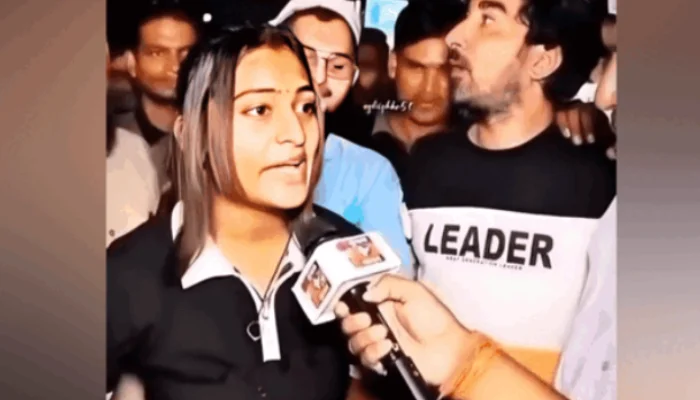
Case Summary
In Ghaziabad's Tulsi Niketan area in Uttar Pradesh, derogatory remarks were made against the Hindu community by a Muslim girl named Farzana. She also abused a Hindu religious leader, Yogi Adityanath, who is the Chief Minister of Uttar Pradesh. The accused also threatened to kill and eat cows, a sacred animal in Hinduism. The first video of the accused had surfaced on 23rd October 2025, in which she could be heard saying that she had eaten cow meat and used derogatory language for the Chief Minister of Uttar Pradesh. In the video, the accused said, “We (Muslims) will eat cow, and I have eaten it.” She also referred to Yogi Adityanath as “Kutta,” meaning dog, and “Takla,” meaning bald. The video of the accused went viral on social media, causing severe outrage for hurting religious sentiments. In the same video, she had incited people by publicly sharing her house address and challenging them to come to her home, saying that only then would she consider them courageous. Following this, Hindu activists reached her residence and confronted her for the remarks about killing and eating a cow. They abused and thrashed her for her statements. Subsequently, the Superintendent of Police (SP) of Shalimar Garden, Atul Kumar Singh, stated that an initial First Information Report (FIR) had been registered against Farzana, followed by another FIR against the Hindu activists who thrashed her. The police assured that strict action would be taken against both parties after the investigation. The FIR was registered at the Tila Mod Police Station. Later, a new video of the accused went viral on social media in which she once again made objectionable remarks against the Hindu community. In the video, she said, “Salam to all my Muslim brothers, I made that video for Kafirs (infidel Hindus) and Andhbhakts (blind Hindu followers).” She also used derogatory slurs against Hindus, calling them “Jh**ts.” She further said, “I am not afraid of anyone, nor did I go to jail. Just because some thousand people hit me — referring to Hindu activists — you think I will get scared? We are followers of Ali, a revered figure in Shia Islam; we are not scared.” Earlier in the same video, the girl had used abusive language towards Home Minister Amit Shah and Chief Minister Yogi Adityanath. She concluded the video by chanting “Jai Bheem,” an Ambedkarite slogan, and “Jai Palestine,” meaning “Glory to Palestine.” Following this statement, there had been an uproar on social media, and people began demanding strict action against her. Local residents said that the girl’s repeated provocative videos could spread tension in society. There had been no official statement from the police until then, which had further angered the public. Citizens expressed that the administration should set an example by taking strict action so that no one would dare commit such an act in the future.
Why it is Hate Crime ?
This case has been added to the tracker under the primary category- Hate Speech against Hindus. Within this, the subcategory selected is- Anti-Hindu slurs, mocking faith. Anti-Hindu slurs and the deliberate mocking of the Hindu faith owing to religious animosity involve the usage of derogatory terms, stereotypes, or offensive references to religious practices, symbols, or figures. One of the common anti-Hindu slurs used against Hindus is “cow-worshipper” and “cow piss drinker”. The intention of using this term is to demean and mock Hindus as a group and their religious beliefs since Hindus consider the cow holy. Additionally, some symbols and the slurs attached to them have a historical context that exacerbates the insult, hate, stereotyping, dehumanisation and oppression against Hindus. Cow worship has been used for centuries to denigrate Hindus, insult their faith and oppress Hindus specifically as a religious group. There has been overwhelming documentation about how cow slaughter has been used to persecute Hindus with cow meat being thrown in temples and places of worship. There has also been overwhelming documentation where cow meat (beef) has been force-fed to Hindus to either forcefully convert them to Islam or denigrate their faith. Apart from cow worship, the Swastika – which holds deep religious significance for the Hindus – has also been misinterpreted and distorted to use as a slur against Hindus. Similarly, the worship of the Shivling has been used by supremacist ideologies and religions to denigrate Hindus owing to religious animosity. Such slurs and denigration stem out of inherent animosity and hate towards Hindus and their faith, therefore, it is categorised as hate speech targeted at Hindus specifically owing to their religious identity. The other subcategory selected is- Mocking/denigrating Hindu leaders. Hate speech is defined as any speech, gesture, conduct, writing, or display that is prejudicial against a specific individual and/or group of people, which is leading to or may lead to violence, prejudicial action or hate against that individual and/or group. Religious leaders are often seen as representatives of the community, especially, the community’s religious faith and beliefs. Mocking or denigrating a religious leader specifically owing to his religious identity and/or the religious rituals he observes can be considered hate speech because the motivating factor of the speech is animosity and/or dislike for what he represents – the religious beliefs and faith of the community. It is important to note that mere insulting words against an individual do not constitute hate speech. It is entirely possible that insulting words are used for an individual, however, the specific speech is not the result of religious hate and/or animosity towards the professed faith of the religious leader, but the individual himself. For the speech to be considered hate speech, the speech itself or the motivating factor behind the speech has to be religious in nature. Such speech which denigrates Hindu religious leaders specifically owing to animosity towards the faith they profess and the community faith they represent will be treated as hate speech under this category. The Muslim accused in this incident had openly denigrated the sacred cow, which holds deep religious significance in Hinduism. The cow is regarded as a symbol of purity, motherhood, and non-violence, representing life itself. Hindus revere the cow not merely as an animal but as a sacred being that sustains life through its milk and embodies qualities of selfless service. By claiming that she had eaten cow meat and declaring that “we Muslims will eat cow,” the accused deliberately attempted to incite and provoke the Hindu community. Her statement amounted to a clear act of hostility towards the Hindu faith and traditions, targeting one of its most venerated symbols. The intention to desecrate and kill an animal that represents sanctity, nourishment, and divine protection for Hindus underscores her deep-rooted contempt for the Hindu community and their faith. This act, therefore, constituted a religiously motivated hate speech aimed at humiliating and provoking Hindus on the basis of their faith. The accused further denigrated a revered Hindu religious leader, Yogi Adityanath. He is not only the Chief Minister of Uttar Pradesh but also the head of the Gorakhnath Math, a Nath Sampradaya institution belonging to the Shaivite tradition of Hinduism. As a saffron-clad monk and religious leader, Yogi Adityanath represents the Hindu faith, its values, and its philosophy. In this context, the abuse directed at him by calling him “kutta” (dog) and “takla” (bald) was not political but religious in nature. The accused’s comments were clearly motivated by her animosity towards Hinduism and its representatives. Targeting Yogi Adityanath for his religious identity, rather than his political position, demonstrated her intent to demean a Hindu religious icon and assert superiority of her own community. This again made the act a form of religiously motivated hate speech. In her subsequent video, the accused further inflamed tensions by using deeply offensive language against Hindus, referring to them as “kafirs” (infidels) and “jh**ts,” and mocking them as “andhbhakts” (blind devotees). These terms carried explicit religious contempt. Such derogatory language, directed at Hindus purely for their religious identity, revealed entrenched hostility and bigotry. The intent behind these statements was to insult and dehumanise Hindus, reinforcing the religiously motivated nature of her actions. The repeated abuse and vilification of Hindus reflected not only her prejudice but also the vulnerability that Hindus continue to face in society at the hands of radicalised members of the Muslim community. Furthermore, the accused declared, “We are followers of Ali and we are not scared.” This statement was a clear assertion of Islamic supremacy and an attempt to intimidate the Hindu community by invoking religious pride and defiance. The intention was to provoke fear and demonstrate dominance, rather than remorse or reconciliation. Through this rhetoric, she sought to project the supremacy of her faith over Hinduism, reinforcing the view that her actions were not spontaneous but planned provocations rooted in religious animosity. The accused had also raised the slogan “Jai Bheem,” an Ambedkarite political chant. While outwardly associated with social reform, Ambedkarism as a political ideology has, in many instances, portrayed itself as a movement with strong anti-Hindu undercurrents — from abusing Hindu deities and desecrating Hindu symbols, temples, and scriptures to attempting to break the Hindu social fabric under the pretext of fighting casteism. There also exists a documented pattern of political alignment between Ambedkarite and Islamist groups, united by a shared hostility towards Hinduism and the Hindu social structure. By invoking this slogan, the accused appeared to express solidarity with such ideological tendencies, further underlining her animosity towards Hindu identity. This reinforced the religiously motivated nature of her rhetoric and conduct. In addition, the accused raised the slogan “Jai Palestine.” At first glance, this may appear as an expression of support for the Palestinian cause. However, within the context of her statements, it carried a sectarian dimension. Muslim extremists worldwide have often used such slogans as markers of allegiance to the global Muslim Ummah — the transnational brotherhood of Islam that transcends national boundaries. This worldview historically regards India as a Hindu civilisation and positions Muslims as a distinct collective separate from it. The very partition of India in 1947 was founded on the same ideological premise that Muslims constitute a separate nation that cannot coexist with Hindus. Therefore, the accused's invocation of “Jai Palestine” signified loyalty not to a humanitarian cause, but to the global Islamic identity opposed to what she perceived as a Hindu national identity. In this sense, the slogan was inherently anti-Hindu, expressing solidarity with the global Muslim community over allegiance to India, which she viewed as a Hindu collectivity. Such a declaration indicated ideological alignment with Islamist narratives and transformed her conduct into a religiously motivated act of hate. Every element of her speech — from insults against the Hindu community and its leaders, to mocking sacred symbols, and openly asserting Islamic pride — revealed a pattern of deliberate and targeted hate. It was aimed at humiliating Hindus for their faith, ridiculing their practices, and asserting religious dominance. This made the entire incident a clear and grave instance of anti-Hindu hate speech and a religiously motivated crime against the Hindu community. Therefore, this case is being added to the hate crime database of the Hinduphobia Tracker. Disclaimer: The Hinduphobia Tracker records the date of an incident based on when the crime occurred rather than when it was reported by the media or went viral on social media. However, in this case, media reports do not mention the exact date when the accused first made her anti-Hindu comments. Therefore, for documentation purposes, the date on which her first video went viral — 23rd October 2025 — is being recorded as the indicative date of the incident.


Case Status
Complaint registered


Perpetrators Details
Perpetrators
Muslim Extremists
Perpetrators Range
One Person
Perpetrators Gender
female
 Sources




