Hindu youth assaulted by Muslim man for talking to Muslim girl in Neemuch, Madhya Pradesh
 Neemuch, Madhya Pradesh, India
  1 April, 2025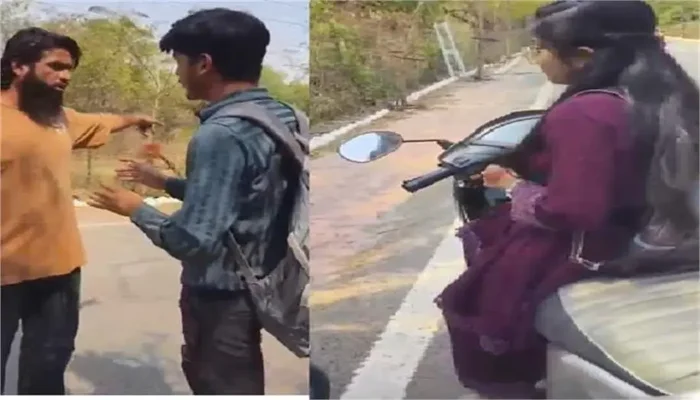
Case Summary
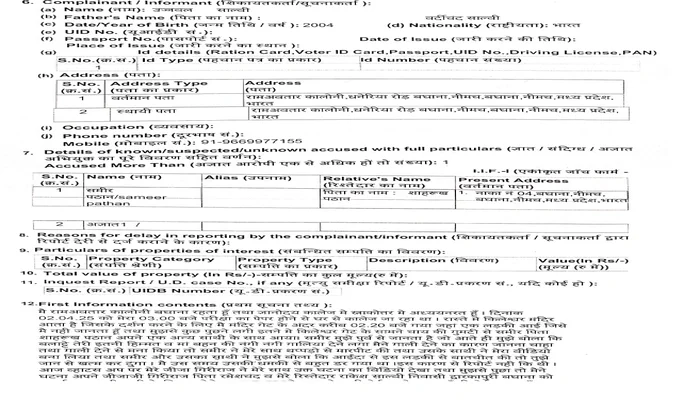
A Muslim man named Sameer in Neemuch, Madhya Pradesh, assaulted a Hindu youth, Ujjwal Salvi, on 2nd April 2025, for talking to a Muslim girl. The incident, which occurred near the Kileshwar Temple gate on Railway Station Road, gained widespread attention after a video surfaced on social media. According to the victim, he was standing near the temple and talking to a Muslim girl when Sameer approached him and began the assault. Salvi stated that the accused slapped him, and one of his associates recorded the incident on video. After the video was shared online, the police registered a case against Sameer at the Neemuch Cantt police station. While the incident is being investigated, the video sparked strong reactions, with several Hindu organisations condemning the assault.
Case Images
Why it is Hate Crime ?
This case has been added to the tracker under the primary category- Men attacked for being associated with non-Hindu women. Within this, the subcategory selected is- Attacked/killed for being associated or suspected of being associated with a Muslim woman. There have been several cases documented of Hindu men/boys being attacked specifically by Muslim groups/mobs for merely being associated or suspected of being associated, or being seen with a Muslim woman in public. In most such cases, the Hindu man is not in a relationship with the Muslim woman; however, the mob proceeds to threaten and/or assault the Hindu man for merely being associated with the Muslim woman in any capacity. The rise of such crimes stems from a particularly sinister campaign run by several Muslim ideologues and activists. The campaign claims that Hindu men are attempting to ‘lure’ Muslim women into relationships to ensure that Muslim women leave their faith and follow Hinduism. The propaganda has been spearheaded with the help of WhatsApp groups and the extensive use of social media, sans evidence of the same. In many cases, pamphlets were fabricated to lend credence to this campaign. The root of this campaign lies in the fact that several cases of sectarian crimes against Hindu women in relationships with Muslim men have been documented. In such cases, Hindu women have often been forced/pressured to convert to Islam, assaulted, threatened and even murdered specifically owing to their religious identity and their refusal to give up that religious identity to adopt Islam. To delegitimise the suffering of Hindu women when such sectarian crimes are committed against them, the theory of ‘Bhagwa Love Trap’ was floated by sections of the Muslim community. As this theory gained traction, Muslim mobs started targeting Hindu men who were seen with Muslim women. In several such cases, the Hindu man was assaulted merely for offering to drop a Muslim woman in his vehicle or for being friends. The differentiating factor between such cases and legitimate cases of Hindu women being targeted while in a relationship with Muslim men is that there is no sectarian violence, and force/pressure to convert. The nature of sectarian violence against Hindu women is not about two adults in a consensual relationship, working together, studying together, or even marrying each other, where religious considerations are declared. In this category of crimes, it is pertinent to remember that in none of the cases is there an element of the Hindu man masking his identity or forced religious conversion. Such cases are driven by specific religious motivations and against the religious identity of the victim and are therefore qualified as hate crimes. This case is a clear instance of a religiously motivated hate crime against Hindus, where the victim, a Hindu youth, was physically assaulted simply because he was seen talking with a Muslim girl. The incident was not triggered by any inappropriate behaviour or public misconduct but solely by the religious identities of the individuals involved. It must be noted here that both the individuals present in this case are adults who are free to make their own decisions. Thus, the Muslim girl was with the Hindu boy out of her own free will. The Muslim aggressors took issue with the fact that a Muslim girl was in the company of a Hindu boy. This reaction was not motivated by concern for the girl’s safety or consent, but rather by an ingrained religious bias and a desire to enforce sectarian boundaries through intimidation. The act of filming the incident and assaulting the Hindu boy sends a broader message of religious control within public spaces. This was not an isolated outburst but a targeted act driven by a deeply ingrained hostility toward the Hindu identity of the boy. The attack was deliberate, unprovoked, and carried out with the intent to publicly enforce a discriminatory belief system that denies Hindu men the right to freely associate with Muslim women. The justification for such actions stems from the conspiracy theory of ‘Bhagwa Love Trap’, which is explicitly rooted in anti-Hindu sentiment. This false narrative vilifies Hindu men by portraying them as predators targeting Muslim women, despite no basis in reality. It is weaponised to legitimise violence against Hindus, as seen in this case, where a Muslim man took it upon himself to stop the Hindu boy and the Muslim girl and assault the Hindu boy for his faith. Given that this case involves the attack on a Hindu boy for his religious identity, it has been rightfully added to the Hate Crime database of the Hinduphobia Tracker. Disclaimer: The Hinduphobia Tracker records incidents based on when an event occurred or when the victim's ordeal began, and not when it was reported in the media. Hence, the date of the incident has been considered as 2nd April 2025.
Victim Details
Total Victim
1
Deceased
0
Gender
- Male 1
- Female 0
- Third Gender 0
- Unknown 0
Caste
- SC/ST 0
- OBC 0
- General 0
- Unknown 1
Age Group
- Minor 0
- Adult 1
- Senior Citizen 0
- Unknown 0


Case Status
Complaint registered


Perpetrators Details
Perpetrators
Muslim Extremists
Perpetrators Range
One Person
Perpetrators Gender
male
 Sources




