Century-old Hindu temple encroached by Muslim family in Sindh, Pakistan
 Shikarpur, Sindh, Pakistan
  31 October, 2025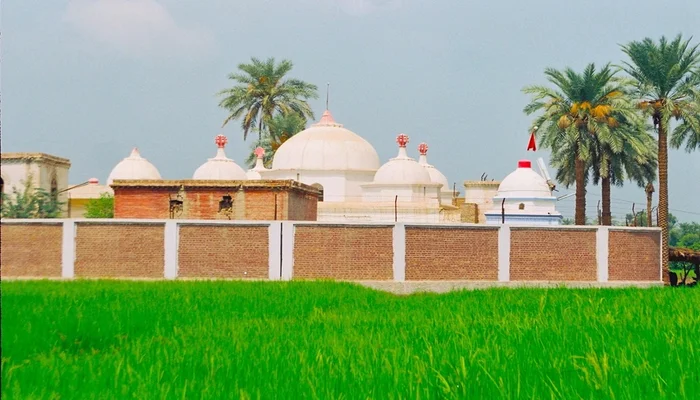
Case Summary
The Swami Shankaranand Bharti Temple in Shikarpur, Sindh, though historically significant, is currently facing serious deterioration and neglect. Parts of the temple complex have been illegally occupied by non-custodian private residents, and some of its portions have been whitewashed or repurposed, which has erased much of its artistic and historical integrity. A Muslim family now resides in the temple, altering its sacred interior. Additionally, mural paintings are disintegrating, ornate wooden doors have been sold off, and there is no formal protection or restoration plan in place. The temple’s decline reflects a wider pattern of loss and neglect of Hindu religious sites in Sindh, especially following the Partition of 1947, when many such places fell into disuse, were converted, or were abandoned due to security and maintenance issues. A 2010 report described the temple as being “out of sight and soon out of mind,” underscoring how worshippers now avoid it because of safety concerns. The temple is thus considered “under siege” — threatened by encroachment, physical decay, loss of heritage rights, and absence of institutional support.
Why it is Hate Crime ?
This case has been added to the tracker under the primary category of - Attack on Hindu religious representations. The sub-category selected is - Encroachment or illicit takeover of temple land/land near the temple. In Hinduism, a temple is the abode of the Deity. The Deity in the Temple is consecrated, thereby making it a real, breathing entity. Hindus believe that not just the Deity but the temple premises itself are sacred to Hindus since Hindus hold the faith that the entire Temple space is an amalgamation of the divine energy of the deity. Not only the Temple but the Temple premises in its entirety are considered sacred by Hindus. In several cases, the premises of the Temple and/or religious centre are illicitly taken over by institutions belonging to other faiths, like the Waqf board or the Church. Other times, the temple property, land or the property of religious centres are illicitly encroached by non-Hindu groups. Any illicit takeover or encroachment is a crime an initio; however, when non-Hindu groups illicitly take over or encroach on the sacred land of Hindus, it is an affront to the Hindu community and is therefore classified as a religiously motivated hate crime under this category. This case constitutes a hate crime as it involves the deliberate encroachment upon space that is sacred to the Hindu community. In Hinduism, a temple is not merely a structure; it is considered the divine residence of a consecrated deity. The temple and its surrounding land are imbued with religious sanctity and are treated as extensions of the deity's presence. Therefore, any intrusion or seizure of this space is not only unlawful but also deeply offensive to the religious sentiments of Hindus. The unlawful occupation of a temple by a non-custodian Muslim family, especially when it is followed by alteration in structure, its usage, and the selling off of decorative pieces, represents more than a mere occupation of property. It is an act of religious aggression that targets a marginalised community’s spiritual and cultural heritage. Such actions fit within the framework of a hate crime because they demonstrate animus against a Hindu community and seek to erase or undermine their places of worship. When Hindu temples and their premises are systematically encroached upon, especially by groups or institutions affiliated with other faiths, it reflects a pattern of religious hostility and discrimination aimed at alienating the community from their spiritual centres. This makes it necessary to classify these incidents as hate crimes aimed specifically at Hindus due to their religious identity. The encroachment of the Swami Shankaranand Bharti Temple by Muslims constitutes a religiously motivated hate crime under the category of restriction on the expression of Hindu identity. This incident reflects a deliberate attempt to suppress the Hindu community’s right to practice and express their religion by obstructing access to a temple that holds deep spiritual and historical significance. This is not an isolated incident, but it is a part of a larger pattern of religious persecution against the Hindu minority in Pakistan. This persecution encompasses various forms of discrimination and violence, deeply affecting the community's ability to practice their faith. By demolishing, encroaching or vandalising places of worship, Pakistani Muslims effectively displace Hindu communities and suppress their religious and cultural practices. Such actions stem from an inherent Hinduphobia, and for this reason, this case qualifies for inclusion in the hate tracker database. Disclaimer: It is important to clarify that the report does not specify the exact date when the occupation and alteration of the temple compound started. Therefore, for documentation purposes, we have recorded the date based on when the incident was reported in the media: 1st November 2025


Case Status
Unknown


Perpetrators Details
Perpetrators
Muslim Extremists
Perpetrators Range
Unknown
Perpetrators Gender
unknown
 Sources




