Hindu girl abducted, raped, forcibly converted to Islam, and married to Muslim man in Pakistan
 Sindh, Pakistan
  19 October, 2025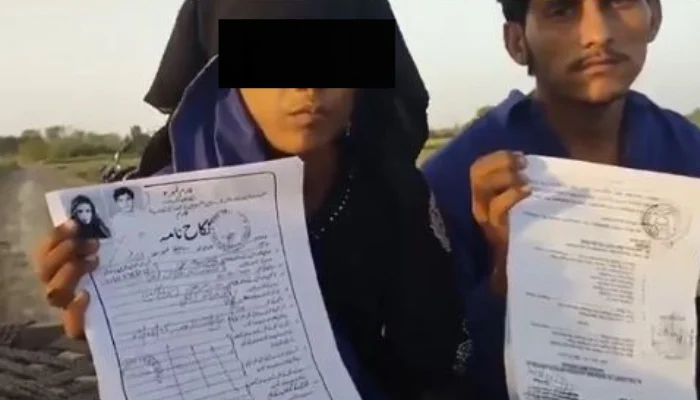
Case Summary
In Tando Muhammad Khan, Sindh, Pakistan, a Hindu girl named Sita was abducted and raped by a Muslim man named Muhammad Saleh. She was also forcibly converted to Islam and married off in a Nikah ceremony, an Islamic marriage ceremony, to her abductor. According to local sources and family members, the incident occurred on the night of Diwali, a festival symbolising hope, joy, and the victory of good over evil. The Hindu victim, Sita, was kidnapped from her home in Tando Muhammad Khan. She was later raped by Muhammad Saleh. After enduring sexual violence, the Hindu girl was forcibly converted to Islam and compelled to marry Saleh against her will. A photograph of the two, circulated by the media, showed them holding documents of Nikah (Islamic marriage). Notably, this was not the first time such incidents had taken place in Pakistan. The Hinduphobia Tracker had previously recorded numerous similar cases. For instance, in September 2025, in Umerkot, Sindh, a minor Hindu girl named Shardha Oad was abducted and subjected to forced religious conversion and marriage by a Muslim man named Riaz Ali and his accomplices. The case came to light after the victim’s widowed mother, Kamla Oad, lodged a complaint at the Women’s Police Station in Umerkot. Similarly, in another case in September 2025, in Mirpur Khas, Sindh, a minor Hindu girl named Aneeta Thakur was abducted and subjected to forced religious conversion and marriage to a Muslim man named Abdul Rehman Mallah. Another such incident occurred in June 2025, in Pabban, Hyderabad, Pakistan, where a minor Hindu girl named Teji Thakur was abducted, raped, forcibly converted to Islam, and married to a Muslim man named Bashir Tangdi. Bashir, along with his accomplice, Murad Tangdi, and others, threatened Teji, warning her that they would harm her family if she resisted marrying Bashir. This case highlights the persecution faced by the Hindu minorities in Pakistan, marked by systemic discrimination, violence, and forced conversions. Hindu women, particularly young girls, are often abducted, forcibly converted to Islam, and married off to Muslim men with little to no legal recourse. Temples are frequently vandalised or destroyed, and Hindu communities are subjected to social and economic marginalisation. Blasphemy laws are disproportionately used against Hindus, leading to false accusations and severe punishments. Many Hindu families are forced to flee their homes due to religious intolerance, living in constant fear of attacks. This sustained persecution highlights the dire conditions for Hindus in Pakistan, where their religious identity makes them targets of oppression.
Why it is Hate Crime ?
This case has been added to the tracker under the primary category- Predatory Proselytisation. Within this, the subcategory selected is- Harassment, threats, coercion for conversion. Harassment covers a wide range of behaviours of an offensive nature. It is commonly understood as behaviour that demeans, humiliates, and intimidates a person, including threats and coercion. Harassment and threats, in this case, find their root on discriminatory grounds which has the effect of nullifying a person’s rights or infringing upon his freedom to exercise his right specifically owing to the victim’s religious identity. Verbal and physical threats and psychological or physical harassment are often used against Hindu victims because they choose to practice their professed religion. Religious harassment also includes forced and involuntary conversions by harassment, threats or coercion. Coercion includes intimidatory tactics like force-feeding a Hindu victim beef to convert to another religion, forceful circumcision etc. In several cases documented, non-Hindu perpetrators or those who harbour specific animosity towards Hinduism, harass victims simply based on their religious identity. Such cases often also include harassment to ensure the Hindu victim abandons his/her professed religion and adopts the religion of the perpetrator. Such cases where Hindu victims are harassed to convert to the perpetrator’s religion are rooted in animosity towards the victim’s religious identity and are therefore documented as religiously motivated hate crimes. Another subcategory selected is- Proselytisation by grooming, brainwashing, manipulation or subtle indoctrination. Within this, the tertiary categories selected are- 'Rape and sexual assault/harassment' and 'Family claims grooming'. Religious brainwashing essentially means the often subtle and forcible indoctrination to induce someone to give up their religious beliefs to accept contrasting regimented ideas. Religious grooming or brainwashing also involves propaganda and manipulation. It involves the systematic effort, driven by religious malice and indoctrination, to persuade “non-believers’ to accept allegiance, command, or doctrine to and of a contrasting faith. Cases of such grooming or brainwashing are far more nuanced than direct threats, coercion, inducement and violence. In such cases, it is often seen that there is repeated, subtle and continual manipulation of the victim to induce disaffection towards their own faith and acceptance of the contrasting faith of the perpetrator. While subtle indoctrination is widely acknowledged as predatory, an element which is often understated in such conversions or the attempts of such conversion is the role of loyalty and trust which might develop between the perpetrator and the victim. Fiduciary relationships are often abused to affect such religious conversion. For example, an educator transmitting religious doctrine of a competing faith to a Hindu student. The Hindu student is likely to accept what the teacher is transmitting owing to existence of the fiduciary relationship. The exploitation of the fiduciary relationship to religiously indoctrinate victims would also be included in this category. Since the underlying animosity towards the victim’s faith forms the basis of predatory proselytization, such cases are considered religiously motivated hate crimes. This case has been categorised as a hate crime, as the abduction, rape, and forced conversion of a Hindu girl, followed by her marriage to a Muslim man in Pakistan, clearly illustrate the exploitation of vulnerable Hindu minorities through coercion and manipulation. Such incidents are not isolated occurrences but form part of a persistent and deeply troubling pattern in Pakistan, where Hindu minorities—particularly young girls—are systematically targeted for abductions, forced religious conversions, and marriages to Muslim men. This ongoing trend reveals the entrenched discrimination and violence faced by Hindu communities, who have endured harassment, marginalisation, and abuse since the country’s inception. In this case, the victim, Sita, was abducted specifically because of her Hindu identity, reflecting a recurring pattern in which minority girls in Pakistan are targeted for their faith. After her abduction, she was subjected to sexual violence. In this context, the act of rape was not driven by sexual desire alone but functioned as a method of religious persecution and domination. The assault on a Hindu girl by a Muslim man under such circumstances operates as a weapon to subjugate her, break her spirit, and impose humiliation for her religious identity. It demonstrates a calculated effort to exercise control and inflict enduring psychological trauma on both the individual victim and the broader Hindu community. Sexual violence served here as a deliberate instrument of coercion—to force Sita into submission, destroy her sense of safety, and shatter her religious and emotional integrity. Following the assault, Sita was forcibly converted to Islam and married to her abductor, Muhammad Saleh. Conversions perpetrated through intimidation, duress, or coercion cannot be regarded as genuine expressions of faith or voluntary belief. Rather, they constitute clear instances of religiously motivated hate crimes aimed at stripping Hindu girls of their religious identity. Such forced conversions reflect pronounced religious hostility and embody a systemic effort to erase the cultural and religious presence of the Hindu community in Pakistan. Given that this incident meets multiple parameters of a religiously motivated crime—including abduction based on religious identity, the use of sexual violence as a form of religious persecution, forced conversion under coercion, and involuntary marriage to eradicate faith affiliation—this case has been unequivocally classified as a religiously motivated hate crime. Accordingly, it has been added to the hate crime database of the Hinduphobia Tracker.
Victim Details
Total Victim
1
Deceased
0
Gender
- Male 0
- Female 1
- Third Gender 0
- Unknown 0
Caste
- SC/ST 0
- OBC 0
- General 0
- Unknown 1
Age Group
- Minor 0
- Adult 0
- Senior Citizen 0
- Unknown 1


Case Status
Unknown


Perpetrators Details
Perpetrators
Muslim Extremists
Perpetrators Range
One Person
Perpetrators Gender
male
 Sources




